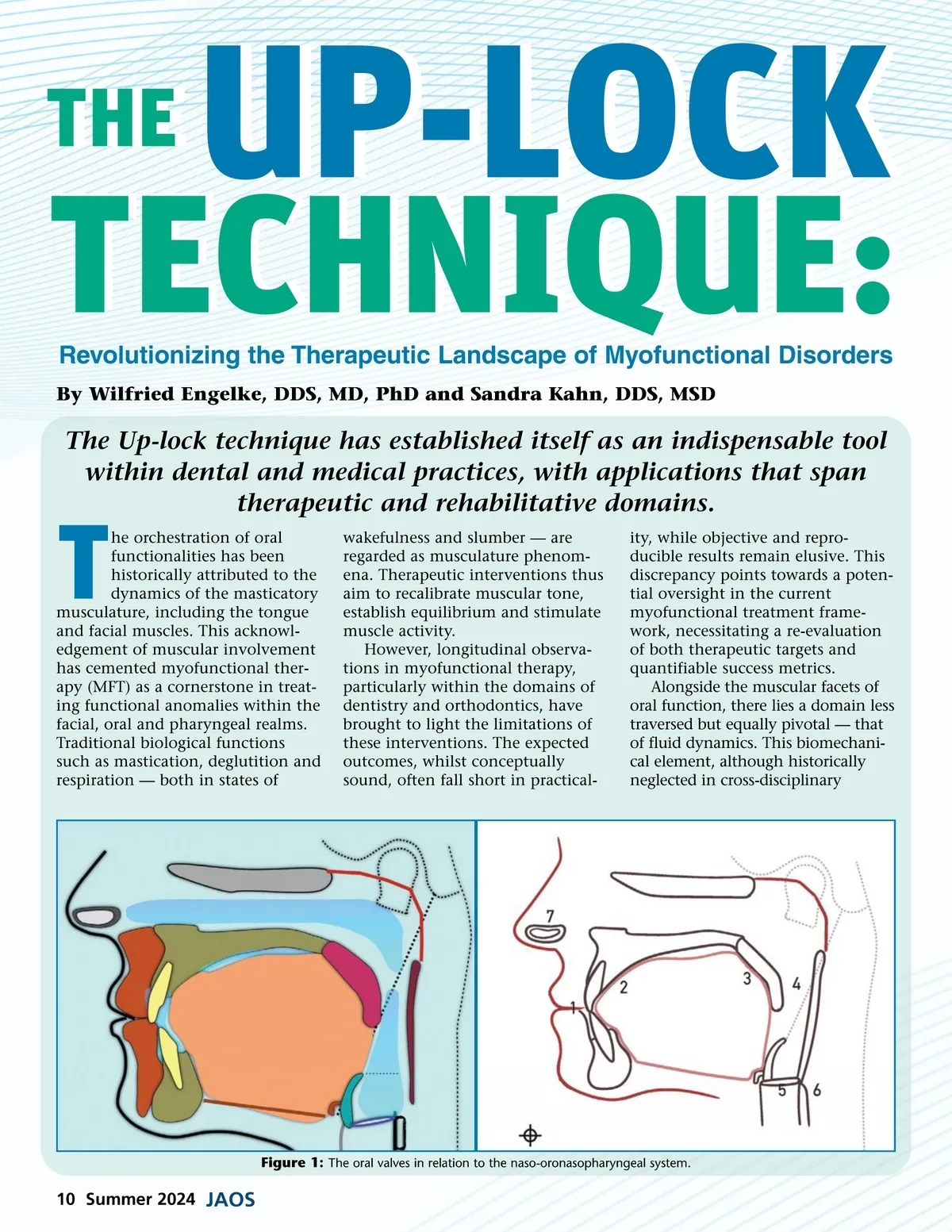
THE THE TECHNIQUE: Revolutionizing the Therapeutic Landscape of Myofunctional Disorders By Wilfried Engelke, DDS, MD, PhD and Sandra Kahn, DDS, MSD UP-LOCK wakefulness and slumber — are regarded as musculature phenom-ena. Therapeutic interventions thus aim to recalibrate muscular tone, establish equilibrium and stimulate muscle activity. However, longitudinal observa-tions in myofunctional therapy, particularly within the domains of dentistry and orthodontics, have brought to light the limitations of these interventions. The expected outcomes, whilst conceptually sound, often fall short in practical-ity, while objective and repro-ducible results remain elusive. This discrepancy points towards a poten-tial oversight in the current myofunctional treatment frame-work, necessitating a re-evaluation of both therapeutic targets and quantifiable success metrics. Alongside the muscular facets of oral function, there lies a domain less traversed but equally pivotal — that of fluid dynamics. This biomechani-cal element, although historically neglected in cross-disciplinary The Up-lock technique has established itself as an indispensable tool within dental and medical practices, with applications that span therapeutic and rehabilitative domains. T he orchestration of oral functionalities has been historically attributed to the dynamics of the masticatory musculature, including the tongue and facial muscles. This acknowl-edgement of muscular involvement has cemented myofunctional ther-apy (MFT) as a cornerstone in treat-ing functional anomalies within the facial, oral and pharyngeal realms. Traditional biological functions such as mastication, deglutition and respiration — both in states of Figure 1: The oral valves in relation to the naso-oronasopharyngeal system. 10 Summer 2024 JAOS
Journal of the American Orthodontic Society Summer 2024: Page 10