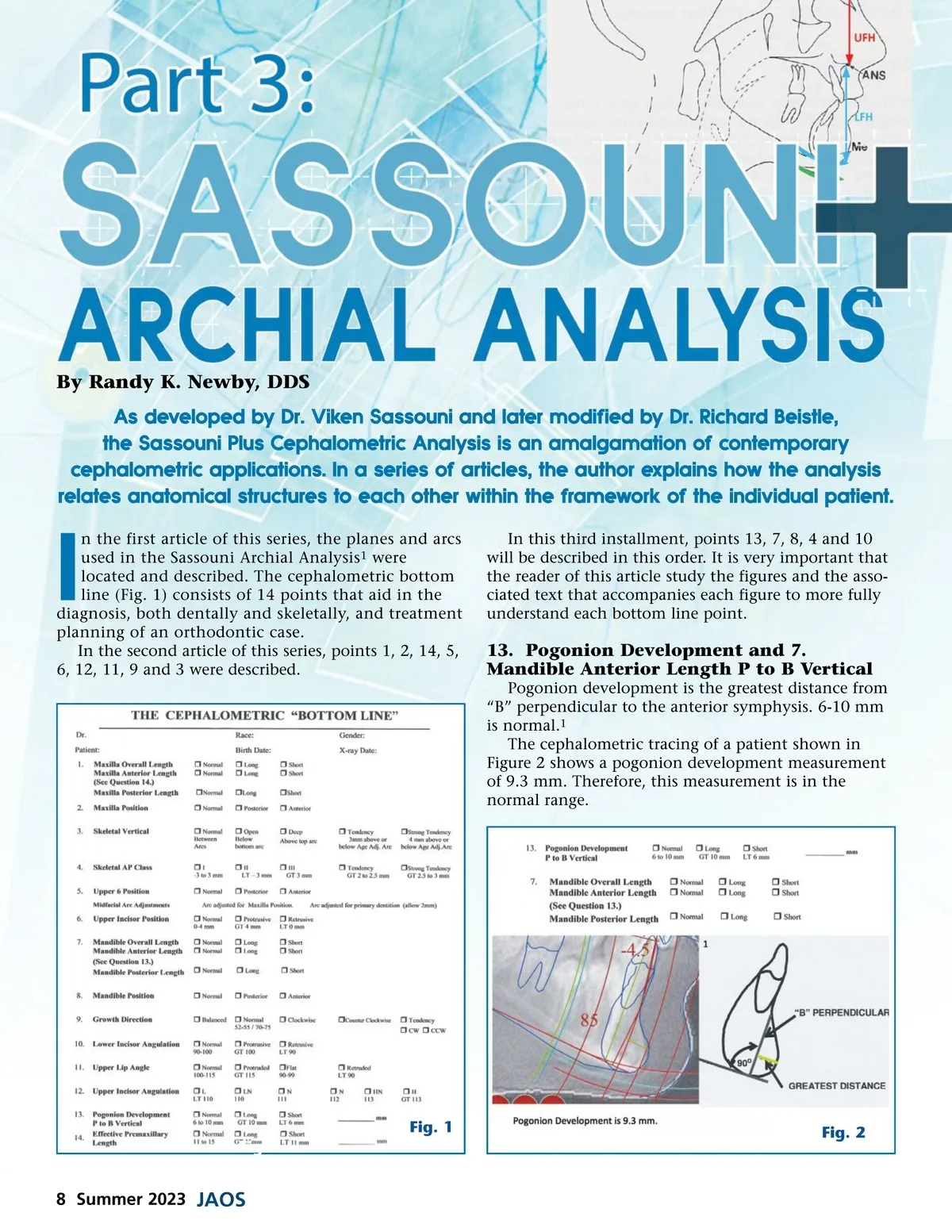
Fig. 5 Fig. 3 Fig. 4 Fig. 6 7. Mandible Posterior Length (Fig. 3) 4 • At age 4, Go should be 6mm ahead of the Posterior Arc. • At age 12, Go should be on the Posterior Arc. • Adult male, Go should fall 6mm behind the Posterior Arc. • Adult female, Go should fall 4mm behind the Posterior Arc. The cephalometric tracing of a 12.5 year old patient is shown in Figure 5. Constructed gonion should be on the Posterior Arc. Therefore, the mandibular posterior length is long. The mandible overall length may be normal (Fig. 4), long or short. The cephalometric tracing in Figure 5 shows a patient whose age is 12.5. The constructed gonion should be on the Posterior Arc. Therefore, the mandibular posterior length is long. In this case to determine the mandibular overall length, transfer the length by which the mandible is too long posteriorly, to the anterior with the posterior arrow on Pogo-nion. The anterior arrow extends beyond the Anterior Arc. Therefore, the mandible overall length is long. The summary of the mandible anterior, posterior and overall length components are shown in Figure 6. 7. Mandible Overall Length The length of the mandible is determined by its relationship with the Anterior Arc and Posterior Arc (Fig. 4). 8. Mandible Position The cephalometric tracing of a 12.5 year old patient is shown in Figure 7. When Pog and Go are displaced in the same direction, either anterior or posterior to the arcs by an equal amount, the mandible is displaced by the equal amount. If displaced by unequal amounts, a displaced mandible exists but also one that is abnormal in size by the difference of the two displacement values. If Go and Pog are displaced in opposite directions, an abnor-mally large mandible (farther apart) or an abnormally small mandible (closer together) exists. What is the main significance of Bottom-Line points 13, 7 and 8? I focus in on the position of the constructed gonion relative to the Posterior Arc. In the case shown in Figure 8, the CG is 13mm behind the Posterior Arc. For a patient this age, CG should be on the Posterior Arc. Dr. Beistle 1 states: “When Go is posterior to the Posterior Arc rela-tive to age, the patient is at much greater risk of having TMJ issues.” www.orthodontics.com Summer 2023 9
Journal of the American Orthodontic Society Summer 2023: Page 9