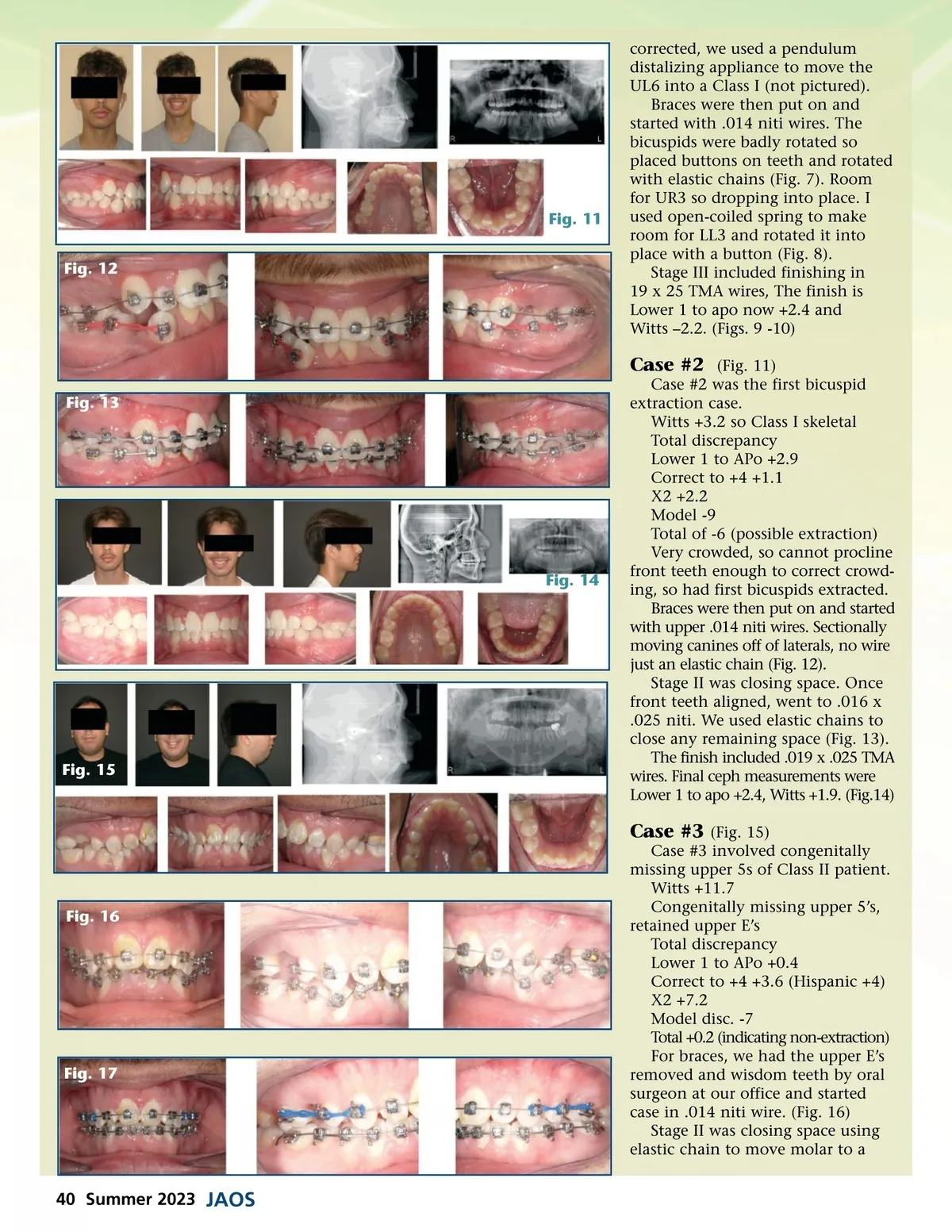
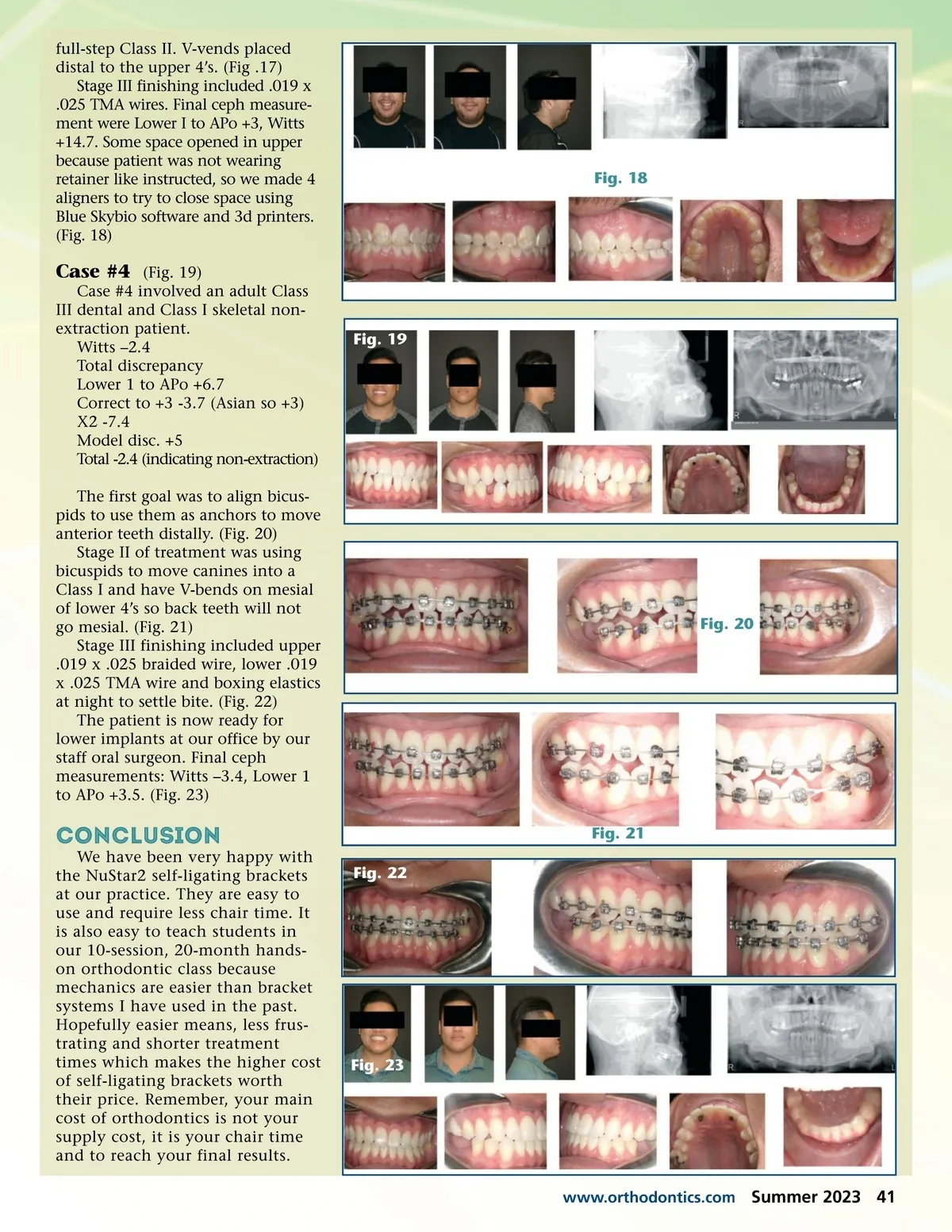
Fig. 11 Fig. 12 corrected, we used a pendulum distalizing appliance to move the UL6 into a Class I (not pictured). Braces were then put on and started with .014 niti wires. The bicuspids were badly rotated so placed buttons on teeth and rotated with elastic chains (Fig. 7). Room for UR3 so dropping into place. I used open-coiled spring to make room for LL3 and rotated it into place with a button (Fig. 8). Stage III included finishing in 19 x 25 TMA wires, The finish is Lower 1 to apo now +2.4 and Witts –2.2. (Figs. 9 -10) Case #2 (Fig. 11) Fig. 13 Case #2 was the first bicuspid extraction case. Witts +3.2 so Class I skeletal Total discrepancy Lower 1 to APo +2.9 Correct to +4 +1.1 X2 +2.2 Model -9 Total of -6 (possible extraction) Very crowded, so cannot procline front teeth enough to correct crowd-ing, so had first bicuspids extracted. Braces were then put on and started with upper .014 niti wires. Sectionally moving canines off of laterals, no wire just an elastic chain (Fig. 12). Stage II was closing space. Once front teeth aligned, went to .016 x .025 niti. We used elastic chains to close any remaining space (Fig. 13). The finish included .019 x .025 TMA wires. Final ceph measurements were Lower 1 to apo +2.4, Witts +1.9. (Fig.14) Fig. 14 Fig. 15 Case #3 (Fig. 15) Case #3 involved congenitally missing upper 5s of Class II patient. Witts +11.7 Congenitally missing upper 5’s, retained upper E’s Total discrepancy Lower 1 to APo +0.4 Correct to +4 +3.6 (Hispanic +4) X2 +7.2 Model disc. -7 Total +0.2 (indicating non-extraction) For braces, we had the upper E’s removed and wisdom teeth by oral surgeon at our office and started case in .014 niti wire. (Fig. 16) Stage II was closing space using elastic chain to move molar to a Fig. 16 Fig. 17 40 Summer 2023 JAOS
Journal of the American Orthodontic Society Summer 2023: Page 40