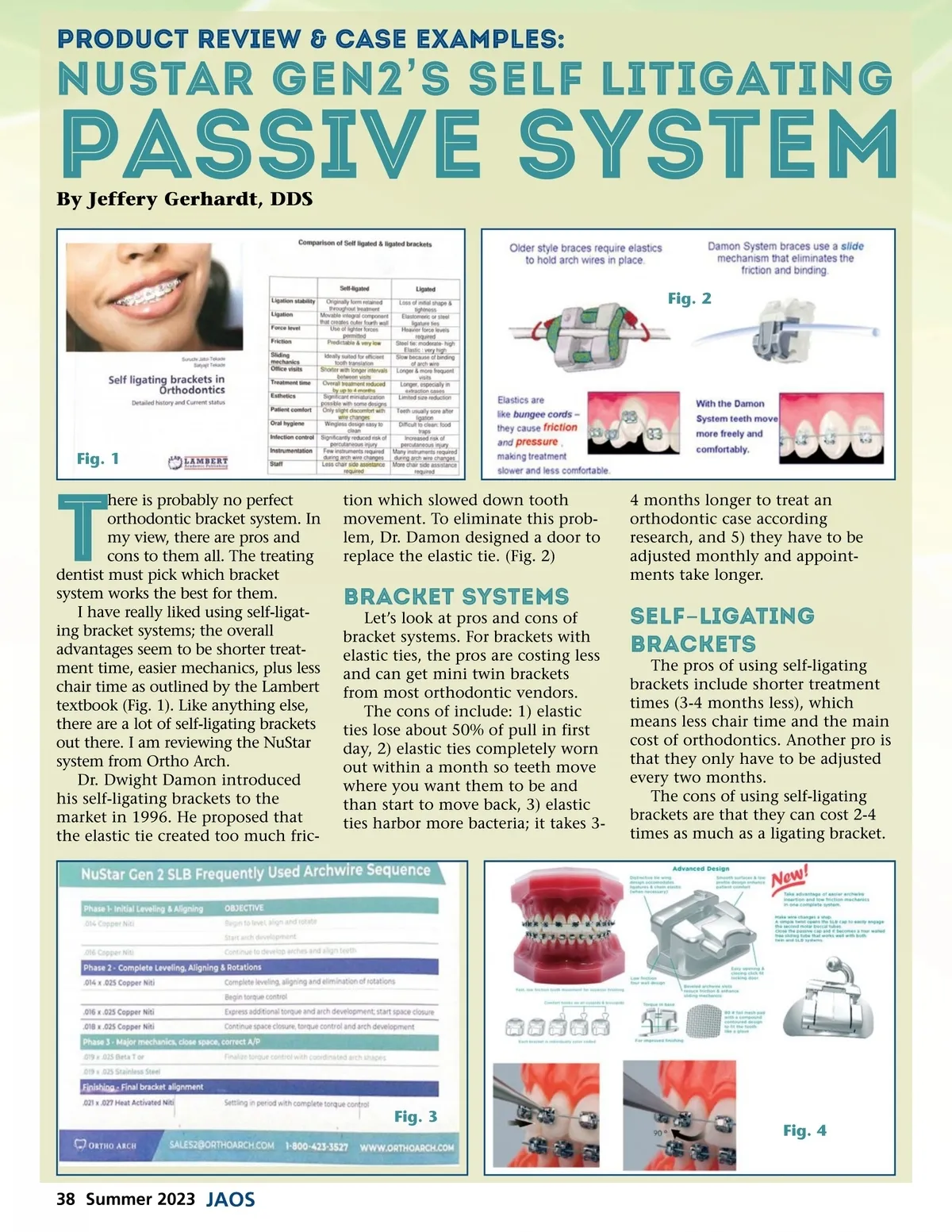
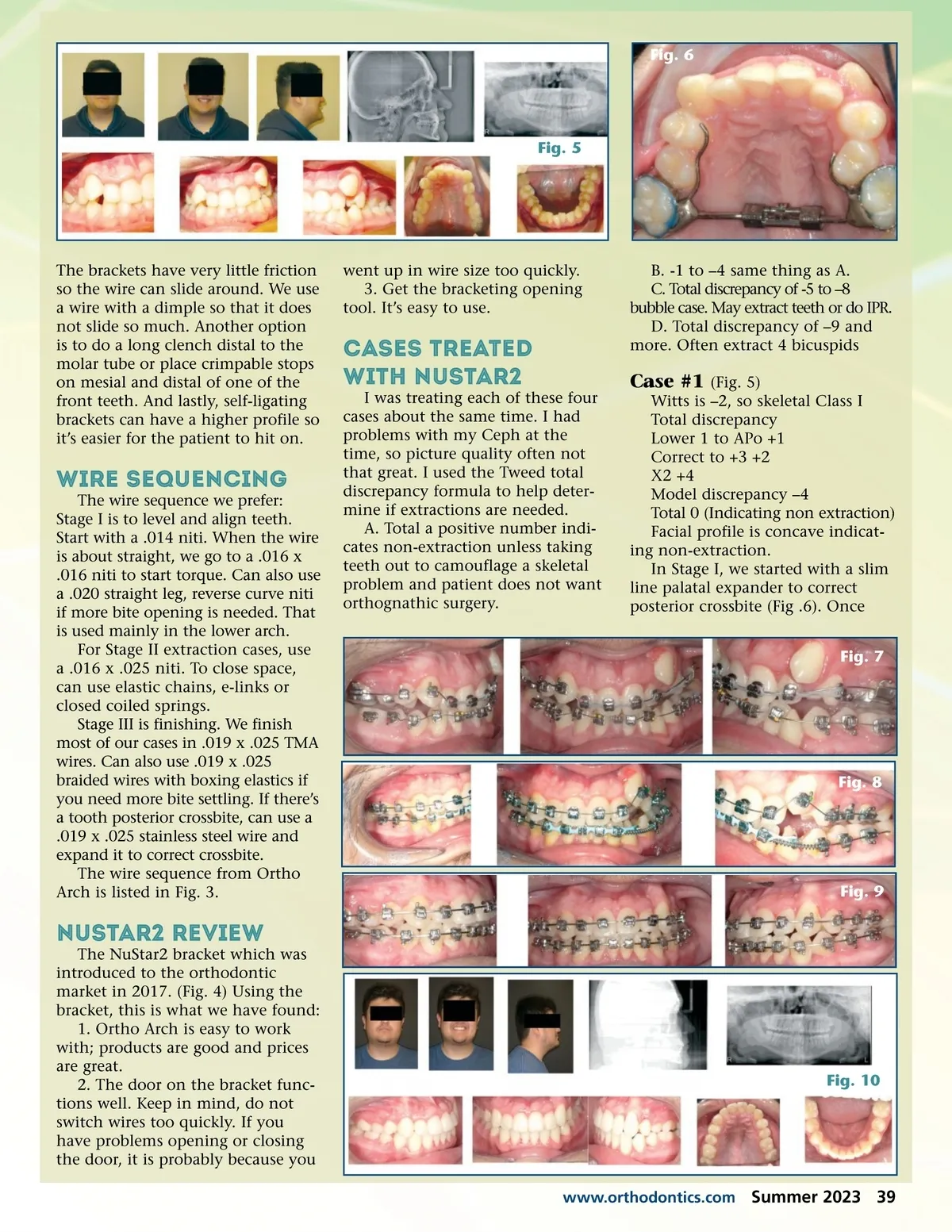
Fig. 6 Fig. 5 The brackets have very little friction so the wire can slide around. We use a wire with a dimple so that it does not slide so much. Another option is to do a long clench distal to the molar tube or place crimpable stops on mesial and distal of one of the front teeth. And lastly, self-ligating brackets can have a higher profile so it’s easier for the patient to hit on. went up in wire size too quickly. 3. Get the bracketing opening tool. It’s easy to use. Cases Treated With Nustar2 I was treating each of these four cases about the same time. I had problems with my Ceph at the time, so picture quality often not that great. I used the Tweed total discrepancy formula to help deter-mine if extractions are needed. A. Total a positive number indi-cates non-extraction unless taking teeth out to camouflage a skeletal problem and patient does not want orthognathic surgery. B. -1 to –4 same thing as A. C. Total discrepancy of -5 to –8 bubble case. May extract teeth or do IPR. D. Total discrepancy of –9 and more. Often extract 4 bicuspids Case #1 (Fig. 5) Witts is –2, so skeletal Class I Total discrepancy Lower 1 to APo +1 Correct to +3 +2 X2 +4 Model discrepancy –4 Total 0 (Indicating non extraction) Facial profile is concave indicat-ing non-extraction. In Stage I, we started with a slim line palatal expander to correct posterior crossbite (Fig .6). Once Fig. 7 Wire Sequencing The wire sequence we prefer: Stage I is to level and align teeth. Start with a .014 niti. When the wire is about straight, we go to a .016 x .016 niti to start torque. Can also use a .020 straight leg, reverse curve niti if more bite opening is needed. That is used mainly in the lower arch. For Stage II extraction cases, use a .016 x .025 niti. To close space, can use elastic chains, e-links or closed coiled springs. Stage III is finishing. We finish most of our cases in .019 x .025 TMA wires. Can also use .019 x .025 braided wires with boxing elastics if you need more bite settling. If there’s a tooth posterior crossbite, can use a .019 x .025 stainless steel wire and expand it to correct crossbite. The wire sequence from Ortho Arch is listed in Fig. 3. Fig. 8 Fig. 9 Nustar2 Review The NuStar2 bracket which was introduced to the orthodontic market in 2017. (Fig. 4) Using the bracket, this is what we have found: 1. Ortho Arch is easy to work with; products are good and prices are great. 2. The door on the bracket func-tions well. Keep in mind, do not switch wires too quickly. If you have problems opening or closing the door, it is probably because you www.orthodontics.com Fig. 10 Summer 2023 39
Journal of the American Orthodontic Society Summer 2023: Page 39