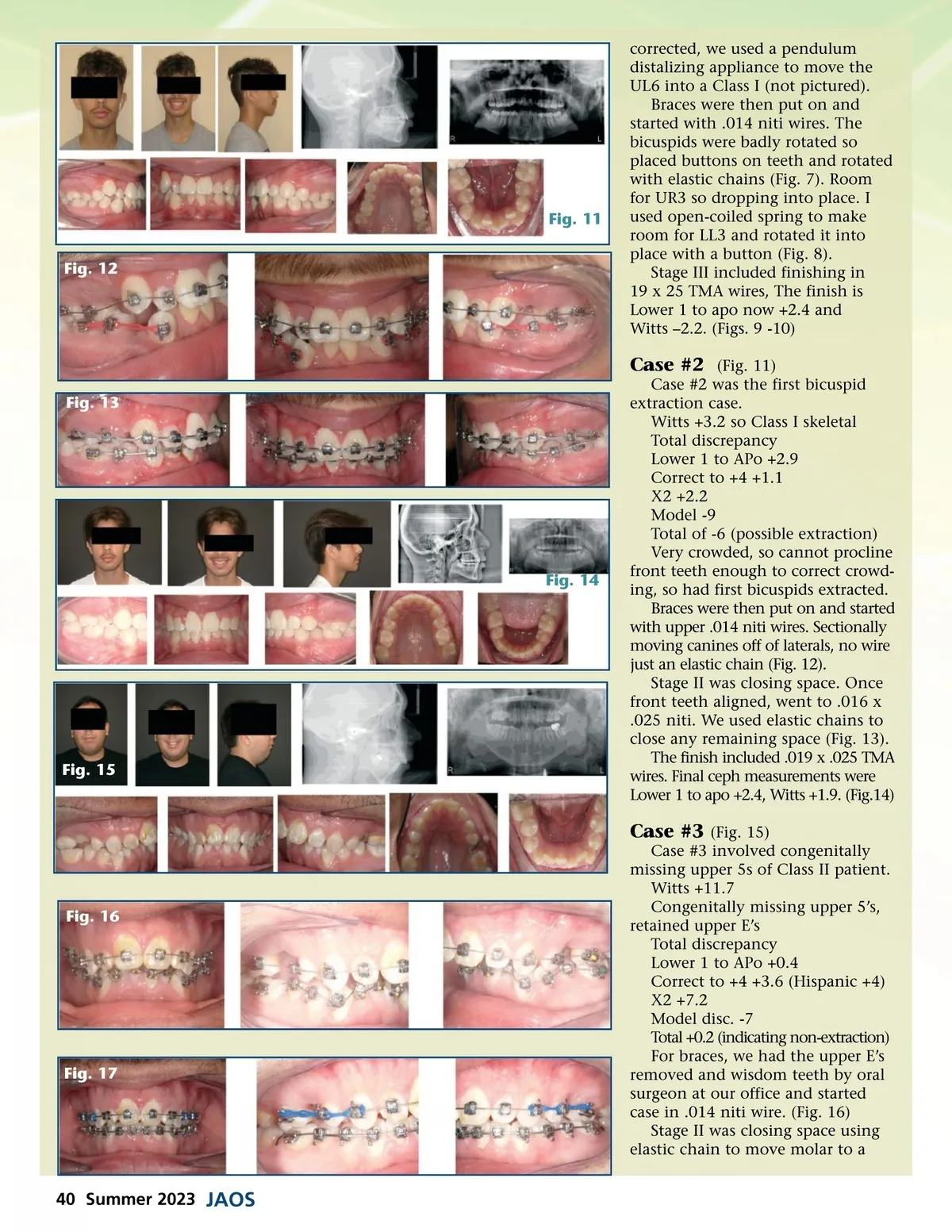
full-step Class II. V-vends placed distal to the upper 4’s. (Fig .17) Stage III finishing included .019 x .025 TMA wires. Final ceph measure-ment were Lower I to APo +3, Witts +14.7. Some space opened in upper because patient was not wearing retainer like instructed, so we made 4 aligners to try to close space using Blue Skybio software and 3d printers. (Fig. 18) Fig. 18 Case #4 (Fig. 19) Case #4 involved an adult Class III dental and Class I skeletal non-extraction patient. Witts –2.4 Total discrepancy Lower 1 to APo +6.7 Correct to +3 -3.7 (Asian so +3) X2 -7.4 Model disc. +5 Total -2.4 (indicating non-extraction) The first goal was to align bicus-pids to use them as anchors to move anterior teeth distally. (Fig. 20) Stage II of treatment was using bicuspids to move canines into a Class I and have V-bends on mesial of lower 4’s so back teeth will not go mesial. (Fig. 21) Stage III finishing included upper .019 x .025 braided wire, lower .019 x .025 TMA wire and boxing elastics at night to settle bite. (Fig. 22) The patient is now ready for lower implants at our office by our staff oral surgeon. Final ceph measurements: Witts –3.4, Lower 1 to APo +3.5. (Fig. 23) Fig. 19 Fig. 20 Conclusion We have been very happy with the NuStar2 self-ligating brackets at our practice. They are easy to use and require less chair time. It is also easy to teach students in our 10-session, 20-month hands-on orthodontic class because mechanics are easier than bracket systems I have used in the past. Hopefully easier means, less frus-trating and shorter treatment times which makes the higher cost of self-ligating brackets worth their price. Remember, your main cost of orthodontics is not your supply cost, it is your chair time and to reach your final results. Fig. 22 Fig. 21 Fig. 23 www.orthodontics.com Summer 2023 41
Journal of the American Orthodontic Society Summer 2023: Page 41