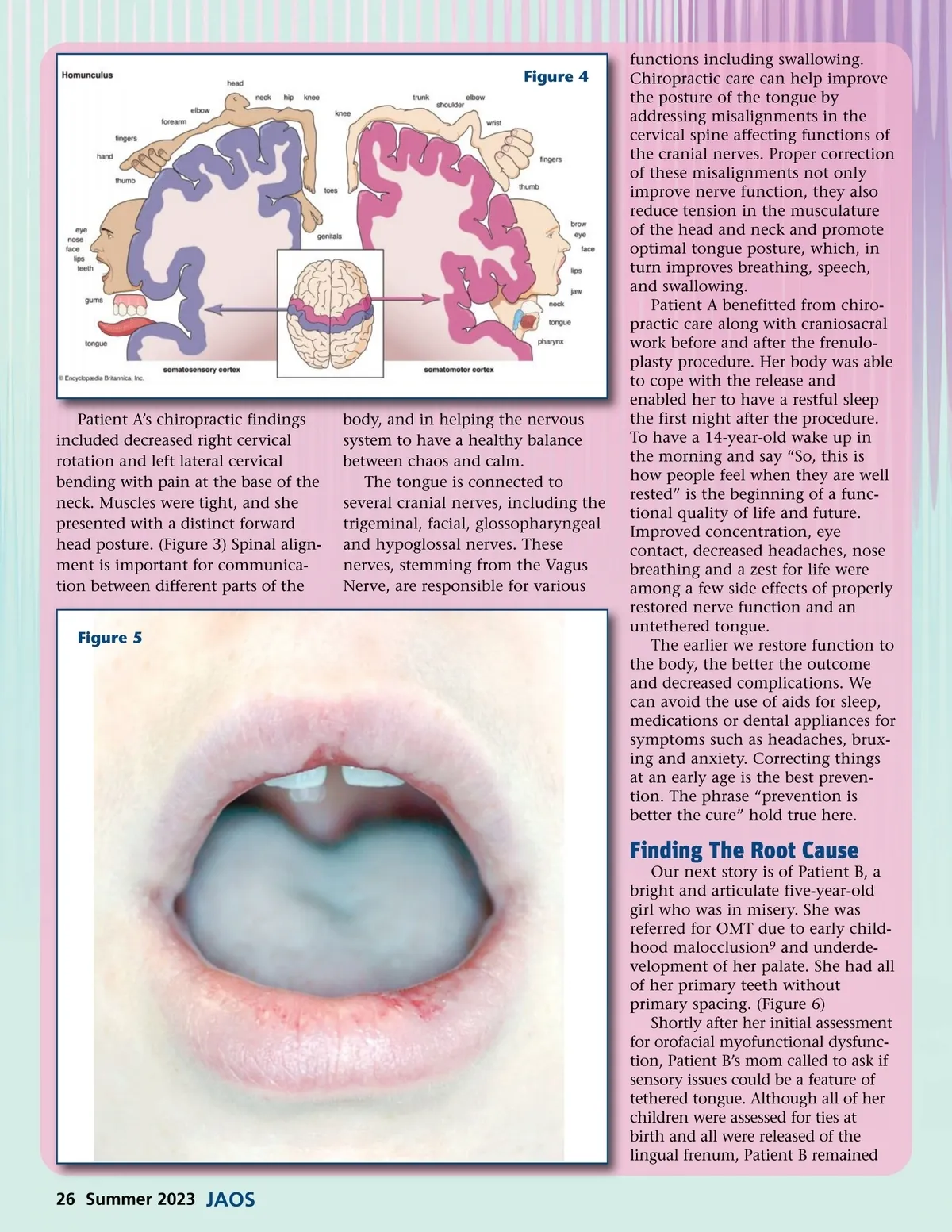
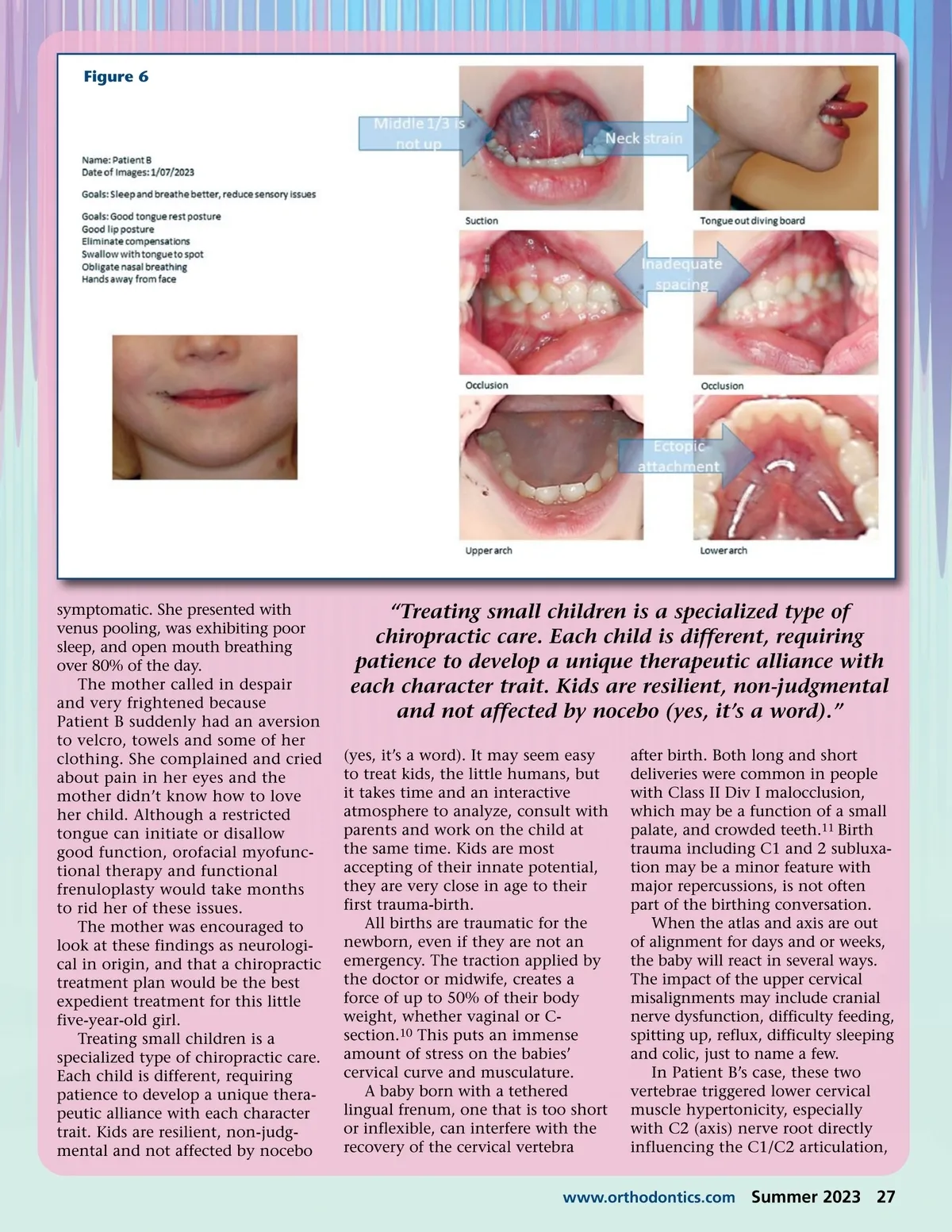
Figure 6 symptomatic. She presented with venus pooling, was exhibiting poor sleep, and open mouth breathing over 80% of the day. The mother called in despair and very frightened because Patient B suddenly had an aversion to velcro, towels and some of her clothing. She complained and cried about pain in her eyes and the mother didn’t know how to love her child. Although a restricted tongue can initiate or disallow good function, orofacial myofunc-tional therapy and functional frenuloplasty would take months to rid her of these issues. The mother was encouraged to look at these findings as neurologi-cal in origin, and that a chiropractic treatment plan would be the best expedient treatment for this little five-year-old girl. Treating small children is a specialized type of chiropractic care. Each child is different, requiring patience to develop a unique thera-peutic alliance with each character trait. Kids are resilient, non-judg-mental and not affected by nocebo “Treating small children is a specialized type of chiropractic care. Each child is different, requiring patience to develop a unique therapeutic alliance with each character trait. Kids are resilient, non-judgmental and not affected by nocebo (yes, it’s a word).” (yes, it’s a word). It may seem easy to treat kids, the little humans, but it takes time and an interactive atmosphere to analyze, consult with parents and work on the child at the same time. Kids are most accepting of their innate potential, they are very close in age to their first trauma-birth. All births are traumatic for the newborn, even if they are not an emergency. The traction applied by the doctor or midwife, creates a force of up to 50% of their body weight, whether vaginal or C-section. 10 This puts an immense amount of stress on the babies’ cervical curve and musculature. A baby born with a tethered lingual frenum, one that is too short or inflexible, can interfere with the recovery of the cervical vertebra after birth. Both long and short deliveries were common in people with Class II Div I malocclusion, which may be a function of a small palate, and crowded teeth. 11 Birth trauma including C1 and 2 subluxa-tion may be a minor feature with major repercussions, is not often part of the birthing conversation. When the atlas and axis are out of alignment for days and or weeks, the baby will react in several ways. The impact of the upper cervical misalignments may include cranial nerve dysfunction, difficulty feeding, spitting up, reflux, difficulty sleeping and colic, just to name a few. In Patient B’s case, these two vertebrae triggered lower cervical muscle hypertonicity, especially with C2 (axis) nerve root directly influencing the C1/C2 articulation, www.orthodontics.com Summer 2023 27
Journal of the American Orthodontic Society Summer 2023: Page 27