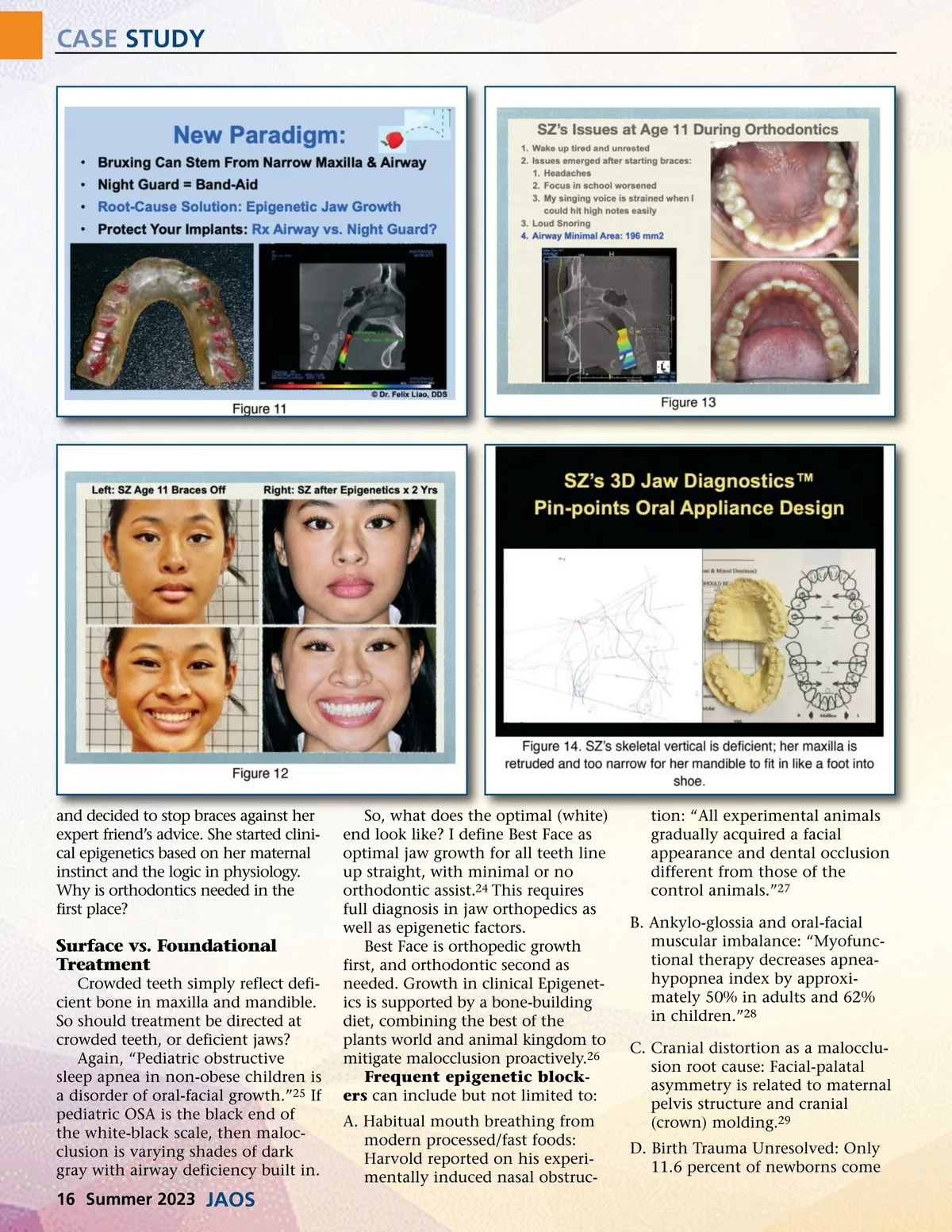
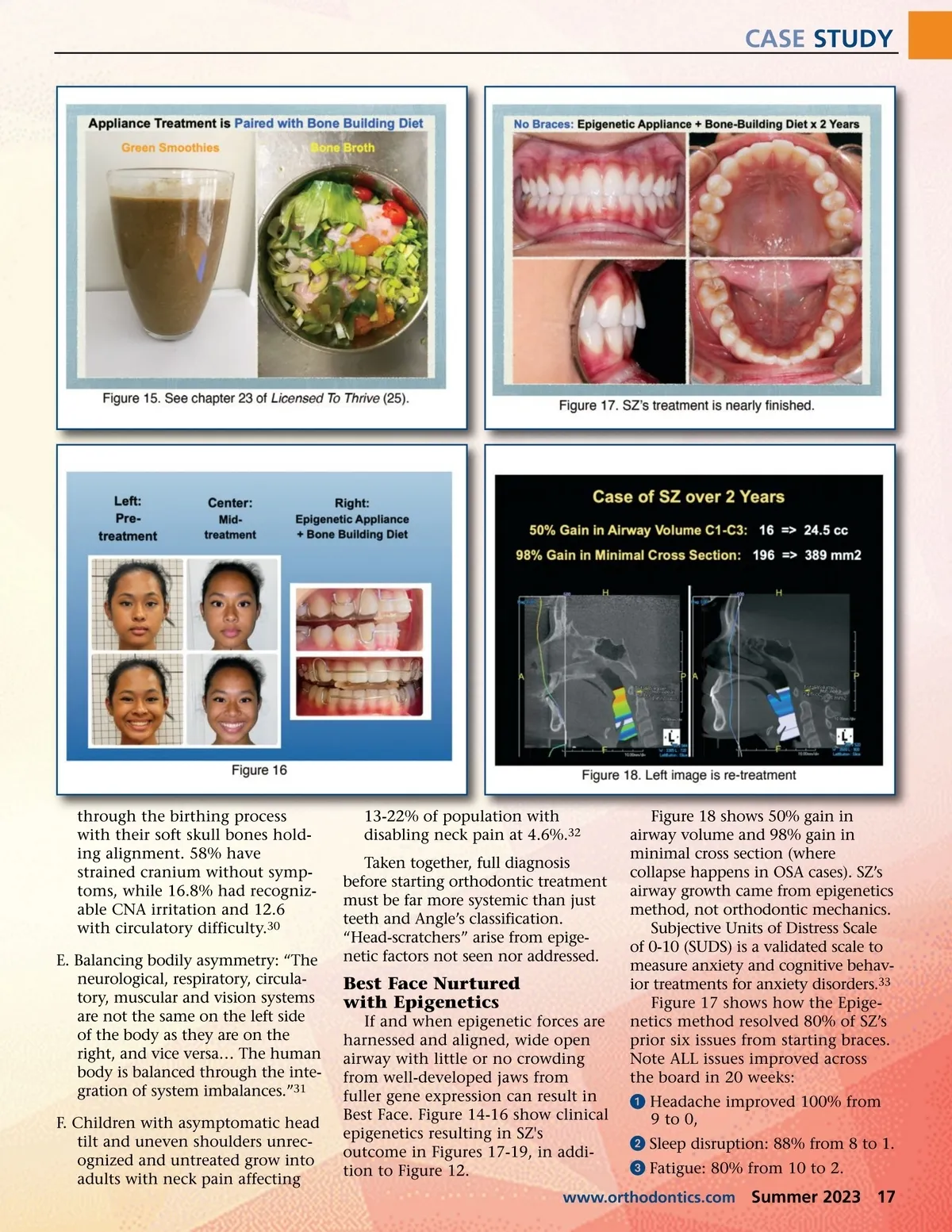
CASE STUDY through the birthing process with their soft skull bones hold-ing alignment. 58% have strained cranium without symp-toms, while 16.8% had recogniz-able CNA irritation and 12.6 with circulatory difficulty. 30 E. Balancing bodily asymmetry: “The neurological, respiratory, circula-tory, muscular and vision systems are not the same on the left side of the body as they are on the right, and vice versa… The human body is balanced through the inte-gration of system imbalances.” 31 F. Children with asymptomatic head tilt and uneven shoulders unrec-ognized and untreated grow into adults with neck pain affecting 13-22% of population with disabling neck pain at 4.6%. 32 Taken together, full diagnosis before starting orthodontic treatment must be far more systemic than just teeth and Angle’s classification. “Head-scratchers” arise from epige-netic factors not seen nor addressed. Best Face Nurtured with Epigenetics If and when epigenetic forces are harnessed and aligned, wide open airway with little or no crowding from well-developed jaws from fuller gene expression can result in Best Face. Figure 14-16 show clinical epigenetics resulting in SZ's outcome in Figures 17-19, in addi-tion to Figure 12. Figure 18 shows 50% gain in airway volume and 98% gain in minimal cross section (where collapse happens in OSA cases). SZ’s airway growth came from epigenetics method, not orthodontic mechanics. Subjective Units of Distress Scale of 0-10 (SUDS) is a validated scale to measure anxiety and cognitive behav-ior treatments for anxiety disorders. 33 Figure 17 shows how the Epige-netics method resolved 80% of SZ’s prior six issues from starting braces. Note ALL issues improved across the board in 20 weeks: ᕡ Headache improved 100% from 9 to 0, ᕢ Sleep disruption: 88% from 8 to 1. ᕣ Fatigue: 80% from 10 to 2. www.orthodontics.com Summer 2023 17
Journal of the American Orthodontic Society Summer 2023: Page 17