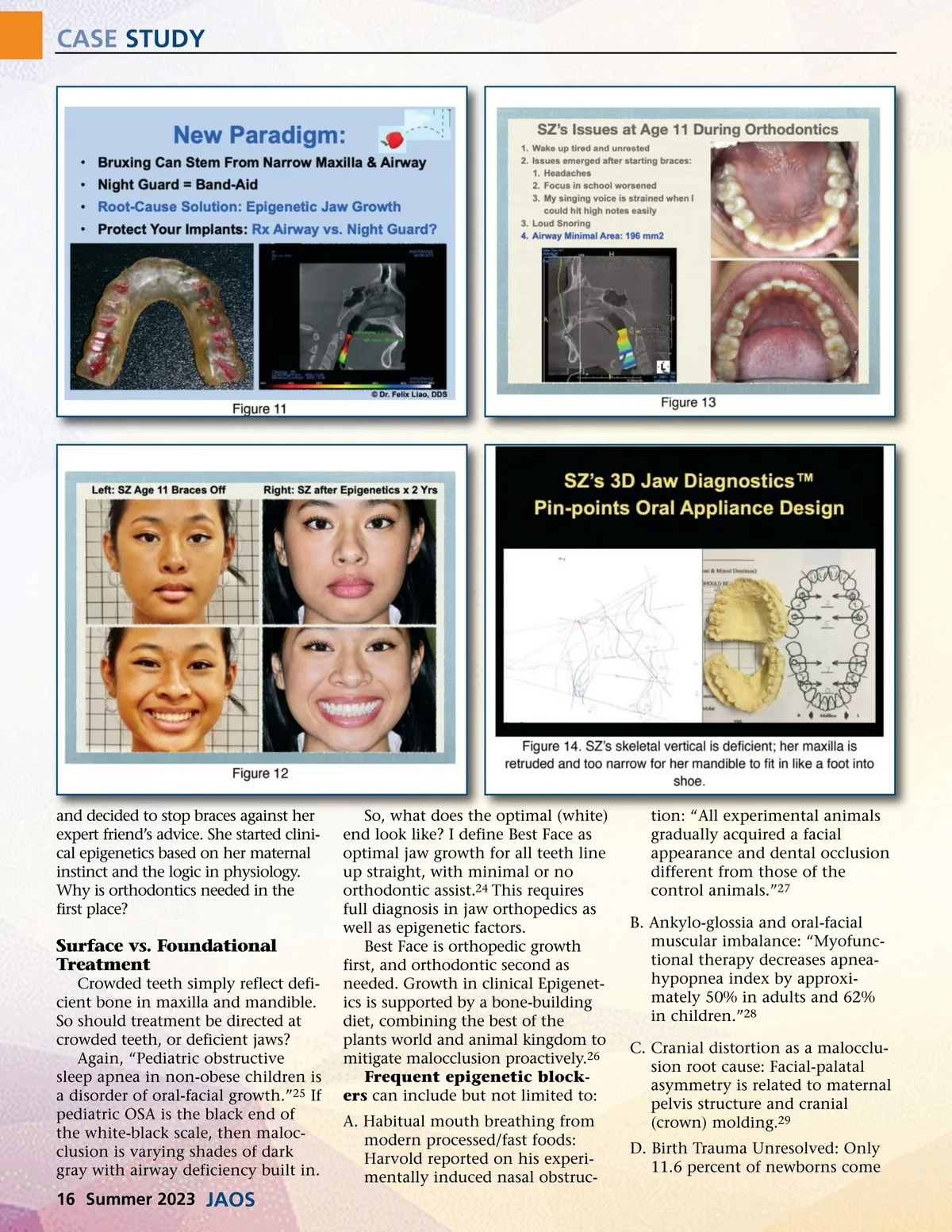
CASE STUDY and decided to stop braces against her expert friend’s advice. She started clini-cal epigenetics based on her maternal instinct and the logic in physiology. Why is orthodontics needed in the first place? Surface vs. Foundational Treatment Crowded teeth simply reflect defi-cient bone in maxilla and mandible. So should treatment be directed at crowded teeth, or deficient jaws? Again, “Pediatric obstructive sleep apnea in non-obese children is a disorder of oral-facial growth.” 25 If pediatric OSA is the black end of the white-black scale, then maloc-clusion is varying shades of dark gray with airway deficiency built in. So, what does the optimal (white) end look like? I define Best Face as optimal jaw growth for all teeth line up straight, with minimal or no orthodontic assist. 24 This requires full diagnosis in jaw orthopedics as well as epigenetic factors. Best Face is orthopedic growth first, and orthodontic second as needed. Growth in clinical Epigenet-ics is supported by a bone-building diet, combining the best of the plants world and animal kingdom to mitigate malocclusion proactively. 26 Frequent epigenetic block-ers can include but not limited to: A. Habitual mouth breathing from modern processed/fast foods: Harvold reported on his experi-mentally induced nasal obstruc-tion: “All experimental animals gradually acquired a facial appearance and dental occlusion different from those of the control animals.” 27 B. Ankylo-glossia and oral-facial muscular imbalance: “Myofunc-tional therapy decreases apnea-hypopnea index by approxi-mately 50% in adults and 62% in children.” 28 C. Cranial distortion as a malocclu-sion root cause: Facial-palatal asymmetry is related to maternal pelvis structure and cranial (crown) molding. 29 D. Birth Trauma Unresolved: Only 11.6 percent of newborns come 16 Summer 2023 JAOS
Journal of the American Orthodontic Society Summer 2023: Page 16