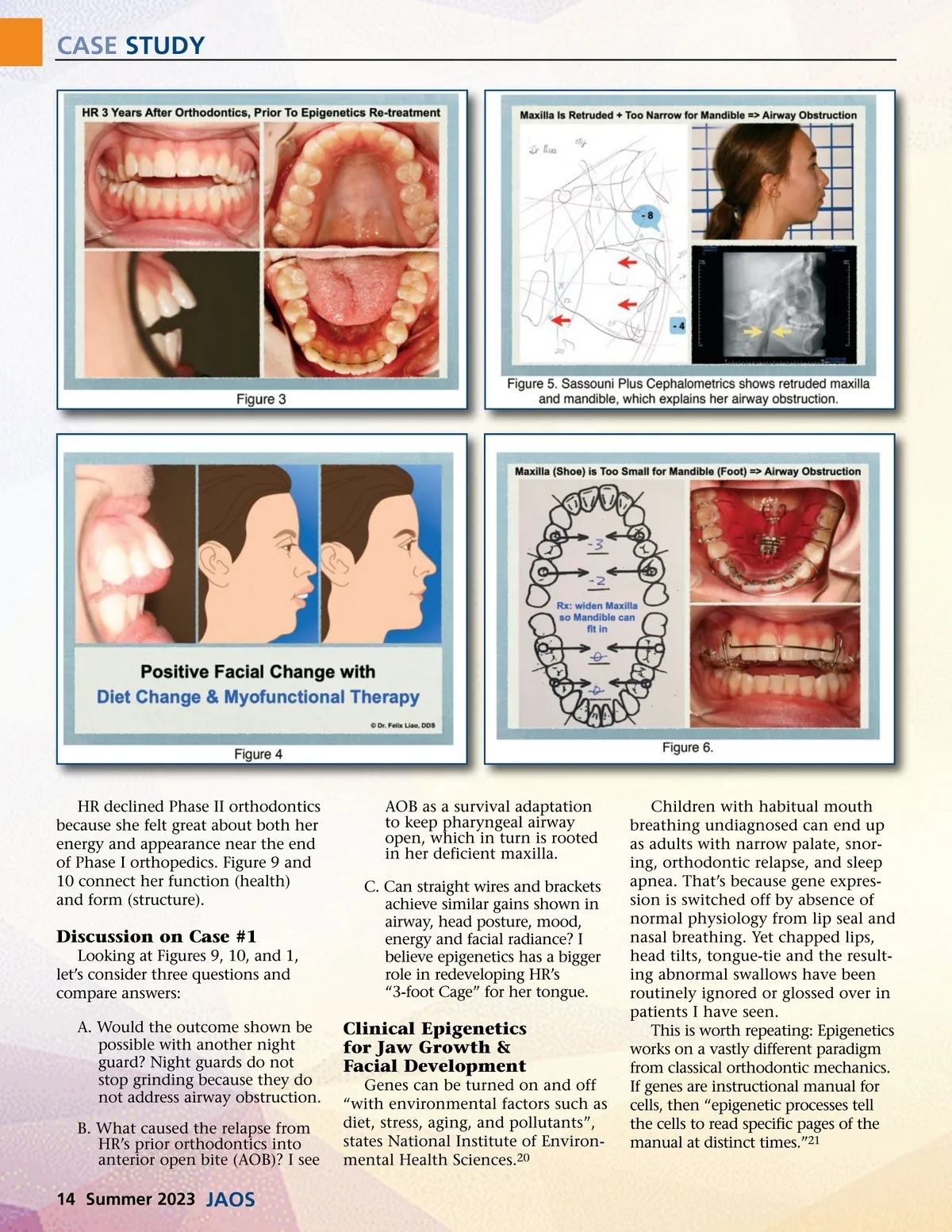
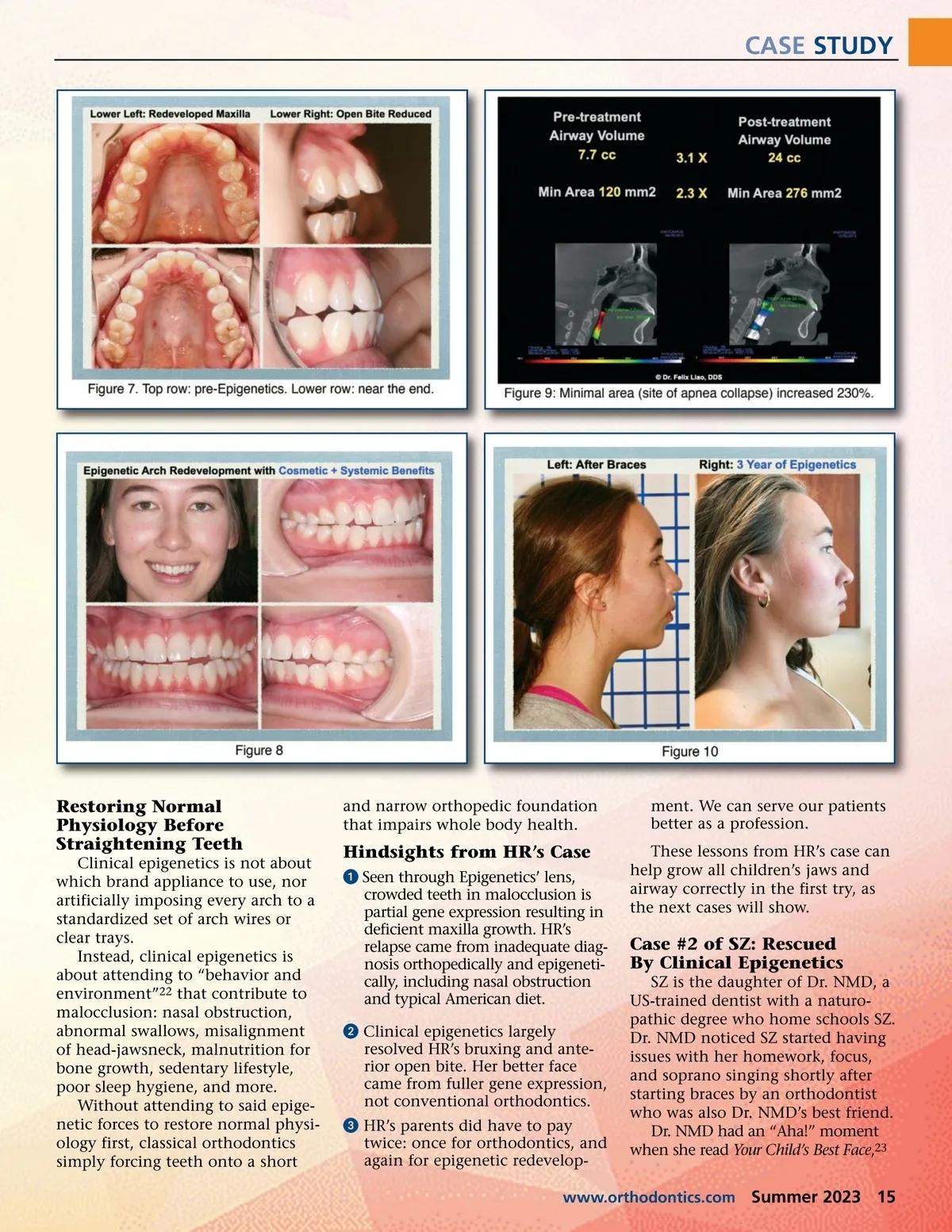
CASE STUDY Restoring Normal Physiology Before Straightening Teeth Clinical epigenetics is not about which brand appliance to use, nor artificially imposing every arch to a standardized set of arch wires or clear trays. Instead, clinical epigenetics is about attending to “behavior and environment” 22 that contribute to malocclusion: nasal obstruction, abnormal swallows, misalignment of head-jawsneck, malnutrition for bone growth, sedentary lifestyle, poor sleep hygiene, and more. Without attending to said epige-netic forces to restore normal physi-ology first, classical orthodontics simply forcing teeth onto a short and narrow orthopedic foundation that impairs whole body health. ment. We can serve our patients better as a profession. These lessons from HR’s case can help grow all children’s jaws and airway correctly in the first try, as the next cases will show. Hindsights from HR’s Case ᕡ Seen through Epigenetics’ lens, crowded teeth in malocclusion is partial gene expression resulting in deficient maxilla growth. HR’s relapse came from inadequate diag-nosis orthopedically and epigeneti-cally, including nasal obstruction and typical American diet. ᕢ Clinical epigenetics largely resolved HR’s bruxing and ante-rior open bite. Her better face came from fuller gene expression, not conventional orthodontics. ᕣ HR’s parents did have to pay twice: once for orthodontics, and again for epigenetic redevelop-Case #2 of SZ: Rescued By Clinical Epigenetics SZ is the daughter of Dr. NMD, a US-trained dentist with a naturo-pathic degree who home schools SZ. Dr. NMD noticed SZ started having issues with her homework, focus, and soprano singing shortly after starting braces by an orthodontist who was also Dr. NMD’s best friend. Dr. NMD had an “Aha!” moment when she read Your Child’s Best Face , 23 www.orthodontics.com Summer 2023 15
Journal of the American Orthodontic Society Summer 2023: Page 15