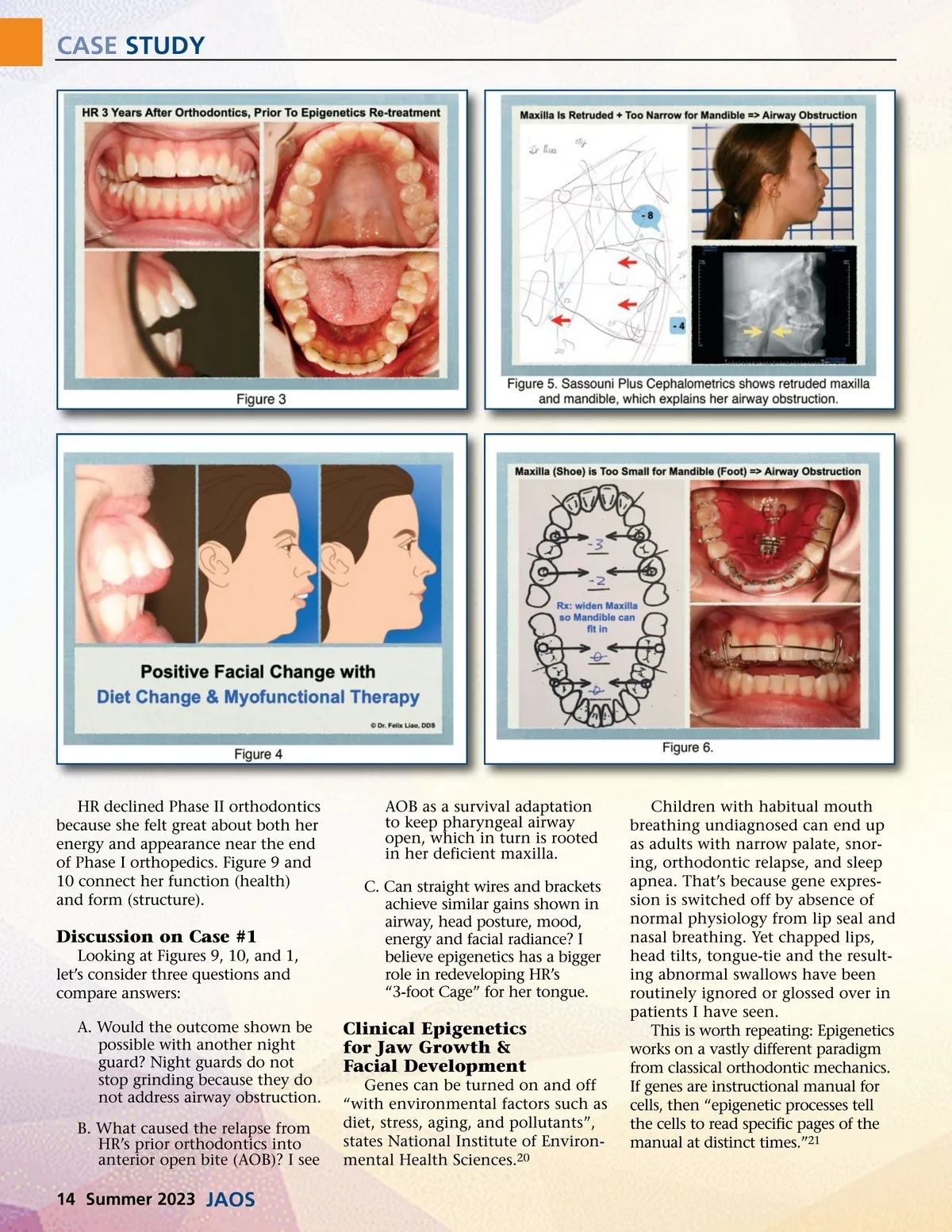
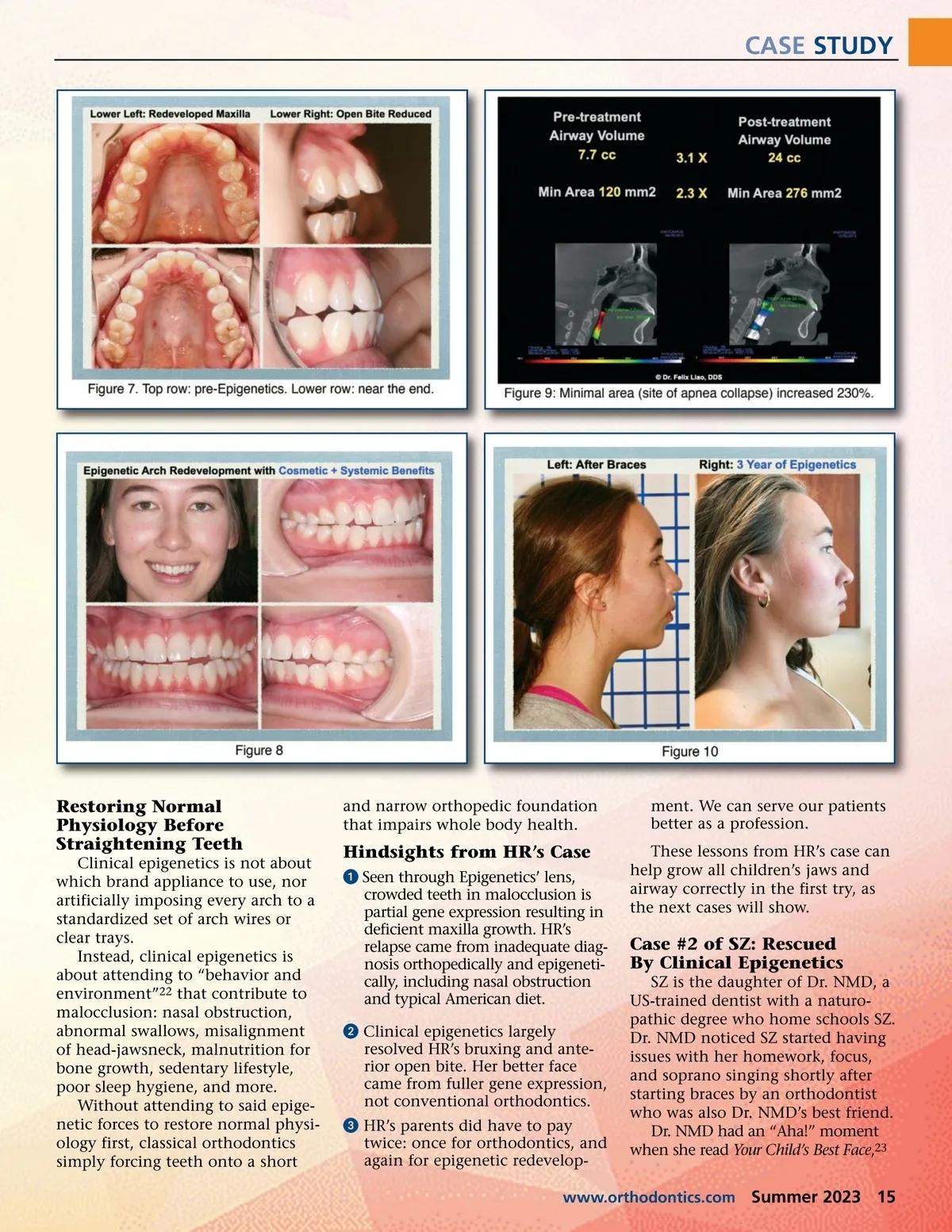
CASE STUDY HR declined Phase II orthodontics because she felt great about both her energy and appearance near the end of Phase I orthopedics. Figure 9 and 10 connect her function (health) and form (structure). AOB as a survival adaptation to keep pharyngeal airway open, which in turn is rooted in her deficient maxilla. C. Can straight wires and brackets achieve similar gains shown in airway, head posture, mood, energy and facial radiance? I believe epigenetics has a bigger role in redeveloping HR’s “3-foot Cage” for her tongue. Discussion on Case #1 Looking at Figures 9, 10, and 1, let’s consider three questions and compare answers: A. Would the outcome shown be possible with another night guard? Night guards do not stop grinding because they do not address airway obstruction. B. What caused the relapse from HR’s prior orthodontics into anterior open bite (AOB)? I see Clinical Epigenetics for Jaw Growth & Facial Development Genes can be turned on and off “with environmental factors such as diet, stress, aging, and pollutants”, states National Institute of Environ-mental Health Sciences. 20 Children with habitual mouth breathing undiagnosed can end up as adults with narrow palate, snor-ing, orthodontic relapse, and sleep apnea. That’s because gene expres-sion is switched off by absence of normal physiology from lip seal and nasal breathing. Yet chapped lips, head tilts, tongue-tie and the result-ing abnormal swallows have been routinely ignored or glossed over in patients I have seen. This is worth repeating: Epigenetics works on a vastly different paradigm from classical orthodontic mechanics. If genes are instructional manual for cells, then “epigenetic processes tell the cells to read specific pages of the manual at distinct times.” 21 14 Summer 2023 JAOS
Journal of the American Orthodontic Society Summer 2023: Page 14