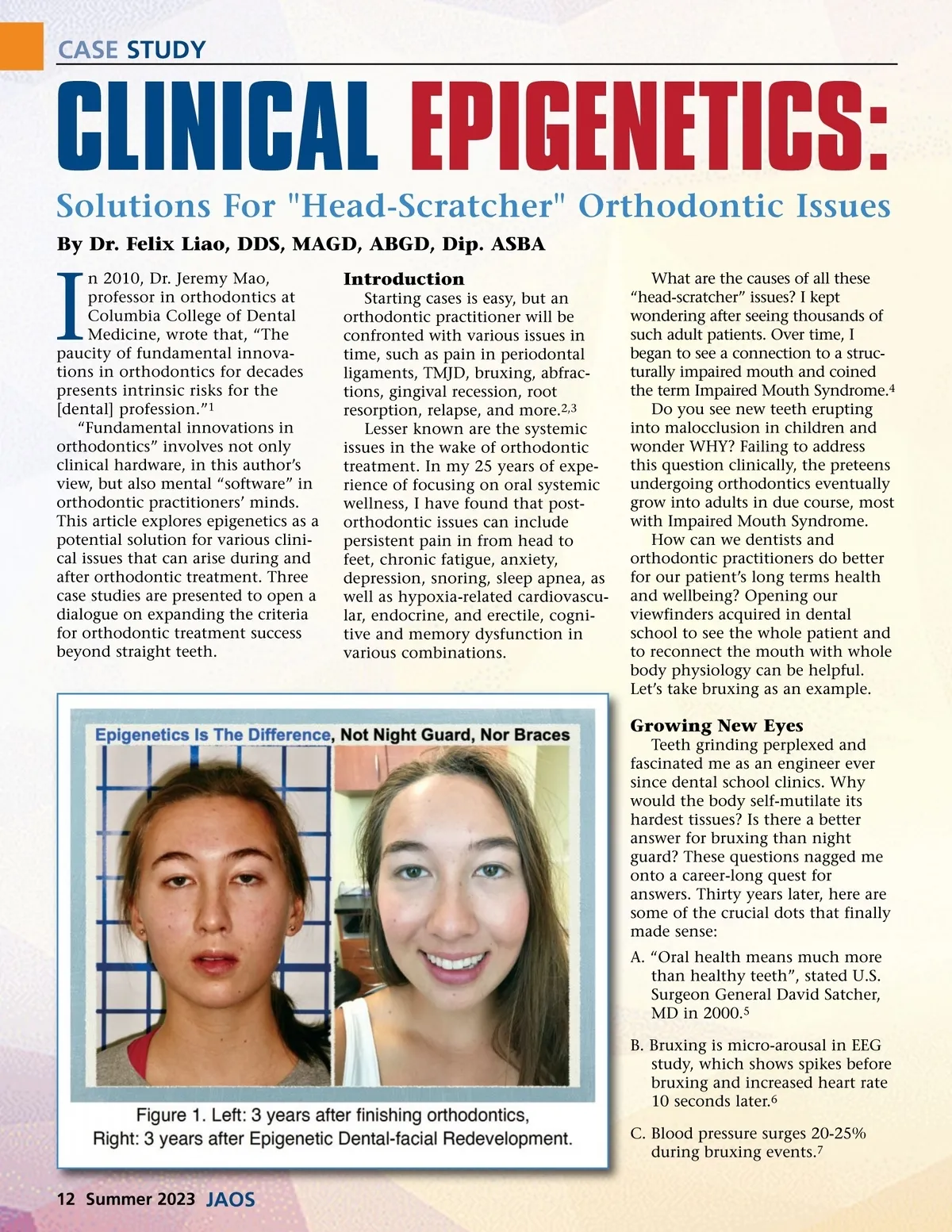
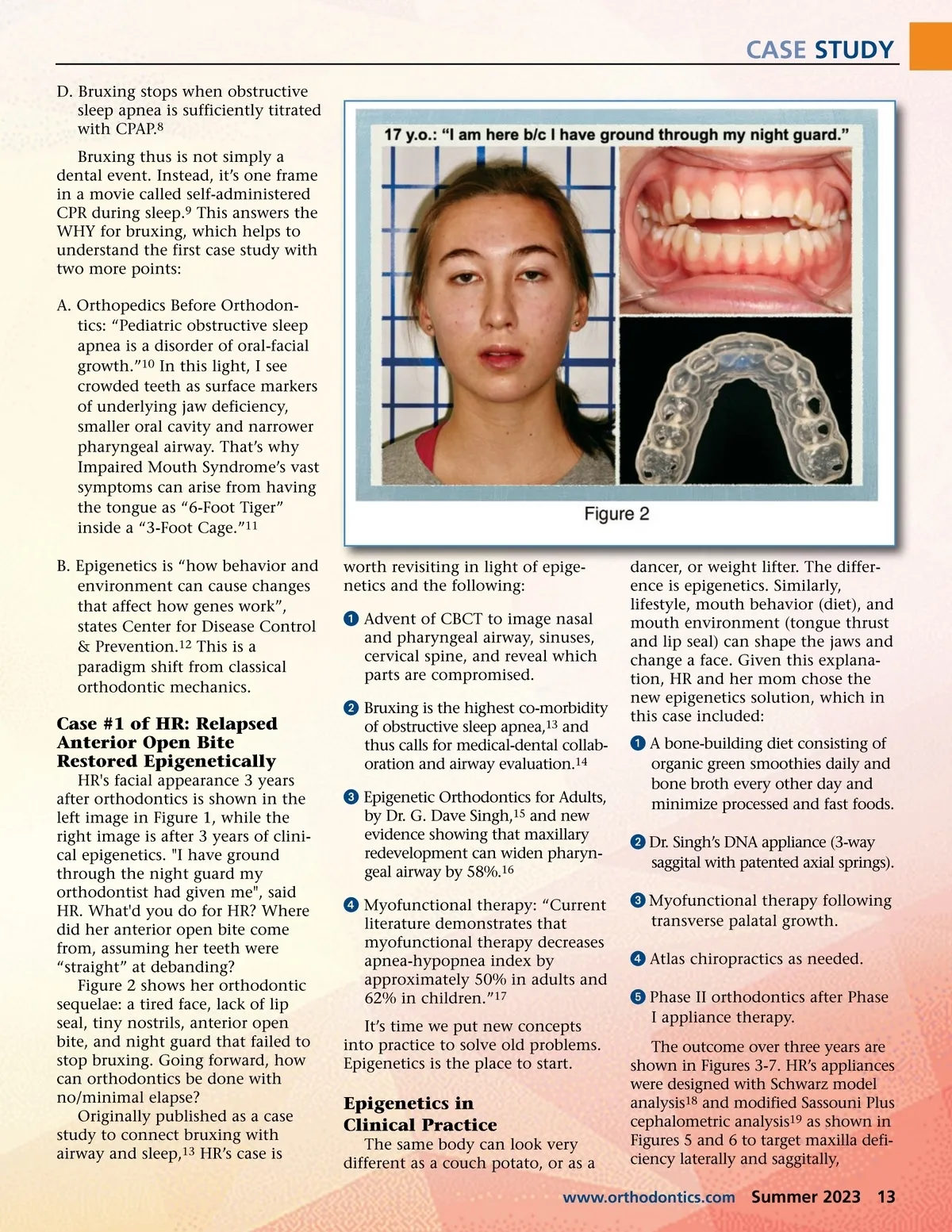
CASE STUDY D. Bruxing stops when obstructive sleep apnea is sufficiently titrated with CPAP. 8 Bruxing thus is not simply a dental event. Instead, it’s one frame in a movie called self-administered CPR during sleep. 9 This answers the WHY for bruxing, which helps to understand the first case study with two more points: A. Orthopedics Before Orthodon-tics: “Pediatric obstructive sleep apnea is a disorder of oral-facial growth.” 10 In this light, I see crowded teeth as surface markers of underlying jaw deficiency, smaller oral cavity and narrower pharyngeal airway. That’s why Impaired Mouth Syndrome’s vast symptoms can arise from having the tongue as “6-Foot Tiger” inside a “3-Foot Cage.” 11 B. Epigenetics is “how behavior and environment can cause changes that affect how genes work”, states Center for Disease Control & Prevention. 12 This is a paradigm shift from classical orthodontic mechanics. worth revisiting in light of epige-netics and the following: ᕡ Advent of CBCT to image nasal and pharyngeal airway, sinuses, cervical spine, and reveal which parts are compromised. ᕢ Bruxing is the highest co-morbidity of obstructive sleep apnea, 13 and thus calls for medical-dental collab-oration and airway evaluation. 14 ᕣ Epigenetic Orthodontics for Adults, by Dr. G. Dave Singh, 15 and new evidence showing that maxillary redevelopment can widen pharyn-geal airway by 58%. 16 ᕤ Myofunctional therapy: “Current literature demonstrates that myofunctional therapy decreases apnea-hypopnea index by approximately 50% in adults and 62% in children.” 17 It’s time we put new concepts into practice to solve old problems. Epigenetics is the place to start. dancer, or weight lifter. The differ-ence is epigenetics. Similarly, lifestyle, mouth behavior (diet), and mouth environment (tongue thrust and lip seal) can shape the jaws and change a face. Given this explana-tion, HR and her mom chose the new epigenetics solution, which in this case included: ᕡ A bone-building diet consisting of organic green smoothies daily and bone broth every other day and minimize processed and fast foods. ᕢ Dr. Singh’s DNA appliance (3-way saggital with patented axial springs). ᕣ Myofunctional therapy following transverse palatal growth. ᕤ Atlas chiropractics as needed. ᕥ Phase II orthodontics after Phase I appliance therapy. The outcome over three years are shown in Figures 3-7. HR’s appliances were designed with Schwarz model analysis 18 and modified Sassouni Plus cephalometric analysis 19 as shown in Figures 5 and 6 to target maxilla defi-ciency laterally and saggitally, Case #1 of HR: Relapsed Anterior Open Bite Restored Epigenetically HR's facial appearance 3 years after orthodontics is shown in the left image in Figure 1, while the right image is after 3 years of clini-cal epigenetics. "I have ground through the night guard my orthodontist had given me", said HR. What'd you do for HR? Where did her anterior open bite come from, assuming her teeth were “straight” at debanding? Figure 2 shows her orthodontic sequelae: a tired face, lack of lip seal, tiny nostrils, anterior open bite, and night guard that failed to stop bruxing. Going forward, how can orthodontics be done with no/minimal elapse? Originally published as a case study to connect bruxing with airway and sleep, 13 HR’s case is Epigenetics in Clinical Practice The same body can look very different as a couch potato, or as a www.orthodontics.com Summer 2023 13
Journal of the American Orthodontic Society Summer 2023: Page 13