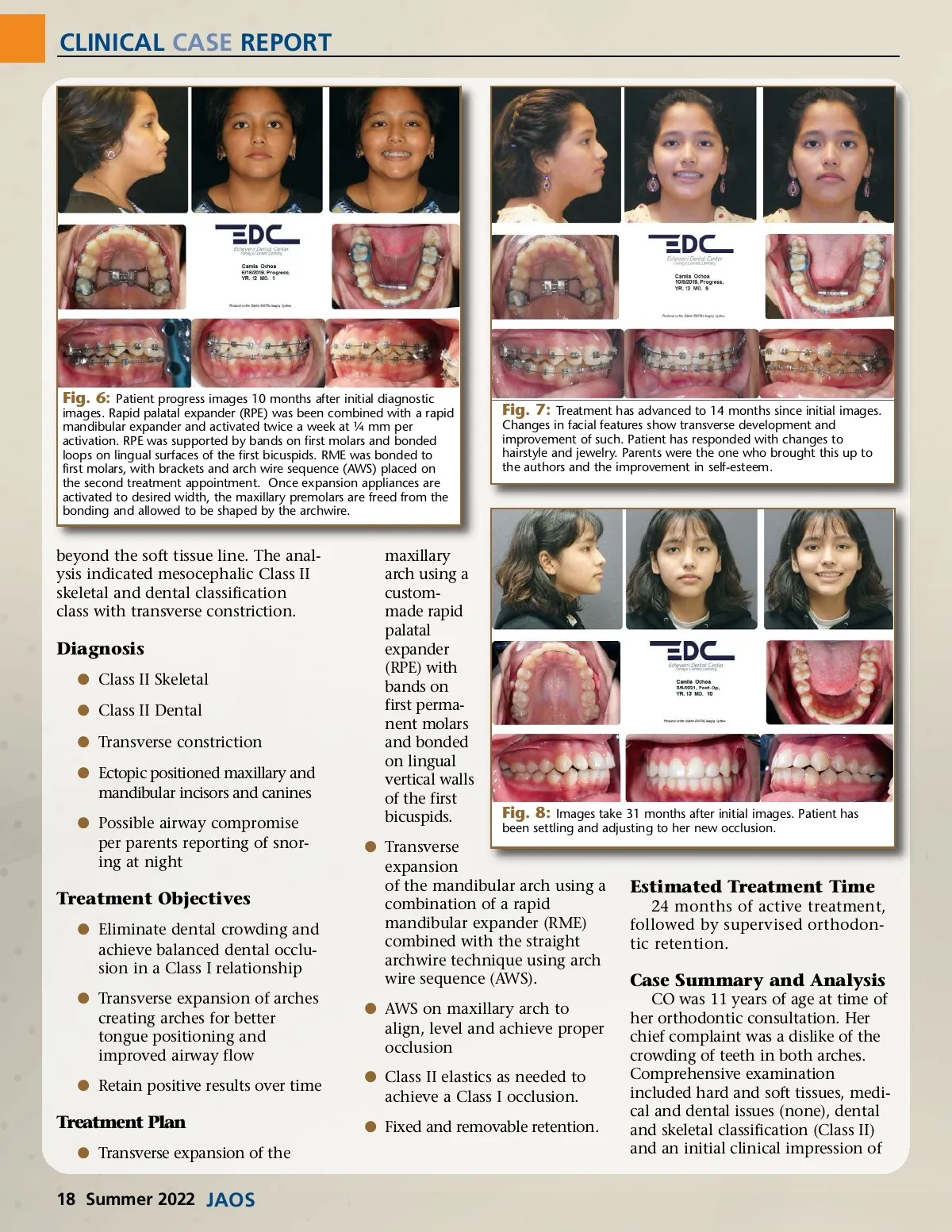
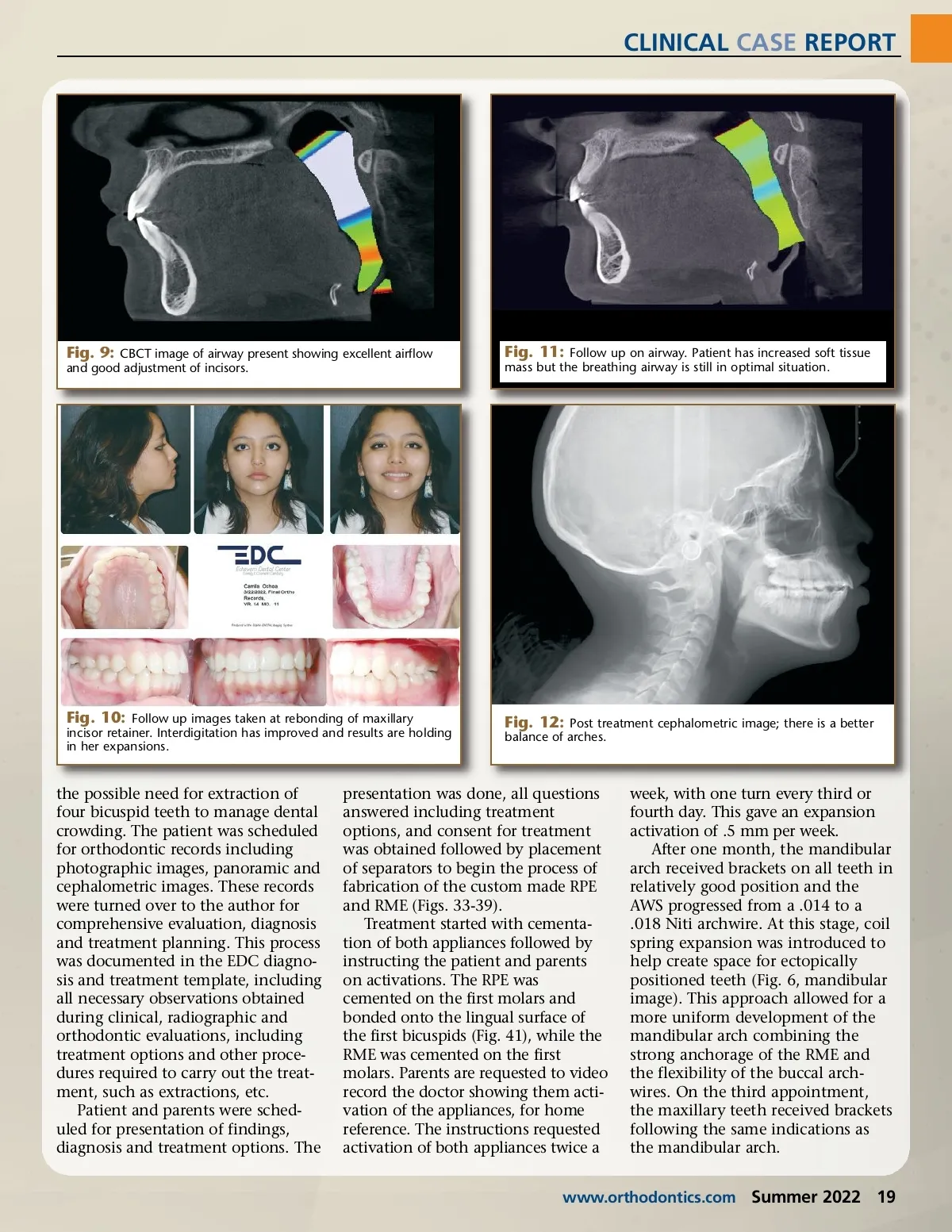
CLINICAL CASE REPORT Fig. 6: Patient progress images 10 months after initial diagnostic images. Rapid palatal expander (RPE) was been combined with a rapid mandibular expander and activated twice a week at ¼ mm per activation. RPE was supported by bands on first molars and bonded loops on lingual surfaces of the first bicuspids. RME was bonded to first molars, with brackets and arch wire sequence (AWS) placed on the second treatment appointment. Once expansion appliances are activated to desired width, the maxillary premolars are freed from the bonding and allowed to be shaped by the archwire. Fig. 7: Treatment has advanced to 14 months since initial images. Changes in facial features show transverse development and improvement of such. Patient has responded with changes to hairstyle and jewelry. Parents were the one who brought this up to the authors and the improvement in self-esteem. beyond the soft tissue line. The anal-ysis indicated mesocephalic Class II skeletal and dental classification class with transverse constriction. Diagnosis b Class II Skeletal b Class II Dental b Transverse constriction b Ectopic positioned maxillary and mandibular incisors and canines b Possible airway compromise per parents reporting of snor-ing at night maxillary arch using a custom-made rapid palatal expander (RPE) with bands on first perma-nent molars and bonded on lingual vertical walls of the first bicuspids. Fig. 8: Images take 31 months after initial images. Patient has been settling and adjusting to her new occlusion. Treatment Objectives b Eliminate dental crowding and achieve balanced dental occlu-sion in a Class I relationship b Transverse expansion of arches creating arches for better tongue positioning and improved airway flow b Retain positive results over time b Transverse expansion of the mandibular arch using a combination of a rapid mandibular expander (RME) combined with the straight archwire technique using arch wire sequence (AWS). b AWS on maxillary arch to align, level and achieve proper occlusion b Class II elastics as needed to achieve a Class I occlusion. b Fixed and removable retention. Estimated Treatment Time 24 months of active treatment, followed by supervised orthodon-tic retention. Case Summary and Analysis CO was 11 years of age at time of her orthodontic consultation. Her chief complaint was a dislike of the crowding of teeth in both arches. Comprehensive examination included hard and soft tissues, medi-cal and dental issues (none), dental and skeletal classification (Class II) and an initial clinical impression of Treatment Plan b Transverse expansion of the 18 Summer 2022 JAOS
Journal of the American Orthodontic Society Summer 2022: Page 18