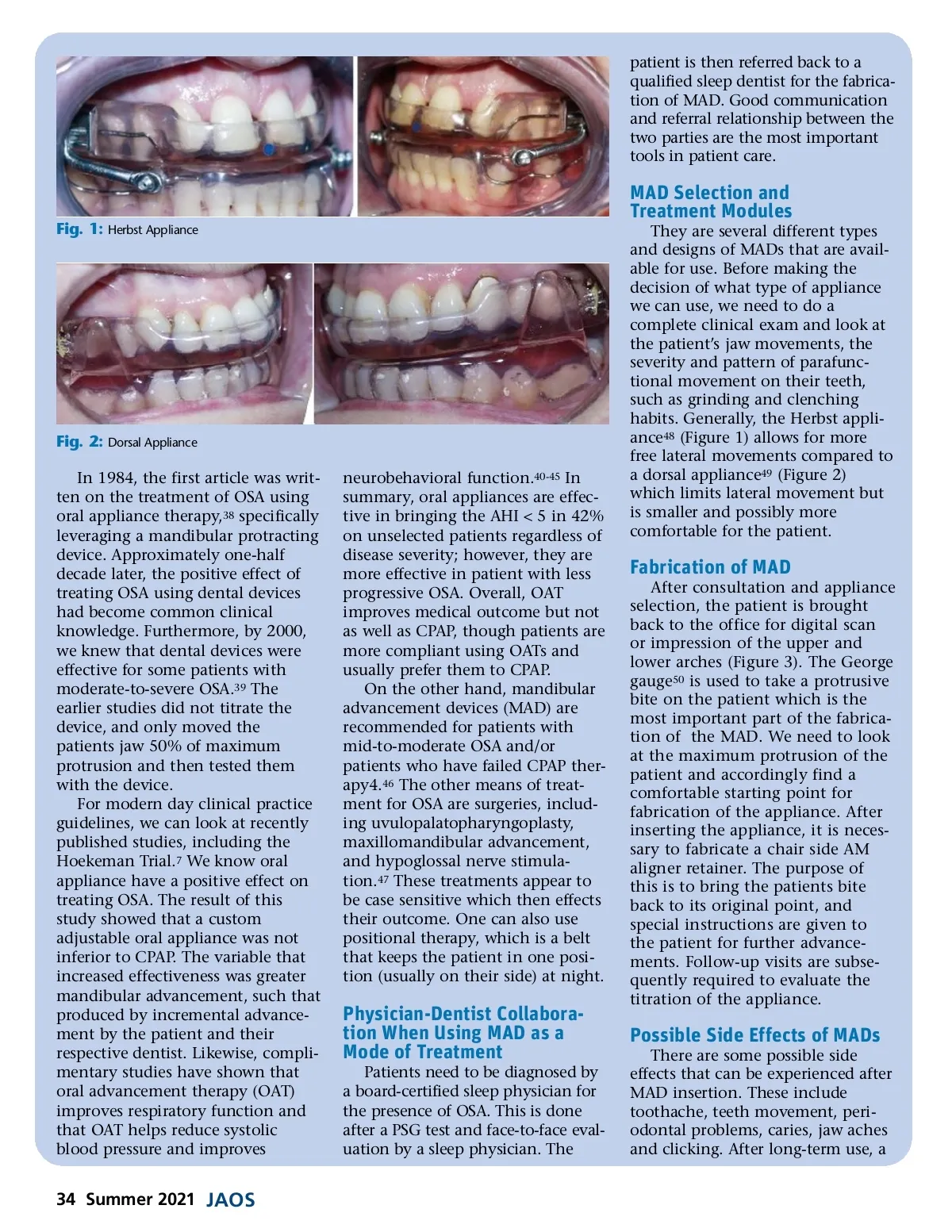
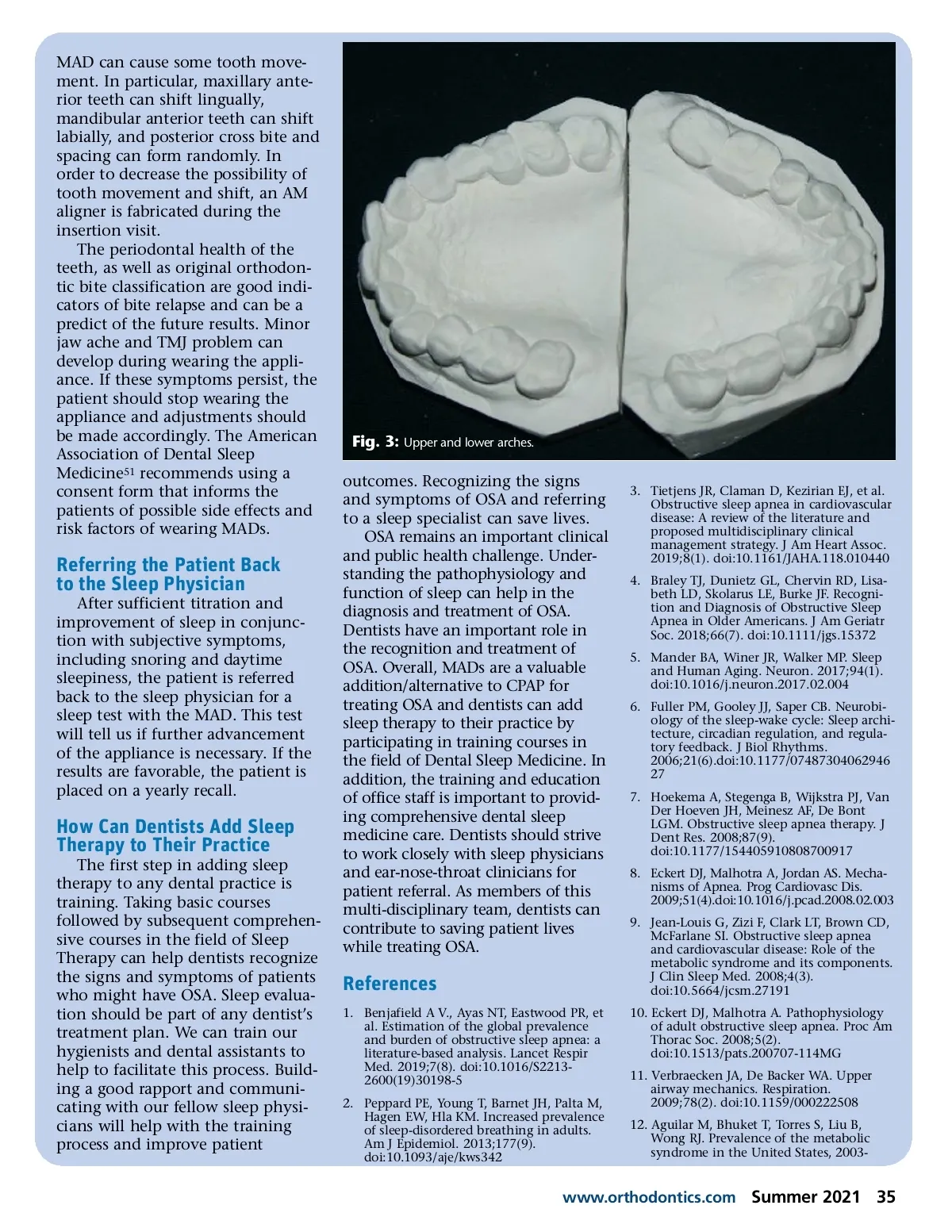
patient is then referred back to a qualified sleep dentist for the fabrica-tion of MAD. Good communication and referral relationship between the two parties are the most important tools in patient care. MAD Selection and Treatment Modules Fig. 1: Herbst Appliance They are several different types and designs of MADs that are avail-able for use. Before making the decision of what type of appliance we can use, we need to do a complete clinical exam and look at the patient’s jaw movements, the severity and pattern of parafunc-tional movement on their teeth, such as grinding and clenching habits. Generally, the Herbst appli-ance 48 (Figure 1) allows for more free lateral movements compared to a dorsal appliance 49 (Figure 2) which limits lateral movement but is smaller and possibly more comfortable for the patient. Fig. 2: Dorsal Appliance In 1984, the first article was writ-ten on the treatment of OSA using oral appliance therapy, 38 specifically leveraging a mandibular protracting device. Approximately one-half decade later, the positive effect of treating OSA using dental devices had become common clinical knowledge. Furthermore, by 2000, we knew that dental devices were effective for some patients with moderate-to-severe OSA. 39 The earlier studies did not titrate the device, and only moved the patients jaw 50% of maximum protrusion and then tested them with the device. For modern day clinical practice guidelines, we can look at recently published studies, including the Hoekeman Trial. 7 We know oral appliance have a positive effect on treating OSA. The result of this study showed that a custom adjustable oral appliance was not inferior to CPAP. The variable that increased effectiveness was greater mandibular advancement, such that produced by incremental advance-ment by the patient and their respective dentist. Likewise, compli-mentary studies have shown that oral advancement therapy (OAT) improves respiratory function and that OAT helps reduce systolic blood pressure and improves neurobehavioral function. 40-45 In summary, oral appliances are effec-tive in bringing the AHI < 5 in 42% on unselected patients regardless of disease severity; however, they are more effective in patient with less progressive OSA. Overall, OAT improves medical outcome but not as well as CPAP, though patients are more compliant using OATs and usually prefer them to CPAP. On the other hand, mandibular advancement devices (MAD) are recommended for patients with mid-to-moderate OSA and/or patients who have failed CPAP ther-apy4. 46 The other means of treat-ment for OSA are surgeries, includ-ing uvulopalatopharyngoplasty, maxillomandibular advancement, and hypoglossal nerve stimula-tion. 47 These treatments appear to be case sensitive which then effects their outcome. One can also use positional therapy, which is a belt that keeps the patient in one posi-tion (usually on their side) at night. Fabrication of MAD After consultation and appliance selection, the patient is brought back to the office for digital scan or impression of the upper and lower arches (Figure 3). The George gauge 50 is used to take a protrusive bite on the patient which is the most important part of the fabrica-tion of the MAD. We need to look at the maximum protrusion of the patient and accordingly find a comfortable starting point for fabrication of the appliance. After inserting the appliance, it is neces-sary to fabricate a chair side AM aligner retainer. The purpose of this is to bring the patients bite back to its original point, and special instructions are given to the patient for further advance-ments. Follow-up visits are subse-quently required to evaluate the titration of the appliance. Physician-Dentist Collabora-tion When Using MAD as a Mode of Treatment Patients need to be diagnosed by a board-certified sleep physician for the presence of OSA. This is done after a PSG test and face-to-face eval-uation by a sleep physician. The Possible Side Effects of MADs There are some possible side effects that can be experienced after MAD insertion. These include toothache, teeth movement, peri-odontal problems, caries, jaw aches and clicking. After long-term use, a 34 Summer 2021 JAOS
Journal of the American Orthodontic Society Summer 2021: Page 34