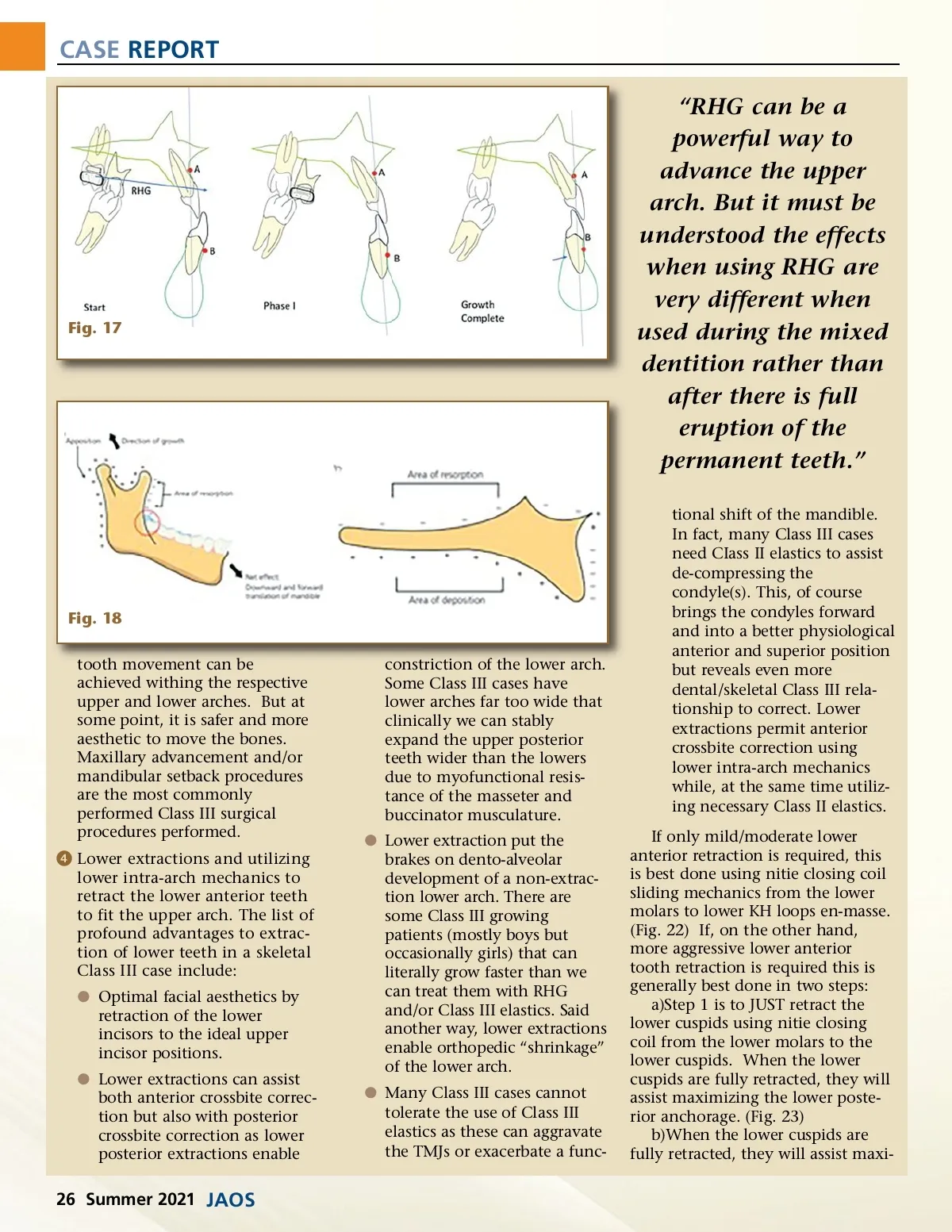
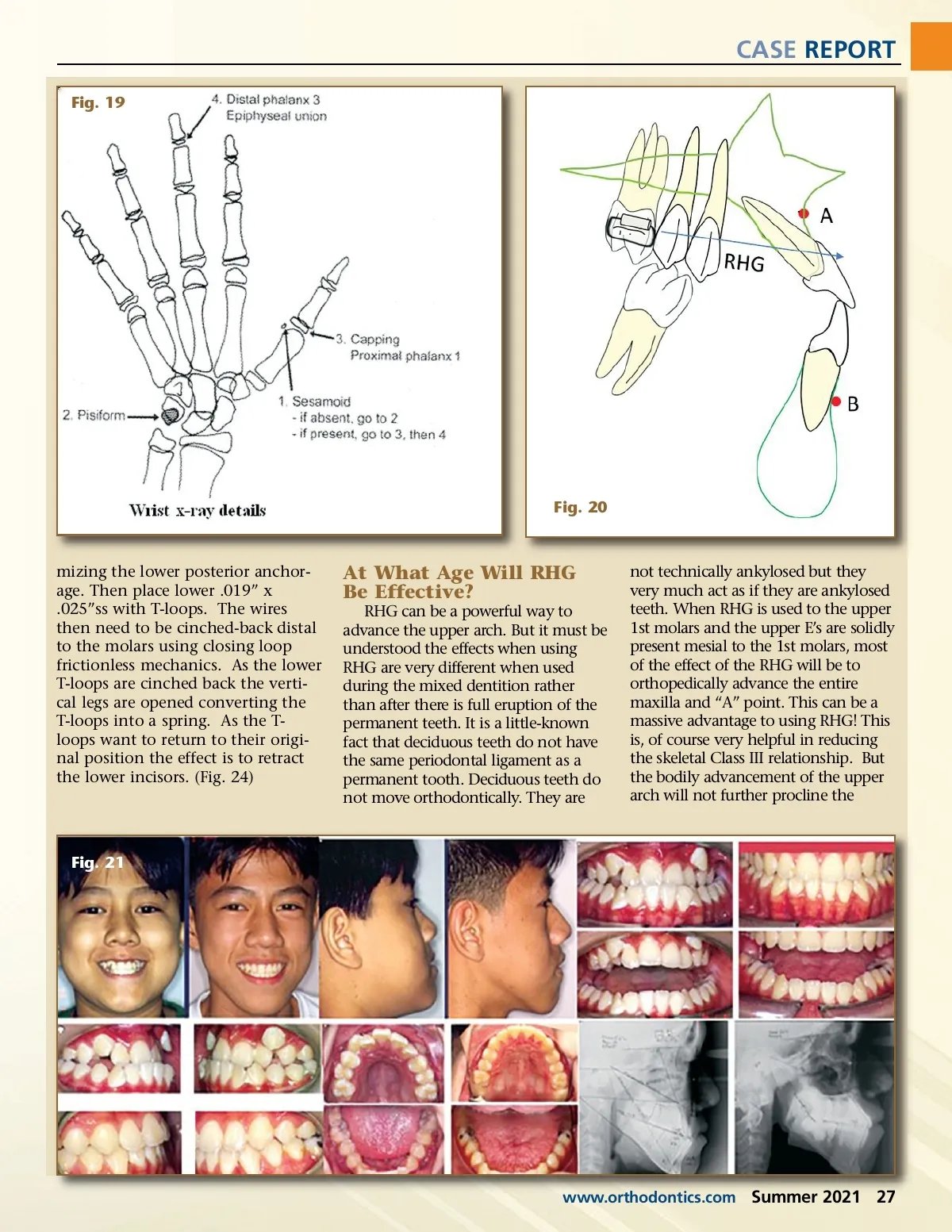
CASE REPORT “RHG can be a powerful way to advance the upper arch. But it must be understood the effects when using RHG are very different when used during the mixed dentition rather than after there is full eruption of the permanent teeth.” tional shift of the mandible. In fact, many Class III cases need CIass II elastics to assist de-compressing the condyle(s). This, of course brings the condyles forward and into a better physiological anterior and superior position but reveals even more dental/skeletal Class III rela-tionship to correct. Lower extractions permit anterior crossbite correction using lower intra-arch mechanics while, at the same time utiliz-ing necessary Class II elastics. If only mild/moderate lower anterior retraction is required, this is best done using nitie closing coil sliding mechanics from the lower molars to lower KH loops en-masse. (Fig. 22) If, on the other hand, more aggressive lower anterior tooth retraction is required this is generally best done in two steps: a)Step 1 is to JUST retract the lower cuspids using nitie closing coil from the lower molars to the lower cuspids. When the lower cuspids are fully retracted, they will assist maximizing the lower poste-rior anchorage. (Fig. 23) b)When the lower cuspids are fully retracted, they will assist maxi-Fig. 17 Fig. 18 tooth movement can be achieved withing the respective upper and lower arches. But at some point, it is safer and more aesthetic to move the bones. Maxillary advancement and/or mandibular setback procedures are the most commonly performed Class III surgical procedures performed. ᕤ Lower extractions and utilizing lower intra-arch mechanics to retract the lower anterior teeth to fit the upper arch. The list of profound advantages to extrac-tion of lower teeth in a skeletal Class III case include: b Optimal facial aesthetics by retraction of the lower incisors to the ideal upper incisor positions. b Lower extractions can assist both anterior crossbite correc-tion but also with posterior crossbite correction as lower posterior extractions enable constriction of the lower arch. Some Class III cases have lower arches far too wide that clinically we can stably expand the upper posterior teeth wider than the lowers due to myofunctional resis-tance of the masseter and buccinator musculature. b Lower extraction put the brakes on dento-alveolar development of a non-extrac-tion lower arch. There are some Class III growing patients (mostly boys but occasionally girls) that can literally grow faster than we can treat them with RHG and/or Class III elastics. Said another way, lower extractions enable orthopedic “shrinkage” of the lower arch. b Many Class III cases cannot tolerate the use of Class III elastics as these can aggravate the TMJs or exacerbate a func-26 Summer 2021 JAOS
Journal of the American Orthodontic Society Summer 2021: Page 26