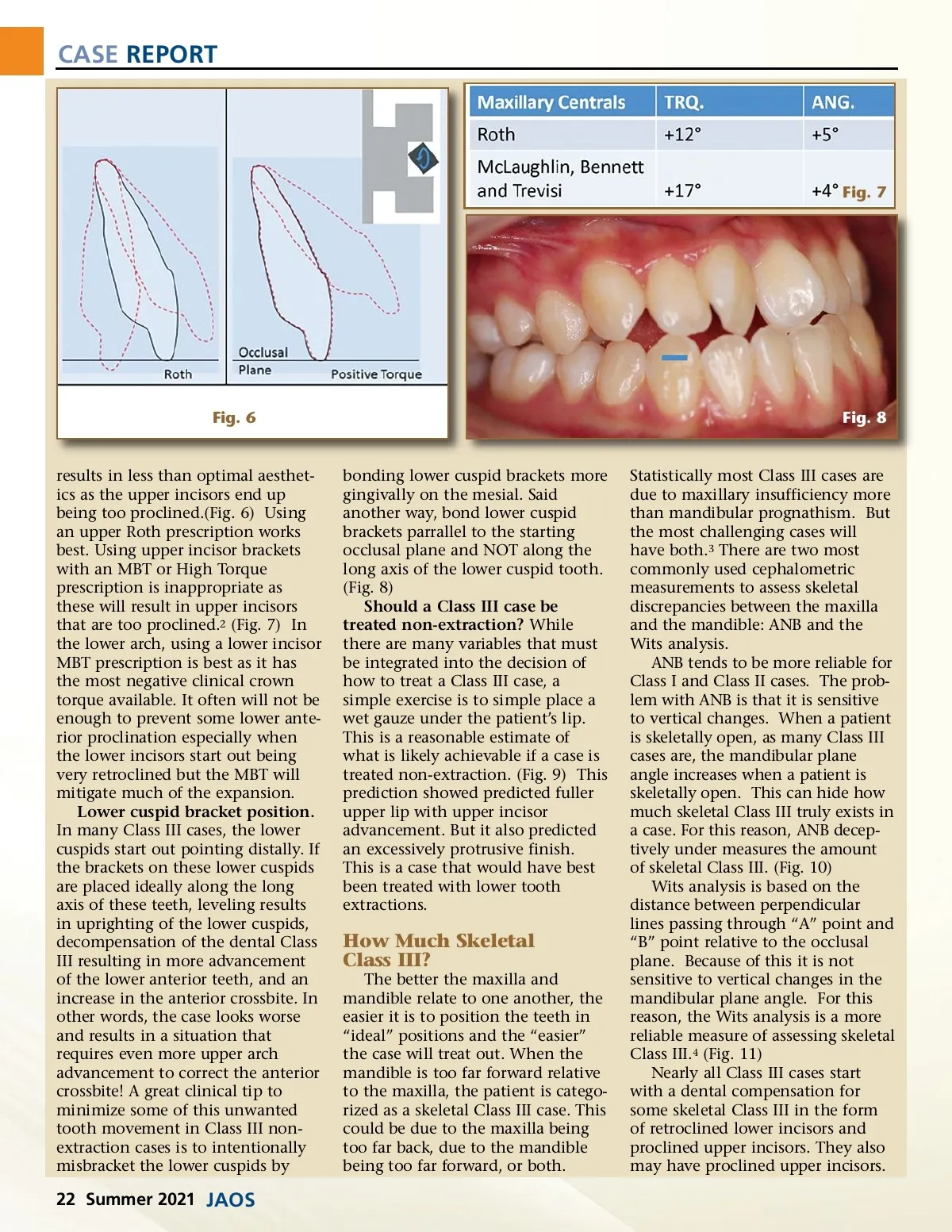
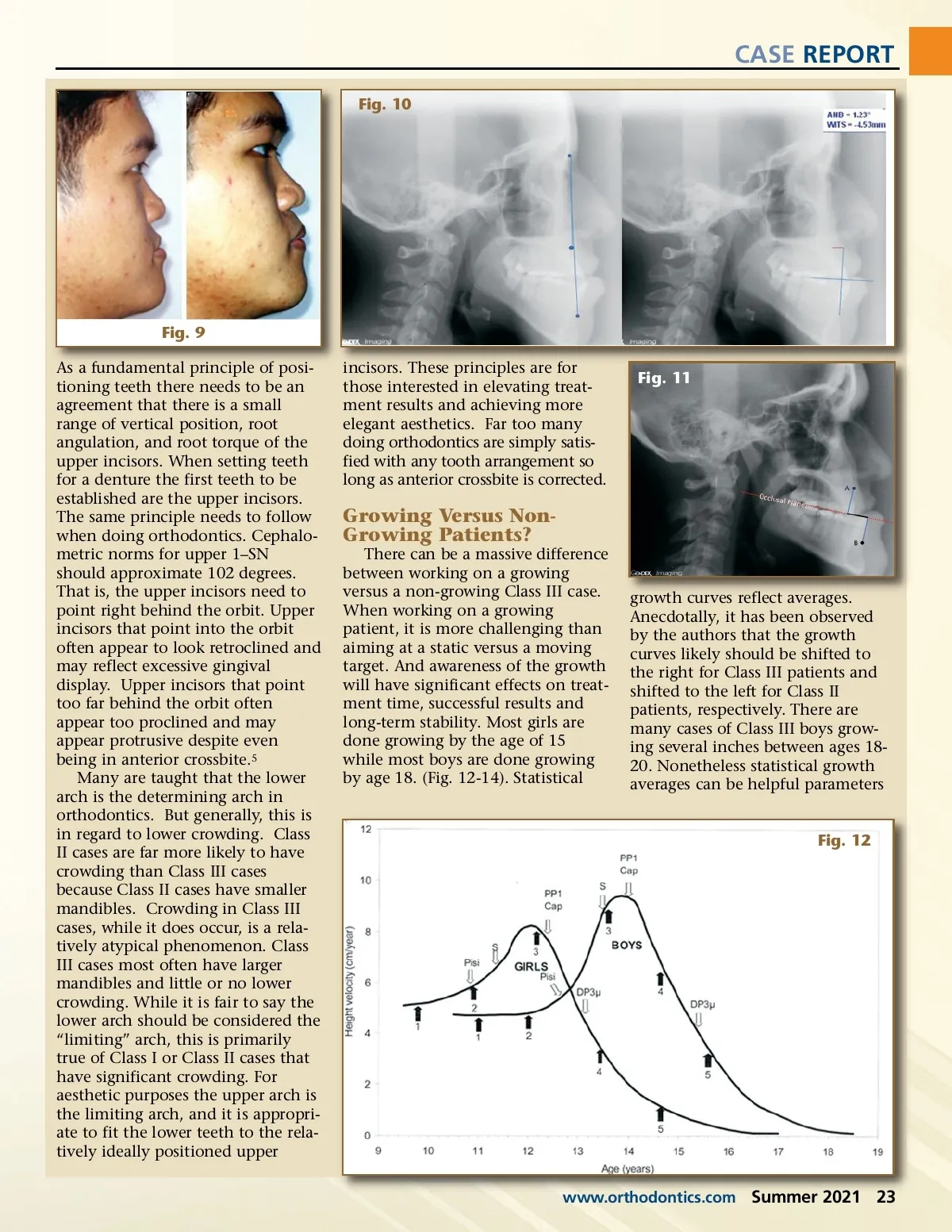
CASE REPORT Fig. 10 Fig. 9 As a fundamental principle of posi-tioning teeth there needs to be an agreement that there is a small range of vertical position, root angulation, and root torque of the upper incisors. When setting teeth for a denture the first teeth to be established are the upper incisors. The same principle needs to follow when doing orthodontics. Cephalo-metric norms for upper 1–SN should approximate 102 degrees. That is, the upper incisors need to point right behind the orbit. Upper incisors that point into the orbit often appear to look retroclined and may reflect excessive gingival display. Upper incisors that point too far behind the orbit often appear too proclined and may appear protrusive despite even being in anterior crossbite. 5 Many are taught that the lower arch is the determining arch in orthodontics. But generally, this is in regard to lower crowding. Class II cases are far more likely to have crowding than Class III cases because Class II cases have smaller mandibles. Crowding in Class III cases, while it does occur, is a rela-tively atypical phenomenon. Class III cases most often have larger mandibles and little or no lower crowding. While it is fair to say the lower arch should be considered the “limiting” arch, this is primarily true of Class I or Class II cases that have significant crowding. For aesthetic purposes the upper arch is the limiting arch, and it is appropri-ate to fit the lower teeth to the rela-tively ideally positioned upper incisors. These principles are for those interested in elevating treat-ment results and achieving more elegant aesthetics. Far too many doing orthodontics are simply satis-fied with any tooth arrangement so long as anterior crossbite is corrected. Fig. 11 Growing Versus Non-Growing Patients? There can be a massive difference between working on a growing versus a non-growing Class III case. When working on a growing patient, it is more challenging than aiming at a static versus a moving target. And awareness of the growth will have significant effects on treat-ment time, successful results and long-term stability. Most girls are done growing by the age of 15 while most boys are done growing by age 18. (Fig. 12-14). Statistical growth curves reflect averages. Anecdotally, it has been observed by the authors that the growth curves likely should be shifted to the right for Class III patients and shifted to the left for Class II patients, respectively. There are many cases of Class III boys grow-ing several inches between ages 18-20. Nonetheless statistical growth averages can be helpful parameters Fig. 12 www.orthodontics.com Summer 2021 23
Journal of the American Orthodontic Society Summer 2021: Page 23