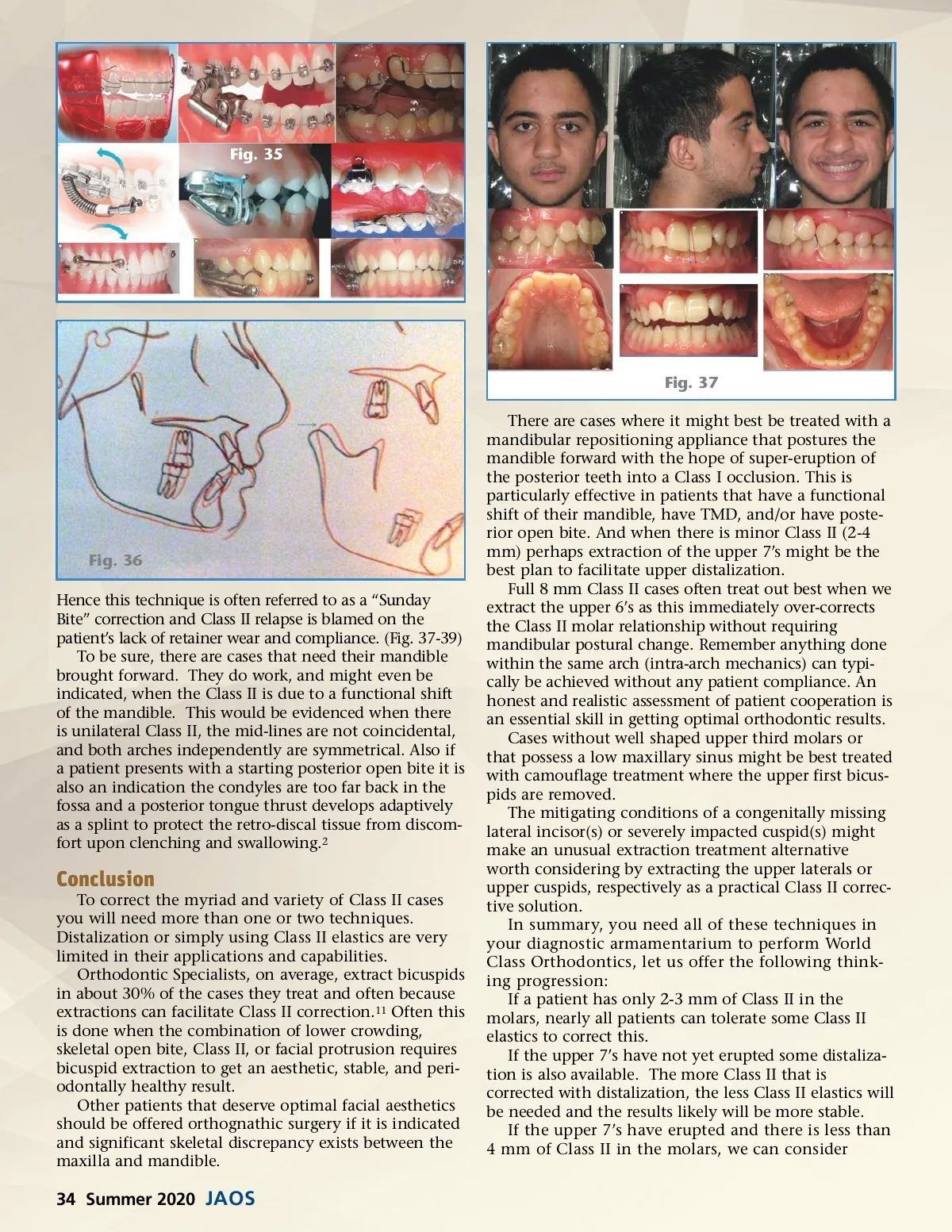
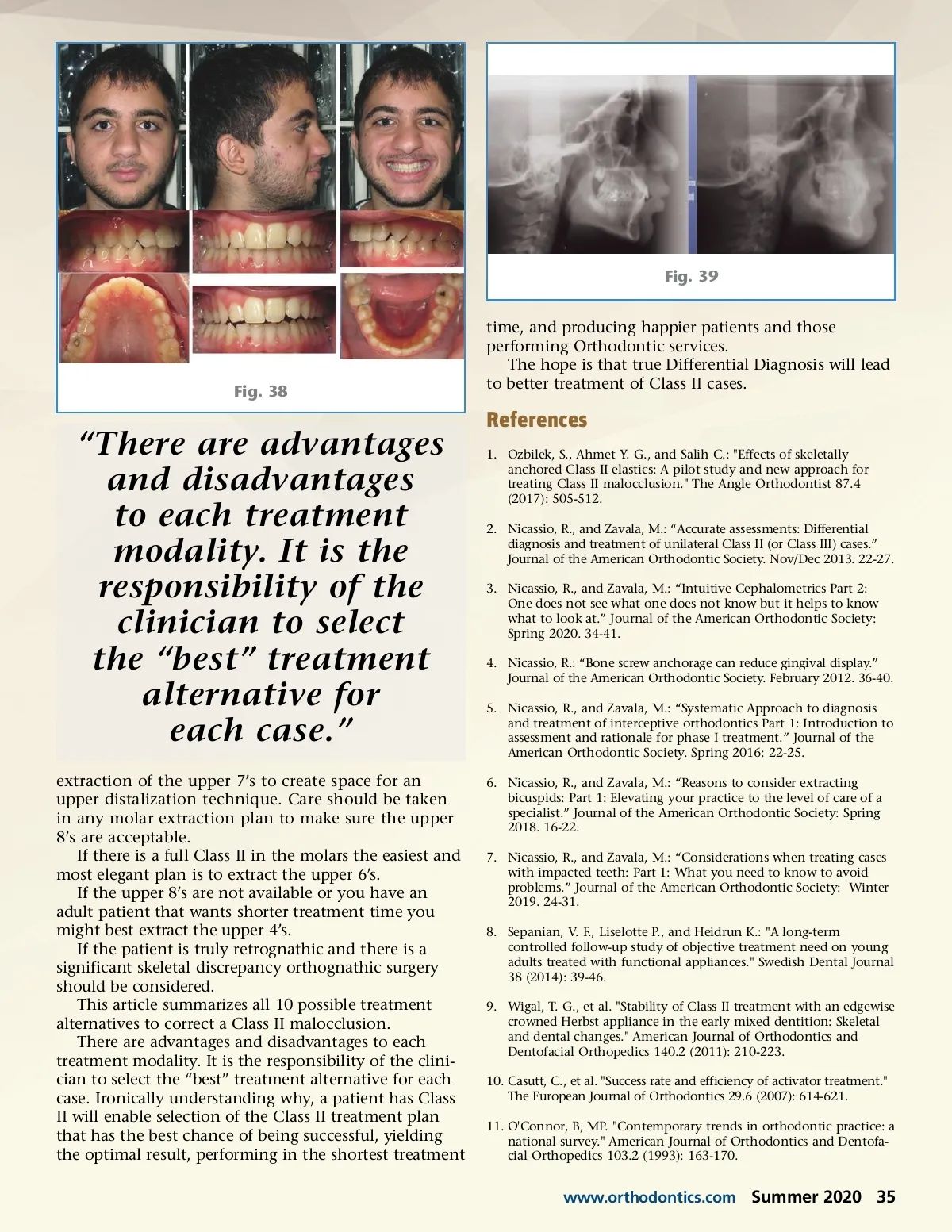
Fig. 35 Fig. 37 There are cases where it might best be treated with a mandibular repositioning appliance that postures the mandible forward with the hope of super-eruption of the posterior teeth into a Class I occlusion. This is particularly effective in patients that have a functional shift of their mandible, have TMD, and/or have poste-rior open bite. And when there is minor Class II (2-4 mm) perhaps extraction of the upper 7’s might be the best plan to facilitate upper distalization. Full 8 mm Class II cases often treat out best when we extract the upper 6’s as this immediately over-corrects the Class II molar relationship without requiring mandibular postural change. Remember anything done within the same arch (intra-arch mechanics) can typi-cally be achieved without any patient compliance. An honest and realistic assessment of patient cooperation is an essential skill in getting optimal orthodontic results. Cases without well shaped upper third molars or that possess a low maxillary sinus might be best treated with camouflage treatment where the upper first bicus-pids are removed. The mitigating conditions of a congenitally missing lateral incisor(s) or severely impacted cuspid(s) might make an unusual extraction treatment alternative worth considering by extracting the upper laterals or upper cuspids, respectively as a practical Class II correc-tive solution. In summary, you need all of these techniques in your diagnostic armamentarium to perform World Class Orthodontics, let us offer the following think-ing progression: If a patient has only 2-3 mm of Class II in the molars, nearly all patients can tolerate some Class II elastics to correct this. If the upper 7’s have not yet erupted some distaliza-tion is also available. The more Class II that is corrected with distalization, the less Class II elastics will be needed and the results likely will be more stable. If the upper 7’s have erupted and there is less than 4 mm of Class II in the molars, we can consider Fig. 36 Hence this technique is often referred to as a “Sunday Bite” correction and Class II relapse is blamed on the patient’s lack of retainer wear and compliance. (Fig. 37-39) To be sure, there are cases that need their mandible brought forward. They do work, and might even be indicated, when the Class II is due to a functional shift of the mandible. This would be evidenced when there is unilateral Class II, the mid-lines are not coincidental, and both arches independently are symmetrical. Also if a patient presents with a starting posterior open bite it is also an indication the condyles are too far back in the fossa and a posterior tongue thrust develops adaptively as a splint to protect the retro-discal tissue from discom-fort upon clenching and swallowing. 2 Conclusion To correct the myriad and variety of Class II cases you will need more than one or two techniques. Distalization or simply using Class II elastics are very limited in their applications and capabilities. Orthodontic Specialists, on average, extract bicuspids in about 30% of the cases they treat and often because extractions can facilitate Class II correction. 11 Often this is done when the combination of lower crowding, skeletal open bite, Class II, or facial protrusion requires bicuspid extraction to get an aesthetic, stable, and peri-odontally healthy result. Other patients that deserve optimal facial aesthetics should be offered orthognathic surgery if it is indicated and significant skeletal discrepancy exists between the maxilla and mandible. 34 Summer 2020 JAOS
Journal of the American Orthodontic Society Summer 2020: Page 34