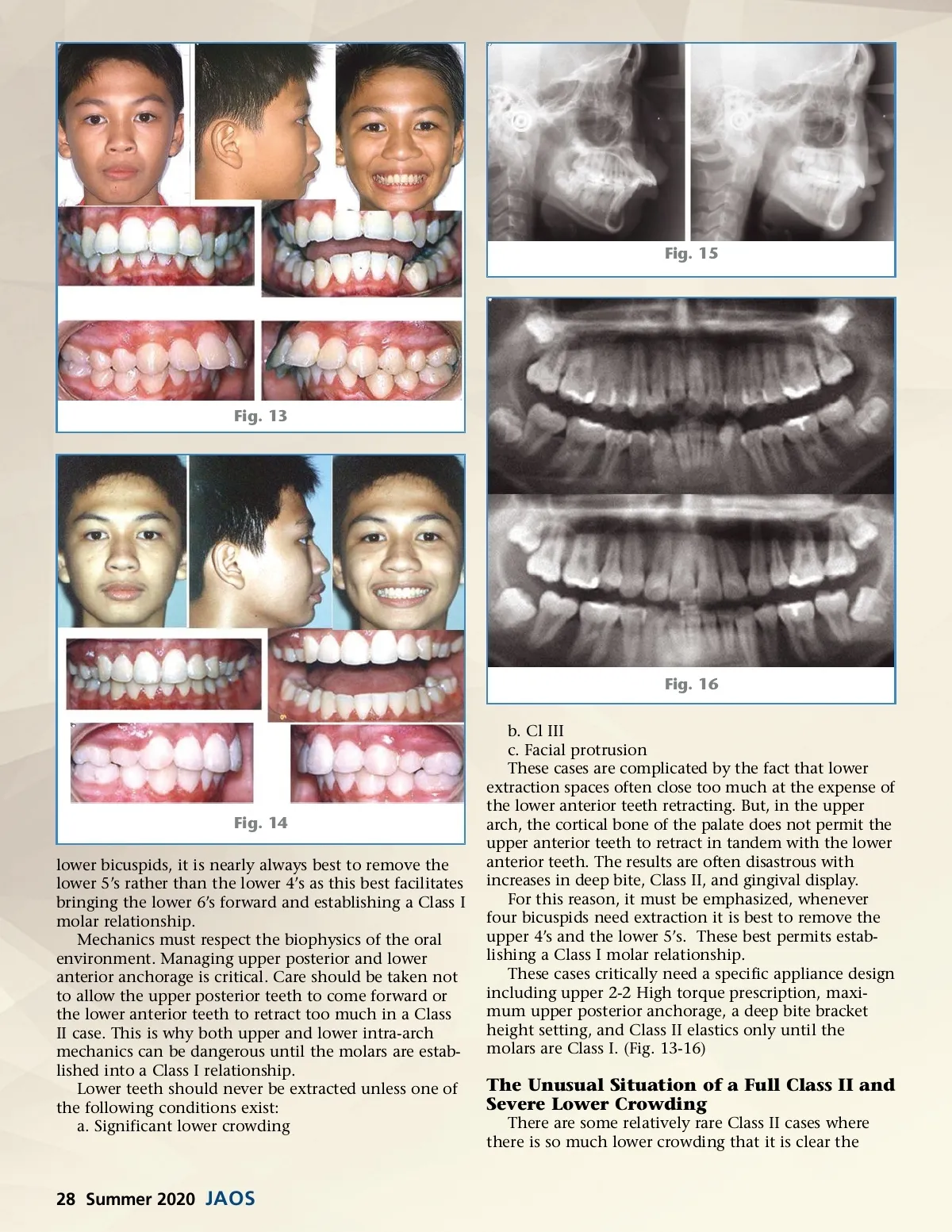
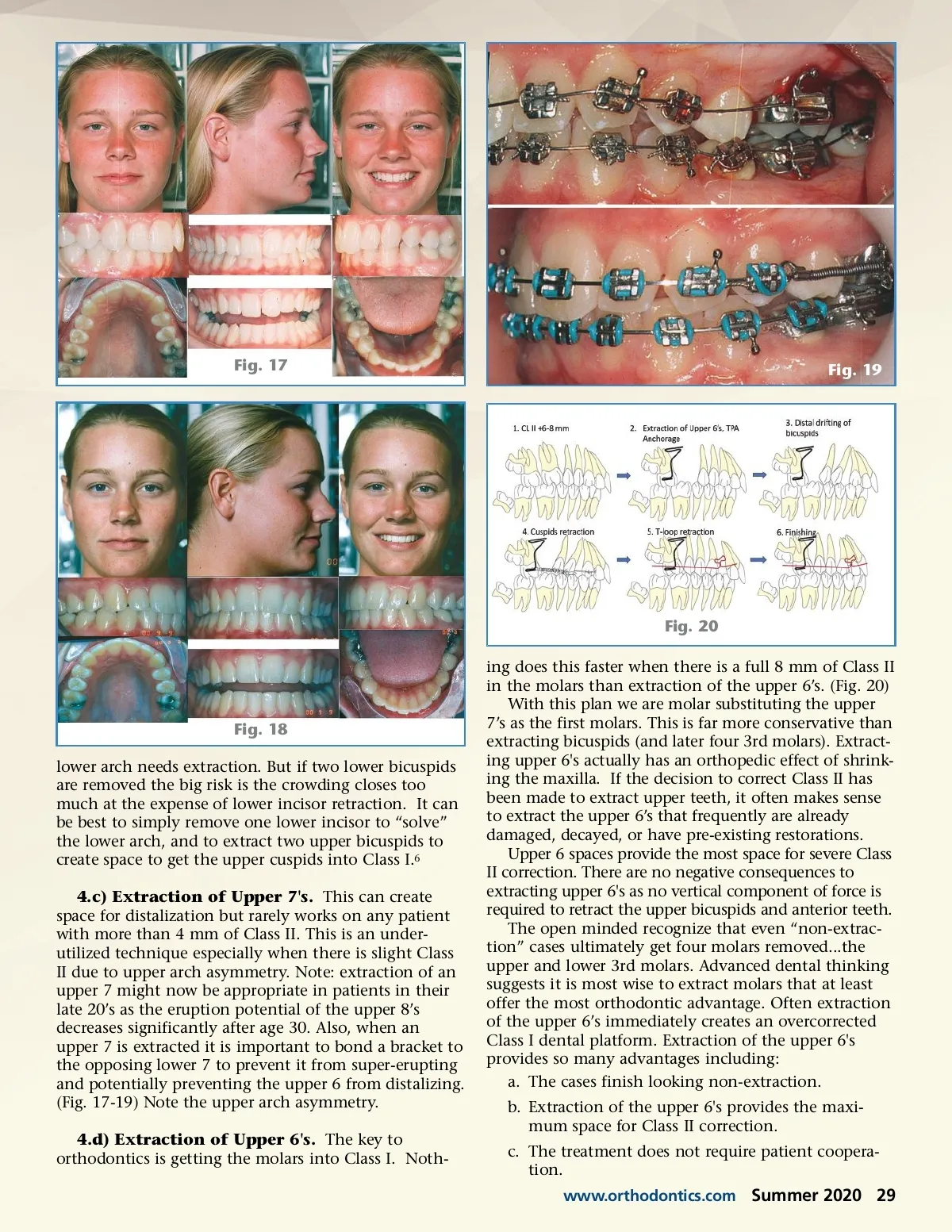
Fig. 17 Fig. 19 Fig. 20 ing does this faster when there is a full 8 mm of Class II in the molars than extraction of the upper 6’s. (Fig. 20) With this plan we are molar substituting the upper 7’s as the first molars. This is far more conservative than extracting bicuspids (and later four 3rd molars). Extract-ing upper 6's actually has an orthopedic effect of shrink-ing the maxilla. If the decision to correct Class II has been made to extract upper teeth, it often makes sense to extract the upper 6’s that frequently are already damaged, decayed, or have pre-existing restorations. Upper 6 spaces provide the most space for severe Class II correction. There are no negative consequences to extracting upper 6's as no vertical component of force is required to retract the upper bicuspids and anterior teeth. The open minded recognize that even “non-extrac-tion” cases ultimately get four molars removed...the upper and lower 3rd molars. Advanced dental thinking suggests it is most wise to extract molars that at least offer the most orthodontic advantage. Often extraction of the upper 6’s immediately creates an overcorrected Class I dental platform. Extraction of the upper 6's provides so many advantages including: a. The cases finish looking non-extraction. b. Extraction of the upper 6's provides the maxi-mum space for Class II correction. c. The treatment does not require patient coopera-tion. www.orthodontics.com Fig. 18 lower arch needs extraction. But if two lower bicuspids are removed the big risk is the crowding closes too much at the expense of lower incisor retraction. It can be best to simply remove one lower incisor to “solve” the lower arch, and to extract two upper bicuspids to create space to get the upper cuspids into Class I. 6 4.c) Extraction of Upper 7's. This can create space for distalization but rarely works on any patient with more than 4 mm of Class II. This is an under-utilized technique especially when there is slight Class II due to upper arch asymmetry. Note: extraction of an upper 7 might now be appropriate in patients in their late 20’s as the eruption potential of the upper 8’s decreases significantly after age 30. Also, when an upper 7 is extracted it is important to bond a bracket to the opposing lower 7 to prevent it from super-erupting and potentially preventing the upper 6 from distalizing. (Fig. 17-19) Note the upper arch asymmetry. 4.d) Extraction of Upper 6's. The key to orthodontics is getting the molars into Class I. Noth-Summer 2020 29
Journal of the American Orthodontic Society Summer 2020: Page 29