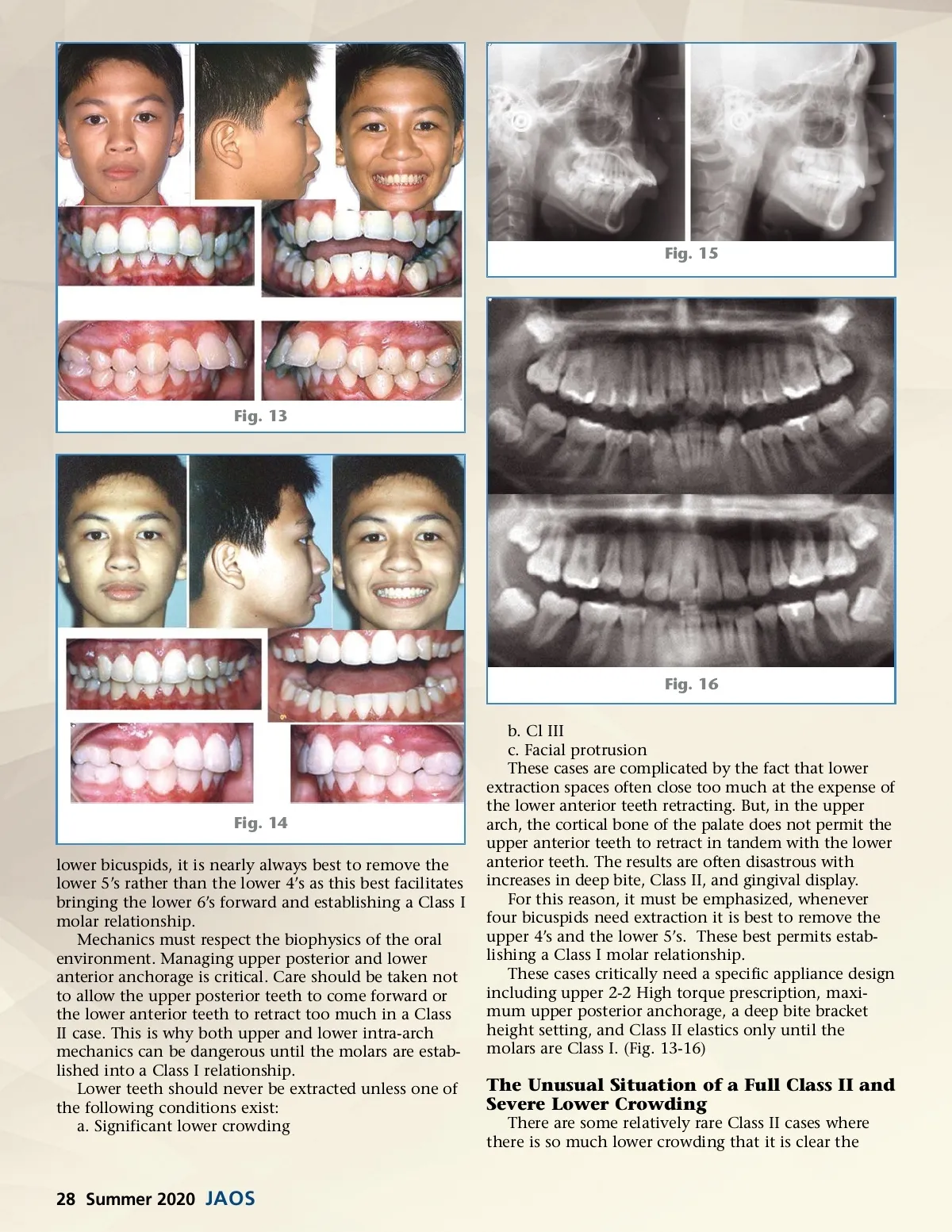
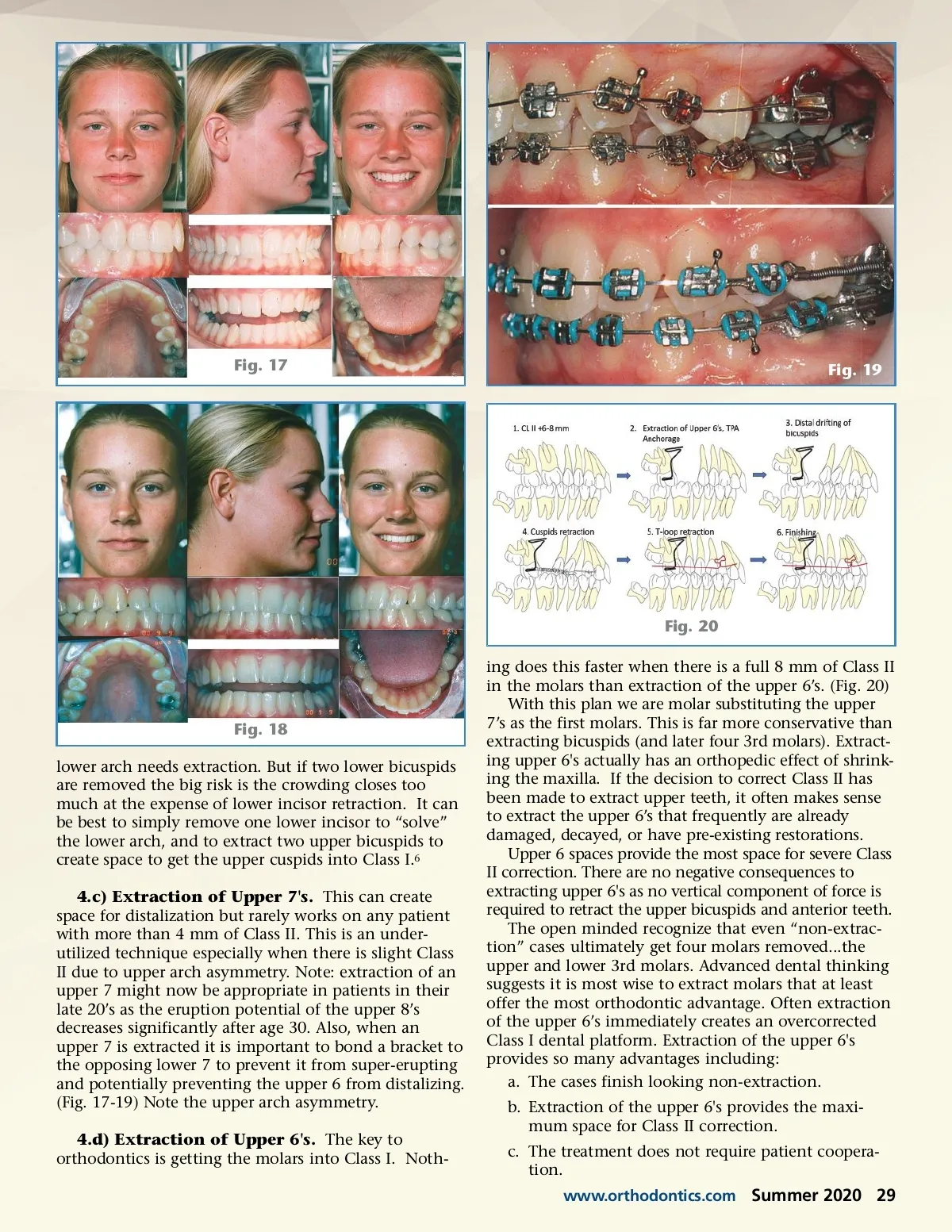
Fig. 15 Fig. 13 Fig. 16 b. Cl III c. Facial protrusion These cases are complicated by the fact that lower extraction spaces often close too much at the expense of the lower anterior teeth retracting. But, in the upper arch, the cortical bone of the palate does not permit the upper anterior teeth to retract in tandem with the lower anterior teeth. The results are often disastrous with increases in deep bite, Class II, and gingival display. For this reason, it must be emphasized, whenever four bicuspids need extraction it is best to remove the upper 4’s and the lower 5’s. These best permits estab-lishing a Class I molar relationship. These cases critically need a specific appliance design including upper 2-2 High torque prescription, maxi-mum upper posterior anchorage, a deep bite bracket height setting, and Class II elastics only until the molars are Class I. (Fig. 13-16) Fig. 14 lower bicuspids, it is nearly always best to remove the lower 5’s rather than the lower 4’s as this best facilitates bringing the lower 6’s forward and establishing a Class I molar relationship. Mechanics must respect the biophysics of the oral environment. Managing upper posterior and lower anterior anchorage is critical. Care should be taken not to allow the upper posterior teeth to come forward or the lower anterior teeth to retract too much in a Class II case. This is why both upper and lower intra-arch mechanics can be dangerous until the molars are estab-lished into a Class I relationship. Lower teeth should never be extracted unless one of the following conditions exist: a. Significant lower crowding The Unusual Situation of a Full Class II and Severe Lower Crowding There are some relatively rare Class II cases where there is so much lower crowding that it is clear the 28 Summer 2020 JAOS
Journal of the American Orthodontic Society Summer 2020: Page 28