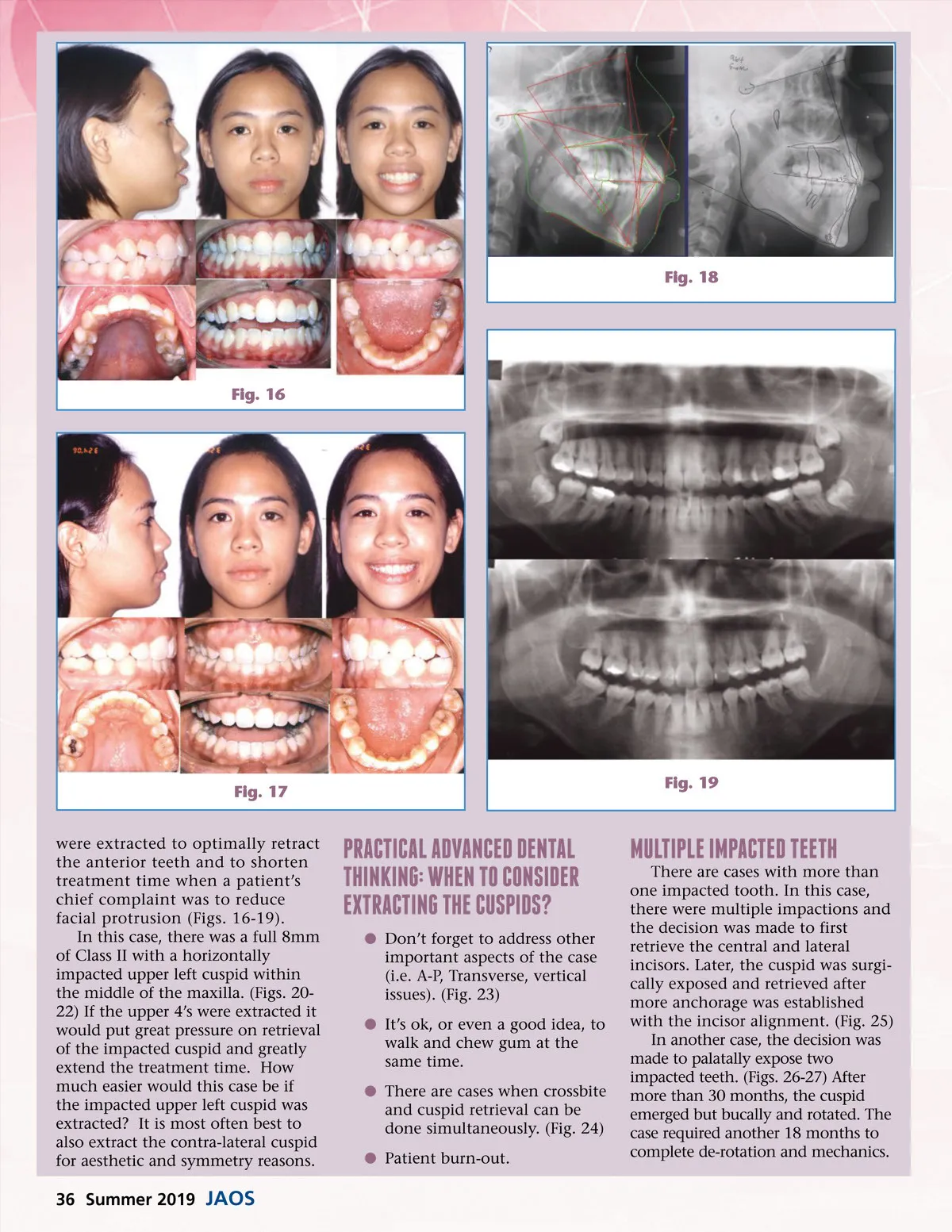
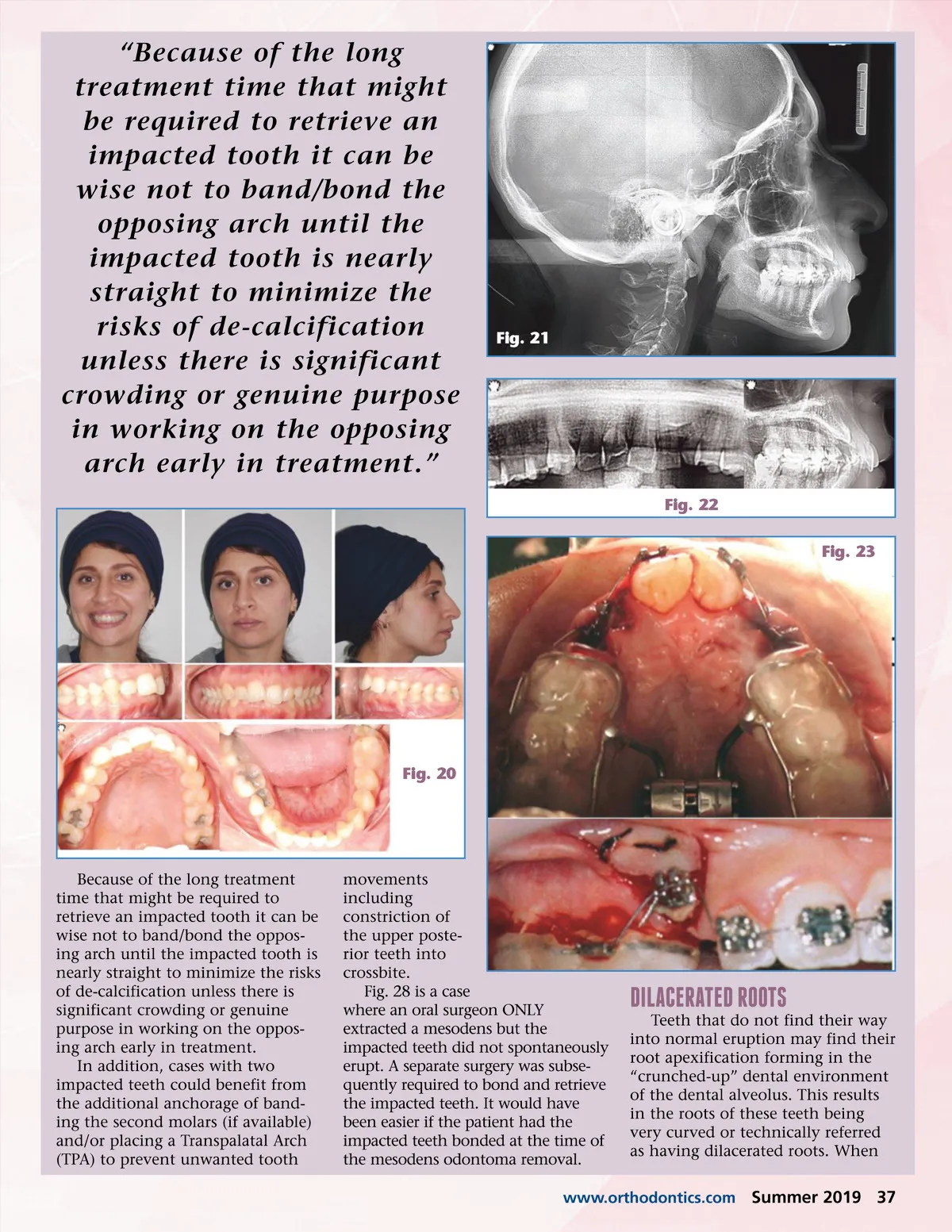
“Because of the long treatment time that might be required to retrieve an impacted tooth it can be wise not to band/bond the opposing arch until the impacted tooth is nearly straight to minimize the risks of de-calcification unless there is significant crowding or genuine purpose in working on the opposing arch early in treatment.” Fig. 21 Fig. 22 Fig. 23 Fig. 20 Because of the long treatment time that might be required to retrieve an impacted tooth it can be wise not to band/bond the oppos-ing arch until the impacted tooth is nearly straight to minimize the risks of de-calcification unless there is significant crowding or genuine purpose in working on the oppos-ing arch early in treatment. In addition, cases with two impacted teeth could benefit from the additional anchorage of band-ing the second molars (if available) and/or placing a Transpalatal Arch (TPA) to prevent unwanted tooth movements including constriction of the upper poste-rior teeth into crossbite. Fig. 28 is a case where an oral surgeon ONLY extracted a mesodens but the impacted teeth did not spontaneously erupt. A separate surgery was subse-quently required to bond and retrieve the impacted teeth. It would have been easier if the patient had the impacted teeth bonded at the time of the mesodens odontoma removal. dIlacerated roots Teeth that do not find their way into normal eruption may find their root apexification forming in the “crunched-up” dental environment of the dental alveolus. This results in the roots of these teeth being very curved or technically referred as having dilacerated roots. When www.orthodontics.com Summer 2019 37
Journal of the American Orthodontic Society Summer 2019: Page 37