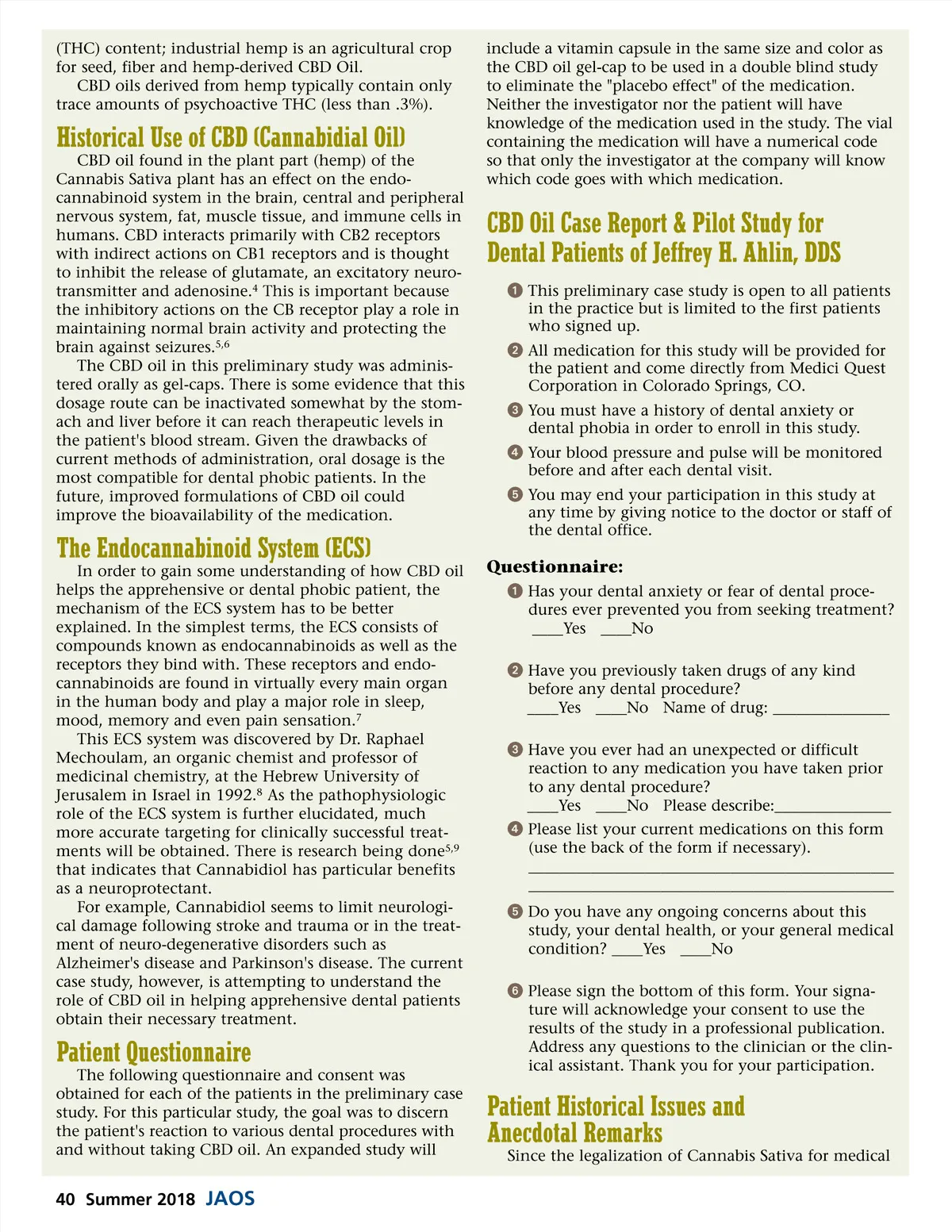
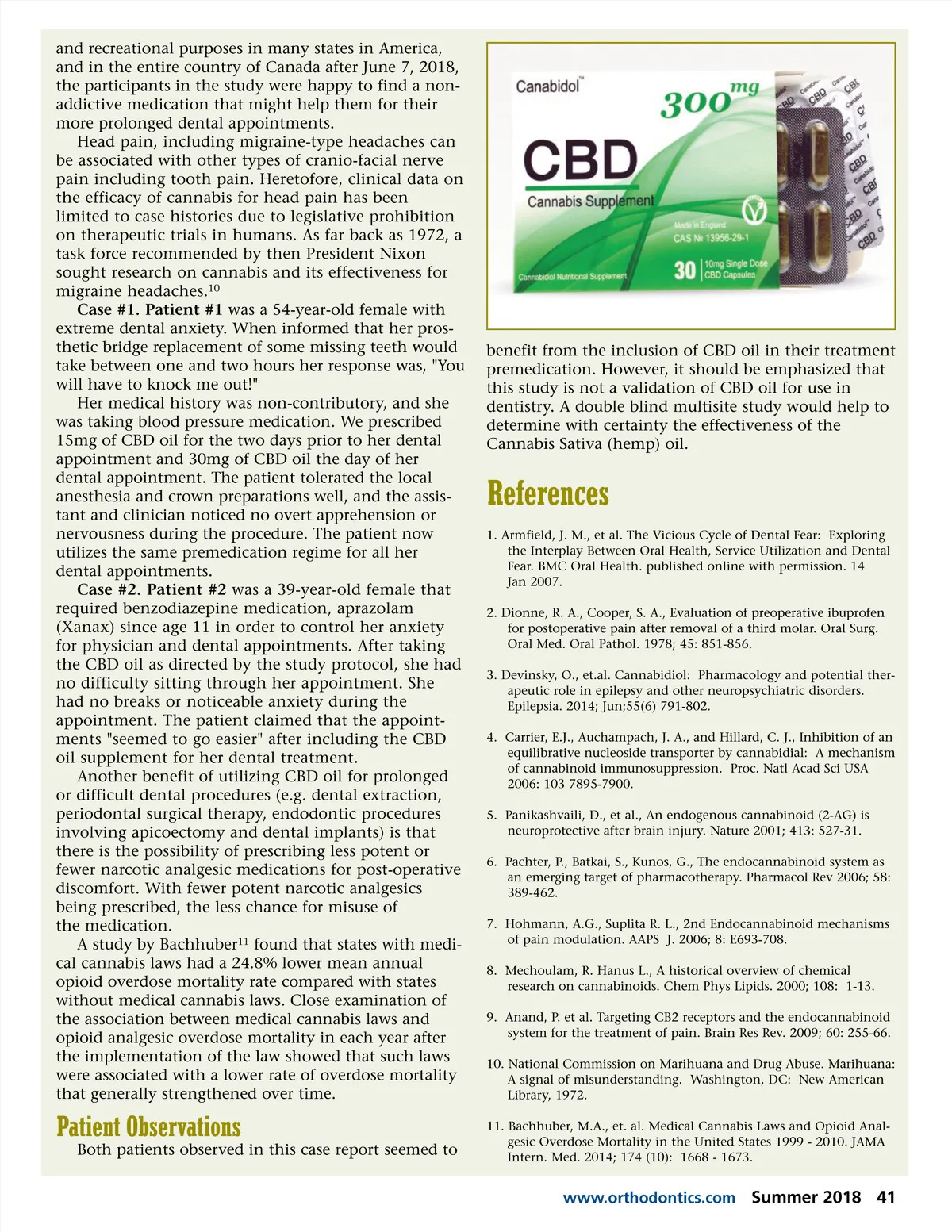
and recreational purposes in many states in America, and in the entire country of Canada after June 7, 2018, the participants in the study were happy to find a non-addictive medication that might help them for their more prolonged dental appointments. Head pain, including migraine-type headaches can be associated with other types of cranio-facial nerve pain including tooth pain. Heretofore, clinical data on the efficacy of cannabis for head pain has been limited to case histories due to legislative prohibition on therapeutic trials in humans. As far back as 1972, a task force recommended by then President Nixon sought research on cannabis and its effectiveness for migraine headaches. 10 Case #1. Patient #1 was a 54-year-old female with extreme dental anxiety. When informed that her pros-thetic bridge replacement of some missing teeth would take between one and two hours her response was, "You will have to knock me out!" Her medical history was non-contributory, and she was taking blood pressure medication. We prescribed 15mg of CBD oil for the two days prior to her dental appointment and 30mg of CBD oil the day of her dental appointment. The patient tolerated the local anesthesia and crown preparations well, and the assis-tant and clinician noticed no overt apprehension or nervousness during the procedure. The patient now utilizes the same premedication regime for all her dental appointments. Case #2. Patient #2 was a 39-year-old female that required benzodiazepine medication, aprazolam (Xanax) since age 11 in order to control her anxiety for physician and dental appointments. After taking the CBD oil as directed by the study protocol, she had no difficulty sitting through her appointment. She had no breaks or noticeable anxiety during the appointment. The patient claimed that the appoint-ments "seemed to go easier" after including the CBD oil supplement for her dental treatment. Another benefit of utilizing CBD oil for prolonged or difficult dental procedures (e.g. dental extraction, periodontal surgical therapy, endodontic procedures involving apicoectomy and dental implants) is that there is the possibility of prescribing less potent or fewer narcotic analgesic medications for post-operative discomfort. With fewer potent narcotic analgesics being prescribed, the less chance for misuse of the medication. A study by Bachhuber 11 found that states with medi-cal cannabis laws had a 24.8% lower mean annual opioid overdose mortality rate compared with states without medical cannabis laws. Close examination of the association between medical cannabis laws and opioid analgesic overdose mortality in each year after the implementation of the law showed that such laws were associated with a lower rate of overdose mortality that generally strengthened over time. benefit from the inclusion of CBD oil in their treatment premedication. However, it should be emphasized that this study is not a validation of CBD oil for use in dentistry. A double blind multisite study would help to determine with certainty the effectiveness of the Cannabis Sativa (hemp) oil. References 1. Armfield, J. M., et al. The Vicious Cycle of Dental Fear: Exploring the Interplay Between Oral Health, Service Utilization and Dental Fear. BMC Oral Health. published online with permission. 14 Jan 2007. 2. Dionne, R. A., Cooper, S. A., Evaluation of preoperative ibuprofen for postoperative pain after removal of a third molar. Oral Surg. Oral Med. Oral Pathol. 1978; 45: 851-856. 3. Devinsky, O., et.al. Cannabidiol: Pharmacology and potential ther-apeutic role in epilepsy and other neuropsychiatric disorders. Epilepsia. 2014; Jun;55(6) 791-802. 4. Carrier, E.J., Auchampach, J. A., and Hillard, C. J., Inhibition of an equilibrative nucleoside transporter by cannabidial: A mechanism of cannabinoid immunosuppression. Proc. Natl Acad Sci USA 2006: 103 7895-7900. 5. Panikashvaili, D., et al., An endogenous cannabinoid (2-AG) is neuroprotective after brain injury. Nature 2001; 413: 527-31. 6. Pachter, P., Batkai, S., Kunos, G., The endocannabinoid system as an emerging target of pharmacotherapy. Pharmacol Rev 2006; 58: 389-462. 7. Hohmann, A.G., Suplita R. L., 2nd Endocannabinoid mechanisms of pain modulation. AAPS J. 2006; 8: E693-708. 8. Mechoulam, R. Hanus L., A historical overview of chemical research on cannabinoids. Chem Phys Lipids. 2000; 108: 1-13. 9. Anand, P. et al. Targeting CB2 receptors and the endocannabinoid system for the treatment of pain. Brain Res Rev. 2009; 60: 255-66. 10. National Commission on Marihuana and Drug Abuse. Marihuana: A signal of misunderstanding. Washington, DC: New American Library, 1972. 11. Bachhuber, M.A., et. al. Medical Cannabis Laws and Opioid Anal-gesic Overdose Mortality in the United States 1999 -2010. JAMA Intern. Med. 2014; 174 (10): 1668 -1673. Patient Observations Both patients observed in this case report seemed to www.orthodontics.com Summer 2018 41
Journal of the American Orthodontic Society Summer 2018/Buyer's Guide: Page 41