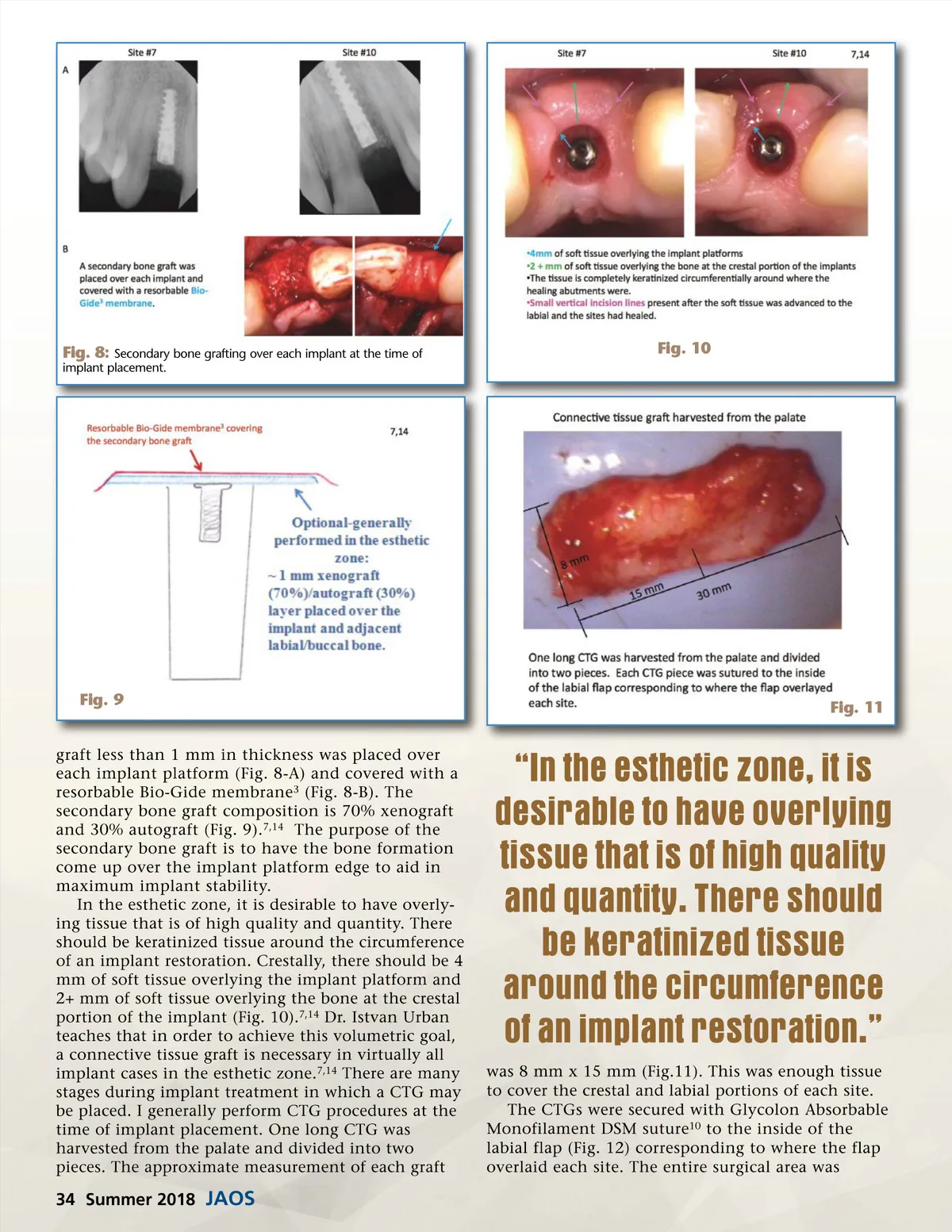
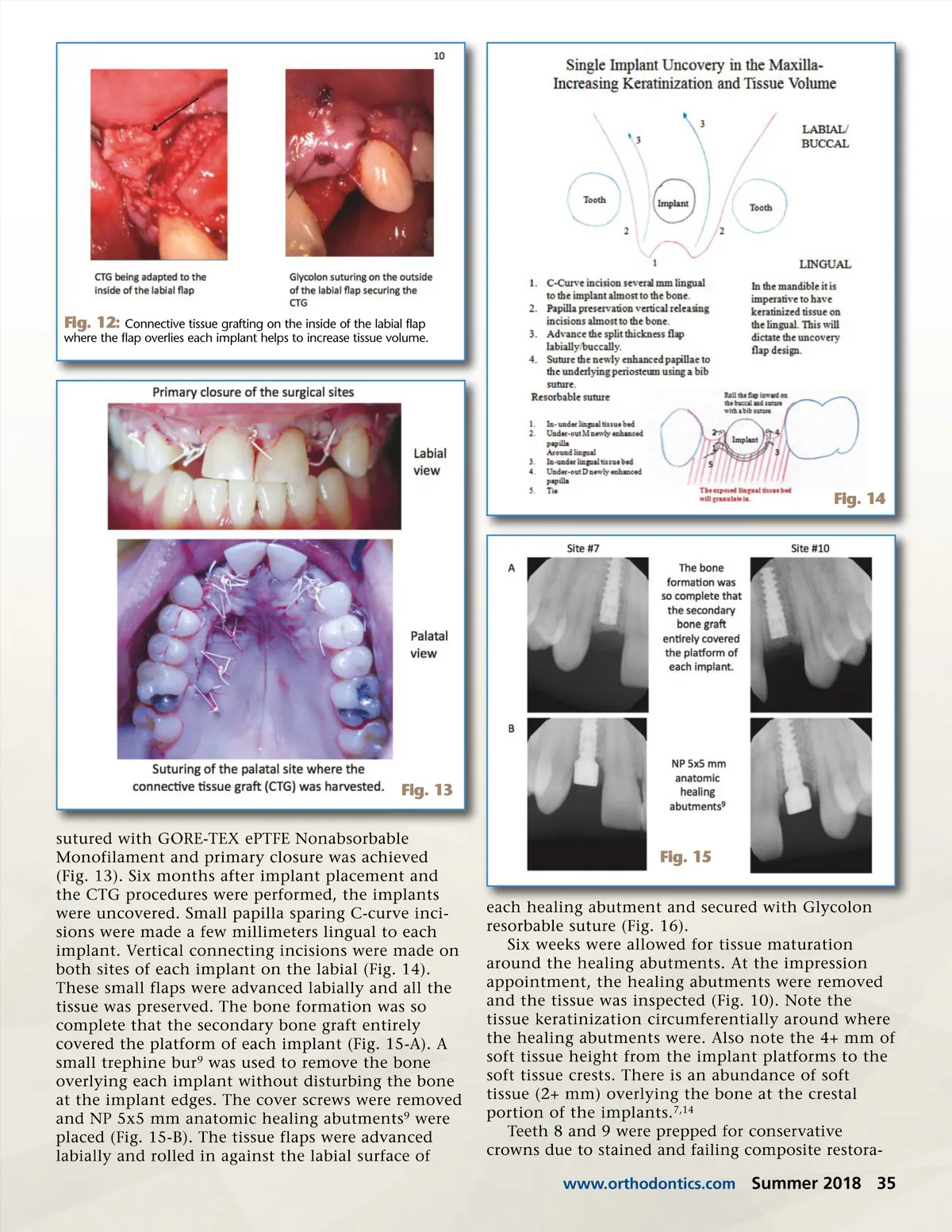
Fig. 8: Secondary bone grafting over each implant at the time of implant placement. Fig. 10 Fig. 9 Fig. 11 graft less than 1 mm in thickness was placed over each implant platform (Fig. 8-A) and covered with a resorbable Bio-Gide membrane 3 (Fig. 8-B). The secondary bone graft composition is 70% xenograft and 30% autograft (Fig. 9). 7,14 The purpose of the secondary bone graft is to have the bone formation come up over the implant platform edge to aid in maximum implant stability. In the esthetic zone, it is desirable to have overly-ing tissue that is of high quality and quantity. There should be keratinized tissue around the circumference of an implant restoration. Crestally, there should be 4 mm of soft tissue overlying the implant platform and 2+ mm of soft tissue overlying the bone at the crestal portion of the implant (Fig. 10). 7,14 Dr. Istvan Urban teaches that in order to achieve this volumetric goal, a connective tissue graft is necessary in virtually all implant cases in the esthetic zone. 7,14 There are many stages during implant treatment in which a CTG may be placed. I generally perform CTG procedures at the time of implant placement. One long CTG was harvested from the palate and divided into two pieces. The approximate measurement of each graft “In the esthetic zone, it is desirable to have overlying tissue that is of high quality and quantity. There should be keratinized tissue around the circumference of an implant restoration.” was 8 mm x 15 mm (Fig.11). This was enough tissue to cover the crestal and labial portions of each site. The CTGs were secured with Glycolon Absorbable Monofilament DSM suture 10 to the inside of the labial flap (Fig. 12) corresponding to where the flap overlaid each site. The entire surgical area was 34 Summer 2018 JAOS
Journal of the American Orthodontic Society Summer 2018/Buyer's Guide: Page 34