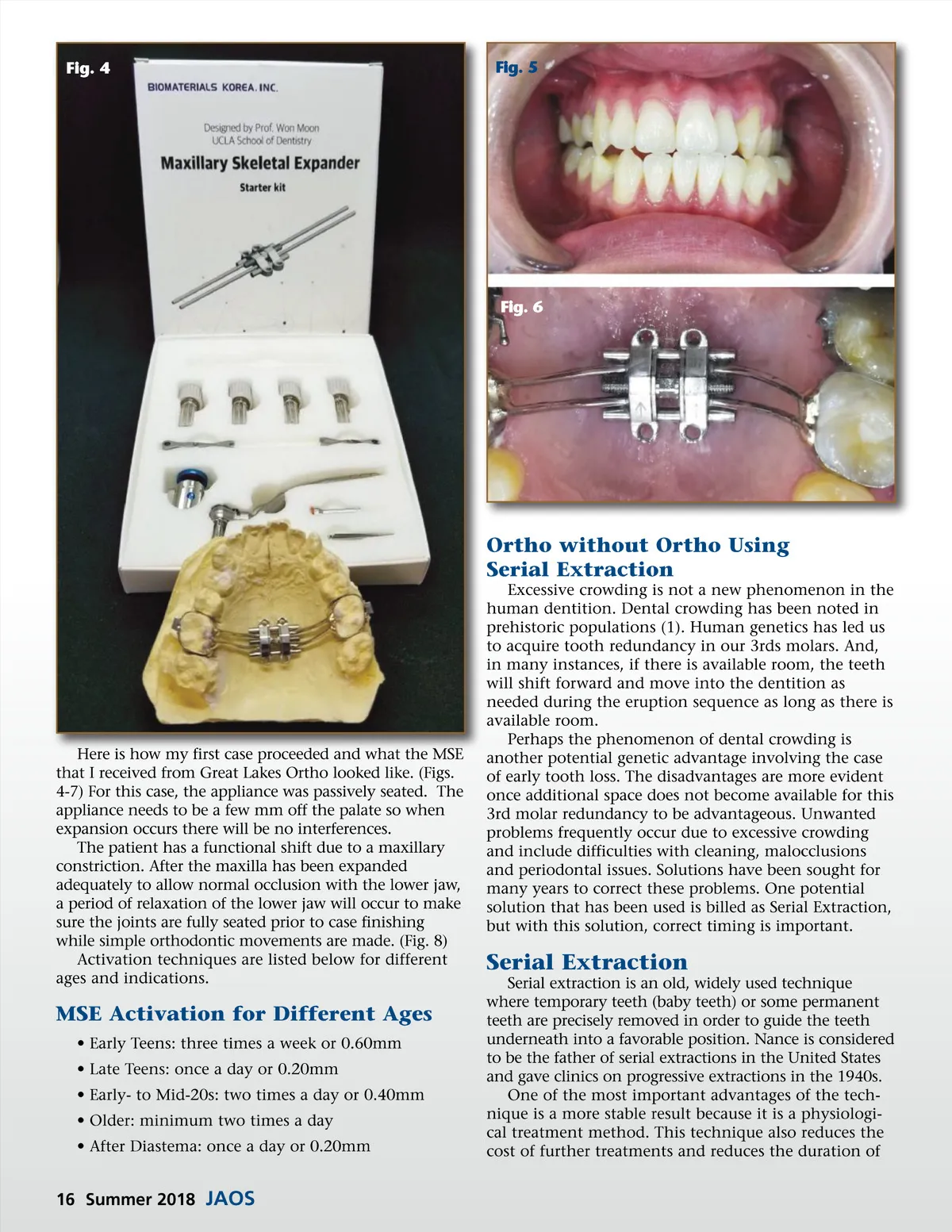
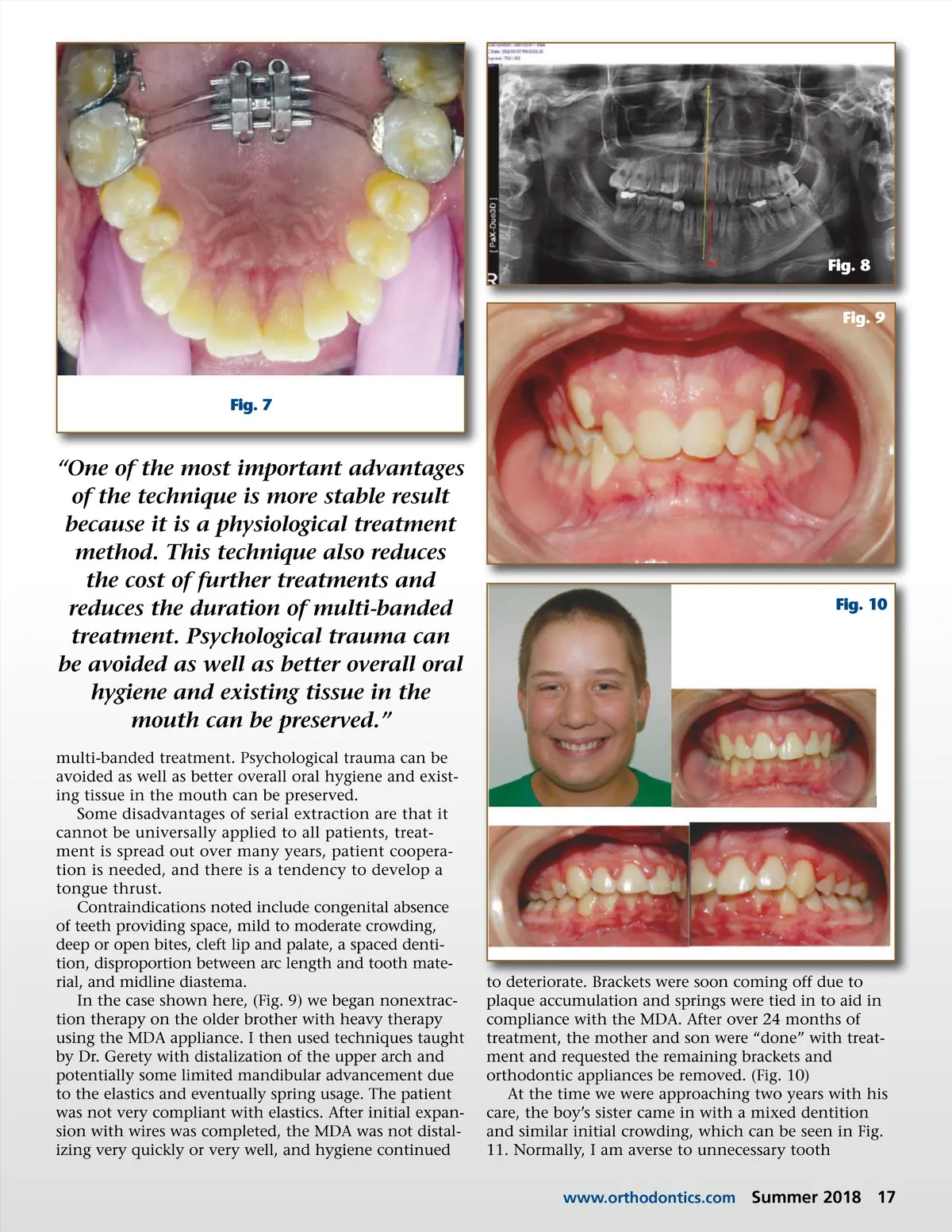
Fig. 4 Fig. 5 Fig. 6 Ortho without Ortho Using Serial Extraction Excessive crowding is not a new phenomenon in the human dentition. Dental crowding has been noted in prehistoric populations (1). Human genetics has led us to acquire tooth redundancy in our 3rds molars. And, in many instances, if there is available room, the teeth will shift forward and move into the dentition as needed during the eruption sequence as long as there is available room. Perhaps the phenomenon of dental crowding is another potential genetic advantage involving the case of early tooth loss. The disadvantages are more evident once additional space does not become available for this 3rd molar redundancy to be advantageous. Unwanted problems frequently occur due to excessive crowding and include difficulties with cleaning, malocclusions and periodontal issues. Solutions have been sought for many years to correct these problems. One potential solution that has been used is billed as Serial Extraction, but with this solution, correct timing is important. Here is how my first case proceeded and what the MSE that I received from Great Lakes Ortho looked like. (Figs. 4-7) For this case, the appliance was passively seated. The appliance needs to be a few mm off the palate so when expansion occurs there will be no interferences. The patient has a functional shift due to a maxillary constriction. After the maxilla has been expanded adequately to allow normal occlusion with the lower jaw, a period of relaxation of the lower jaw will occur to make sure the joints are fully seated prior to case finishing while simple orthodontic movements are made. (Fig. 8) Activation techniques are listed below for different ages and indications. Serial Extraction Serial extraction is an old, widely used technique where temporary teeth (baby teeth) or some permanent teeth are precisely removed in order to guide the teeth underneath into a favorable position. Nance is considered to be the father of serial extractions in the United States and gave clinics on progressive extractions in the 1940s. One of the most important advantages of the tech-nique is a more stable result because it is a physiologi-cal treatment method. This technique also reduces the cost of further treatments and reduces the duration of MSE Activation for Different Ages • Early Teens: three times a week or 0.60mm • Late Teens: once a day or 0.20mm • Early-to Mid-20s: two times a day or 0.40mm • Older: minimum two times a day • After Diastema: once a day or 0.20mm 16 Summer 2018 JAOS
Journal of the American Orthodontic Society Summer 2018/Buyer's Guide: Page 16