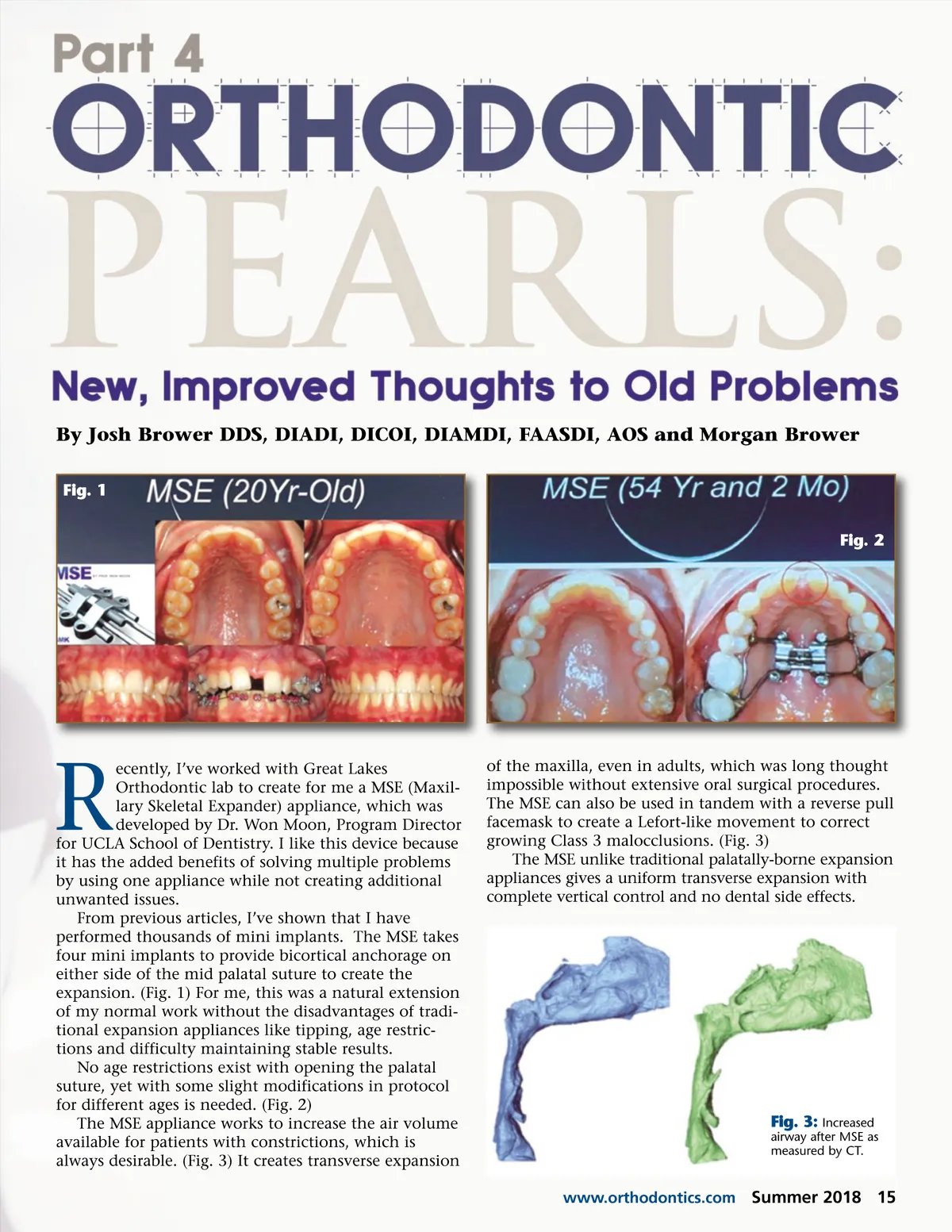
By Josh Brower DDS, DIADI, DICOI, DIAMDI, FAASDI, AOS and Morgan Brower Fig. 1 Fig. 2 R ecently, I’ve worked with Great Lakes Orthodontic lab to create for me a MSE (Maxil-lary Skeletal Expander) appliance, which was developed by Dr. Won Moon, Program Director for UCLA School of Dentistry. I like this device because it has the added benefits of solving multiple problems by using one appliance while not creating additional unwanted issues. From previous articles, I’ve shown that I have performed thousands of mini implants. The MSE takes four mini implants to provide bicortical anchorage on either side of the mid palatal suture to create the expansion. (Fig. 1) For me, this was a natural extension of my normal work without the disadvantages of tradi-tional expansion appliances like tipping, age restric-tions and difficulty maintaining stable results. No age restrictions exist with opening the palatal suture, yet with some slight modifications in protocol for different ages is needed. (Fig. 2) The MSE appliance works to increase the air volume available for patients with constrictions, which is always desirable. (Fig. 3) It creates transverse expansion of the maxilla, even in adults, which was long thought impossible without extensive oral surgical procedures. The MSE can also be used in tandem with a reverse pull facemask to create a Lefort-like movement to correct growing Class 3 malocclusions. (Fig. 3) The MSE unlike traditional palatally-borne expansion appliances gives a uniform transverse expansion with complete vertical control and no dental side effects. Fig. 3: Increased airway after MSE as measured by CT. www.orthodontics.com Summer 2018 15
Journal of the American Orthodontic Society Summer 2018/Buyer's Guide: Page 15