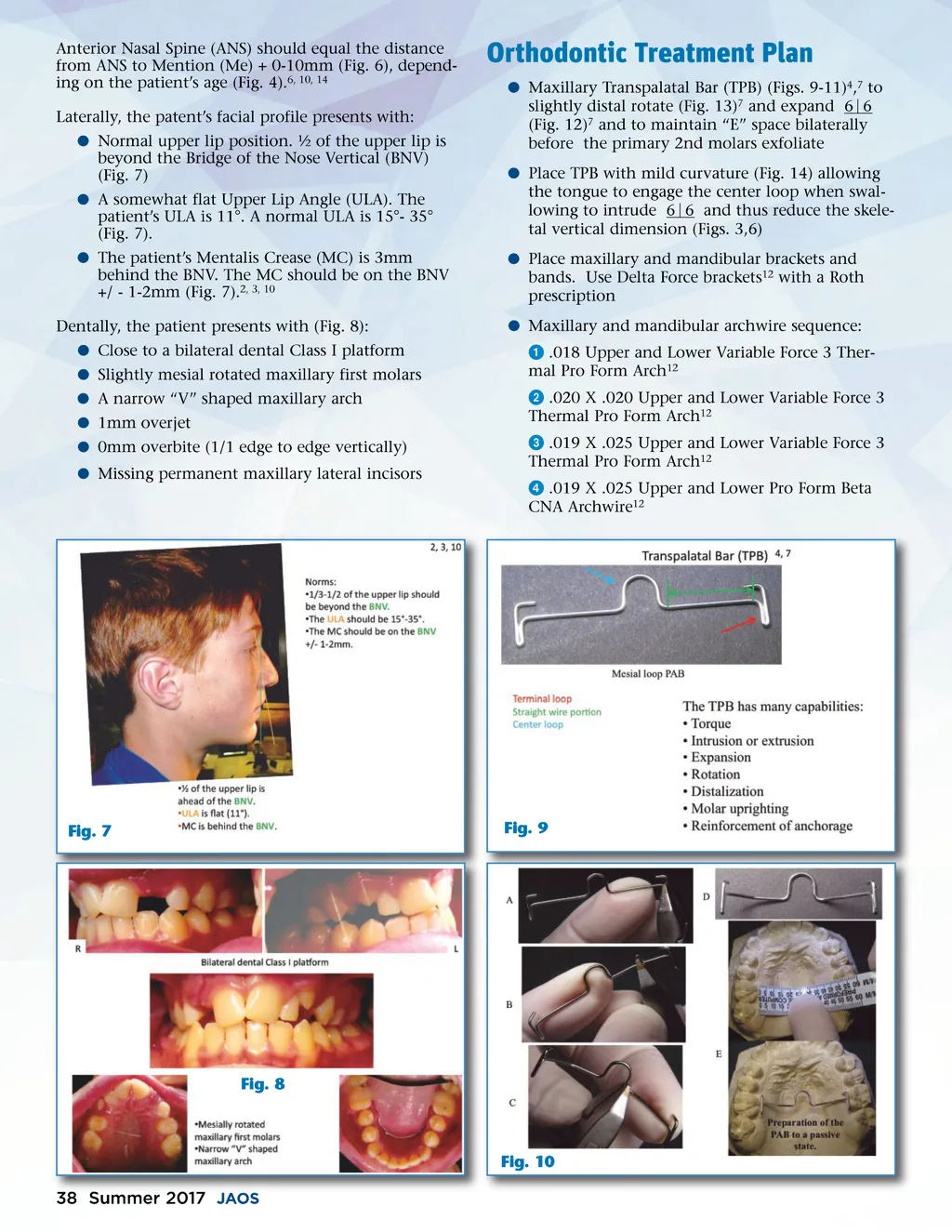
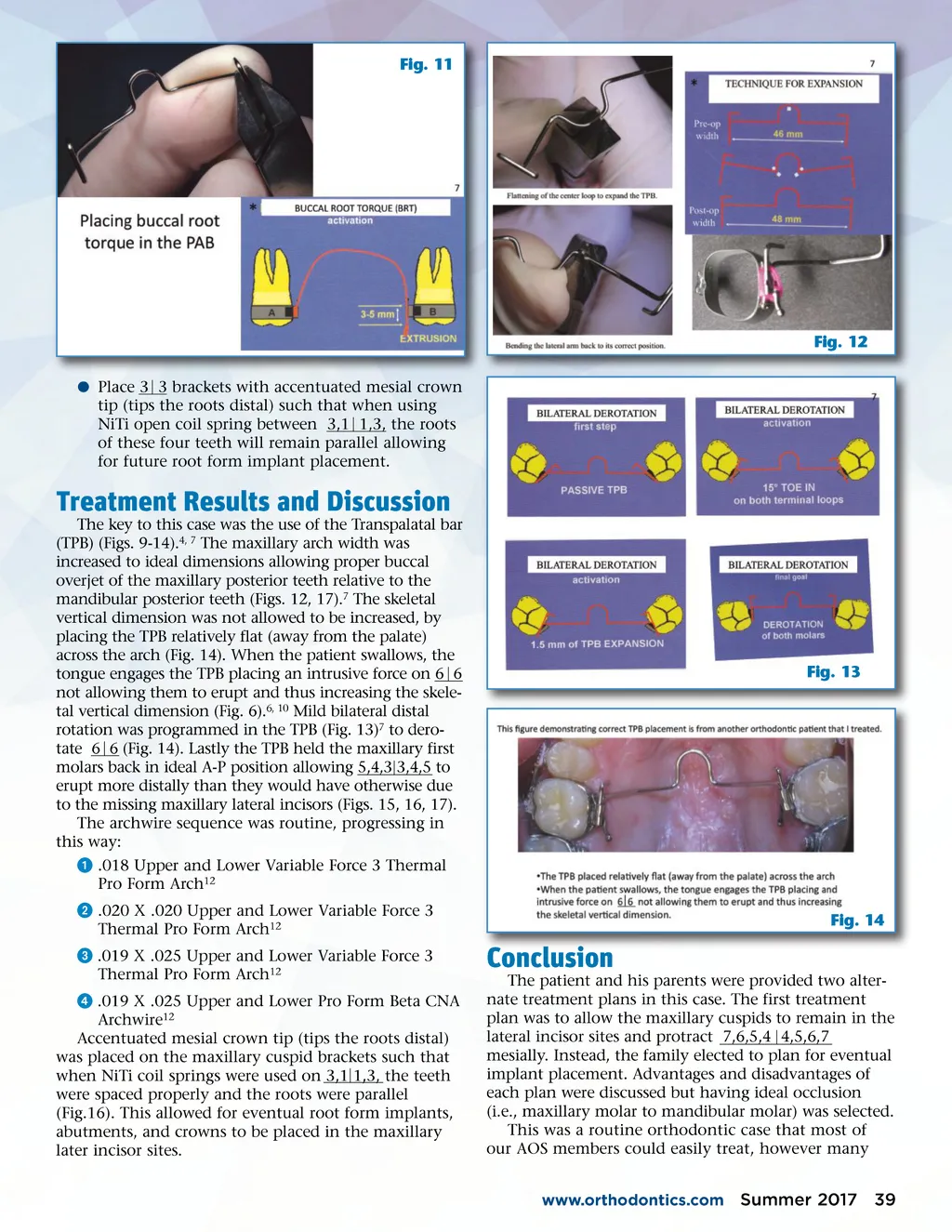
Anterior Nasal Spine (ANS) should equal the distance from ANS to Mention (Me) + 0-10mm (Fig. 6), depend-ing on the patient’s age (Fig. 4). 6, 10, 14 Laterally, the patent’s facial profile presents with: b Normal upper lip position. ½ of the upper lip is beyond the Bridge of the Nose Vertical (BNV) (Fig. 7) b A somewhat flat Upper Lip Angle (ULA). The patient’s ULA is 11°. A normal ULA is 15°-35° (Fig. 7). b The patient’s Mentalis Crease (MC) is 3mm behind the BNV. The MC should be on the BNV +/ -1-2mm (Fig. 7). 2, 3, 10 Dentally, the patient presents with (Fig. 8): b Close to a bilateral dental Class I platform b Slightly mesial rotated maxillary first molars b A narrow “V” shaped maxillary arch b 1mm overjet b 0mm overbite (1/1 edge to edge vertically) b Missing permanent maxillary lateral incisors Orthodontic Treatment Plan b Maxillary Transpalatal Bar (TPB) (Figs. 9-11) 4 , 7 to slightly distal rotate (Fig. 13) 7 and expand 6 6 (Fig. 12) 7 and to maintain “E” space bilaterally before the primary 2nd molars exfoliate b Place TPB with mild curvature (Fig. 14) allowing the tongue to engage the center loop when swal-lowing to intrude 6 6 and thus reduce the skele-tal vertical dimension (Figs. 3,6) b Place maxillary and mandibular brackets and bands. Use Delta Force brackets 12 with a Roth prescription b Maxillary and mandibular archwire sequence: ᕡ .018 Upper and Lower Variable Force 3 Ther-mal Pro Form Arch 12 ᕢ .020 X .020 Upper and Lower Variable Force 3 Thermal Pro Form Arch 12 ᕣ .019 X .025 Upper and Lower Variable Force 3 Thermal Pro Form Arch 12 ᕤ .019 X .025 Upper and Lower Pro Form Beta CNA Archwire 12 Fig. 7 Fig. 9 Fig. 8 Fig. 10 38 Summer 2017 JAOS
Journal of the American Orthodontic Society Summer 2017/Buyer's Guide: Page 38