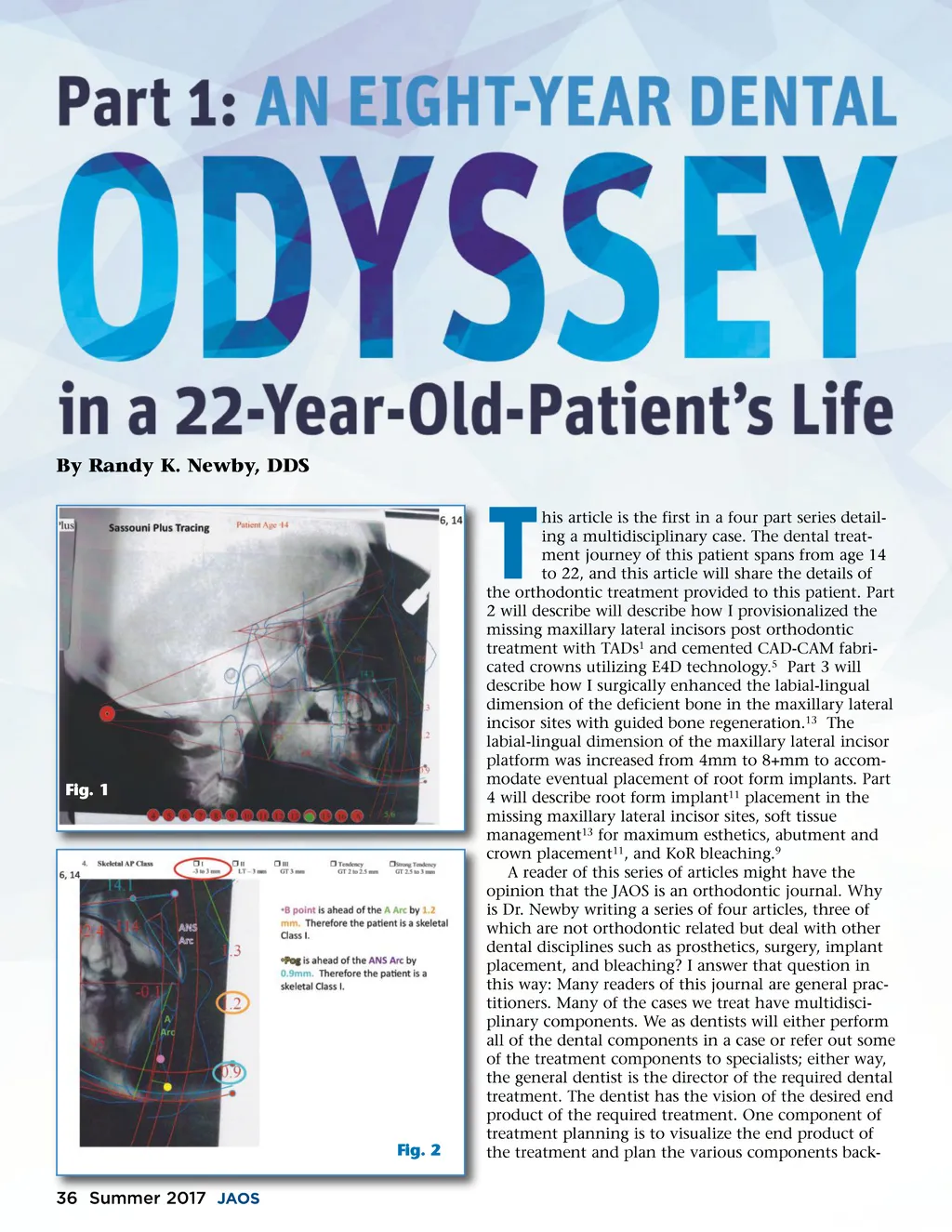
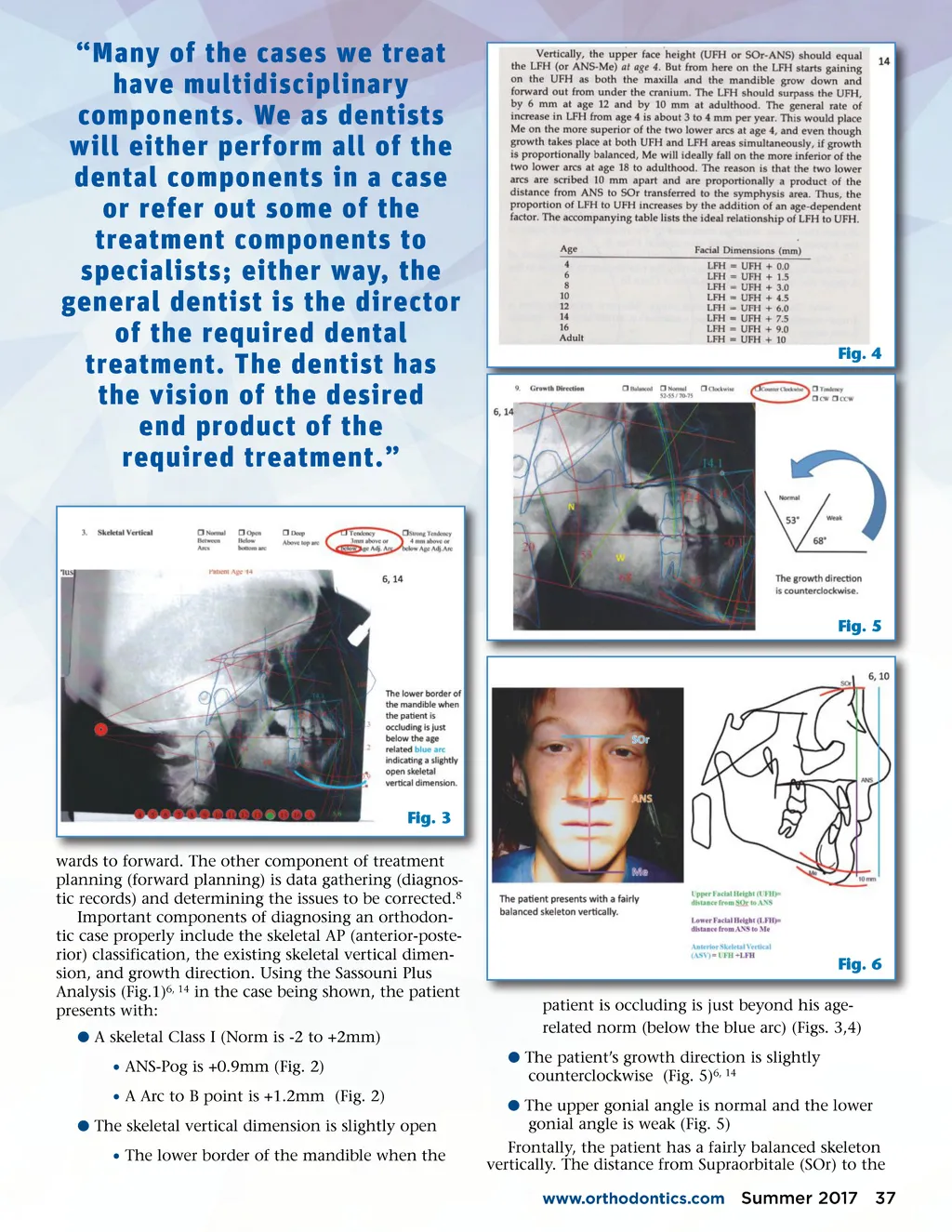
“Many of the cases we treat have multidisciplinary components. We as dentists will either perform all of the dental components in a case or refer out some of the treatment components to specialists; either way, the general dentist is the director of the required dental treatment. The dentist has the vision of the desired end product of the required treatment.” Fig. 4 Fig. 5 Fig. 3 wards to forward. The other component of treatment planning (forward planning) is data gathering (diagnos-tic records) and determining the issues to be corrected. 8 Important components of diagnosing an orthodon-tic case properly include the skeletal AP (anterior-poste-rior) classification, the existing skeletal vertical dimen-sion, and growth direction. Using the Sassouni Plus Analysis (Fig.1) 6, 14 in the case being shown, the patient presents with: b A skeletal Class I (Norm is -2 to +2mm) • ANS-Pog is +0.9mm (Fig. 2) • A Arc to B point is +1.2mm (Fig. 2) Fig. 6 patient is occluding is just beyond his age-related norm (below the blue arc) (Figs. 3,4) b The patient’s growth direction is slightly counterclockwise (Fig. 5) 6, 14 b The upper gonial angle is normal and the lower gonial angle is weak (Fig. 5) Frontally, the patient has a fairly balanced skeleton vertically. The distance from Supraorbitale (SOr) to the www.orthodontics.com b The skeletal vertical dimension is slightly open • The lower border of the mandible when the Summer 2017 37
Journal of the American Orthodontic Society Summer 2017/Buyer's Guide: Page 37