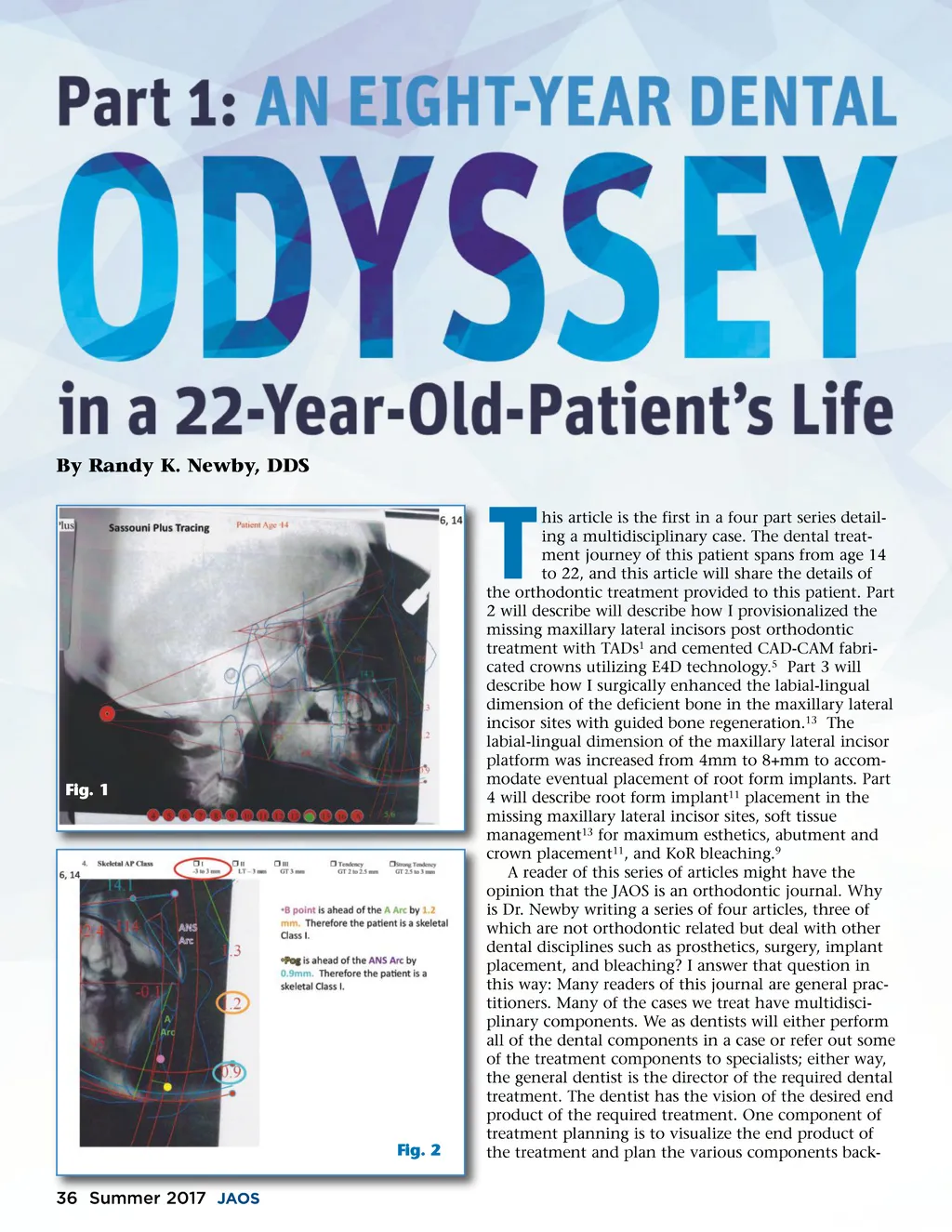
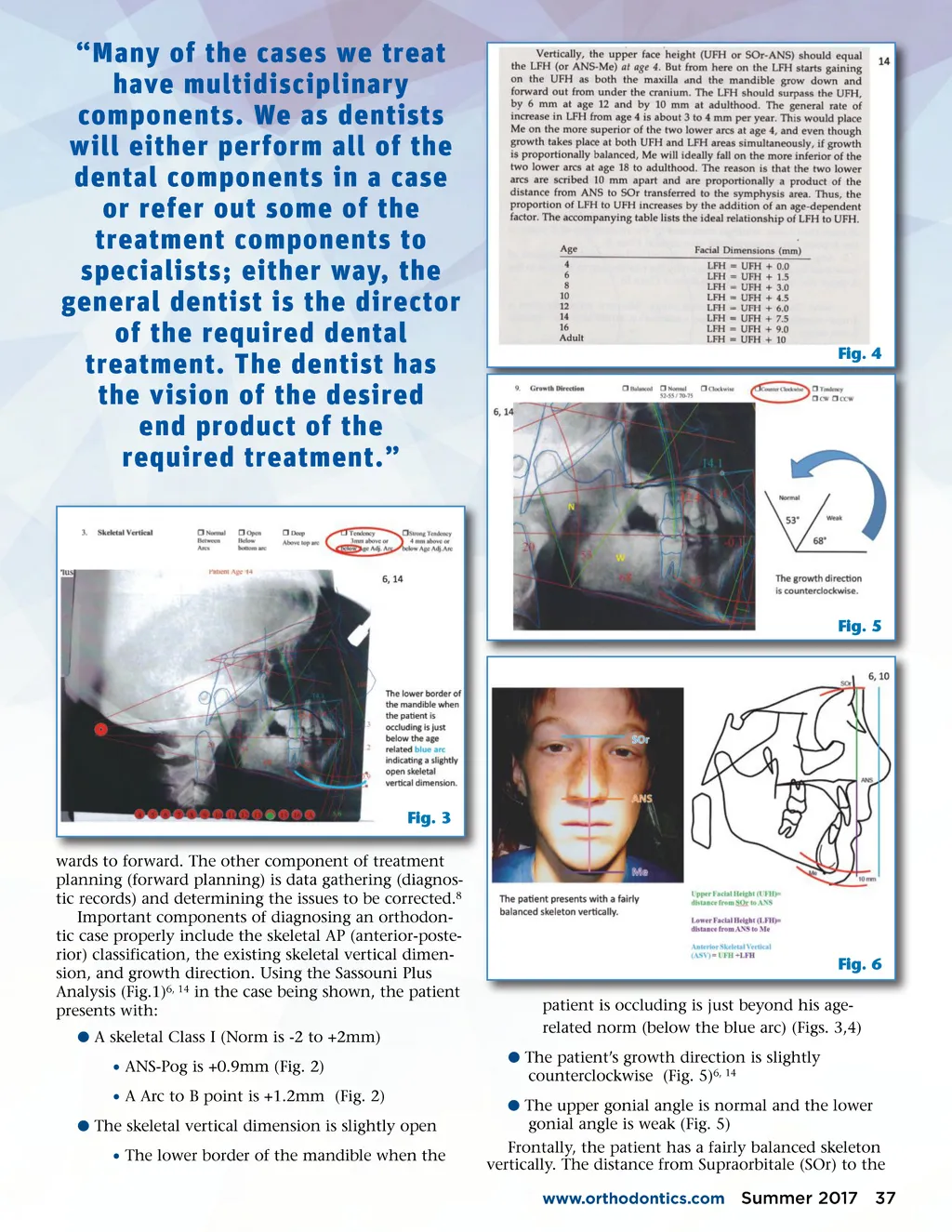
By Randy K. Newby, DDS his article is the first in a four part series detail-ing a multidisciplinary case. The dental treat-ment journey of this patient spans from age 14 to 22, and this article will share the details of the orthodontic treatment provided to this patient. Part 2 will describe will describe how I provisionalized the missing maxillary lateral incisors post orthodontic treatment with TADs 1 and cemented CAD-CAM fabri-cated crowns utilizing E4D technology. 5 Part 3 will describe how I surgically enhanced the labial-lingual dimension of the deficient bone in the maxillary lateral incisor sites with guided bone regeneration. 13 The labial-lingual dimension of the maxillary lateral incisor platform was increased from 4mm to 8+mm to accom-modate eventual placement of root form implants. Part 4 will describe root form implant 11 placement in the missing maxillary lateral incisor sites, soft tissue management 13 for maximum esthetics, abutment and crown placement 11 , and KoR bleaching. 9 A reader of this series of articles might have the opinion that the JAOS is an orthodontic journal. Why is Dr. Newby writing a series of four articles, three of which are not orthodontic related but deal with other dental disciplines such as prosthetics, surgery, implant placement, and bleaching? I answer that question in this way: Many readers of this journal are general prac-titioners. Many of the cases we treat have multidisci-plinary components. We as dentists will either perform all of the dental components in a case or refer out some of the treatment components to specialists; either way, the general dentist is the director of the required dental treatment. The dentist has the vision of the desired end product of the required treatment. One component of treatment planning is to visualize the end product of the treatment and plan the various components back-T Fig. 1 Fig. 2 36 Summer 2017 JAOS
Journal of the American Orthodontic Society Summer 2017/Buyer's Guide: Page 36