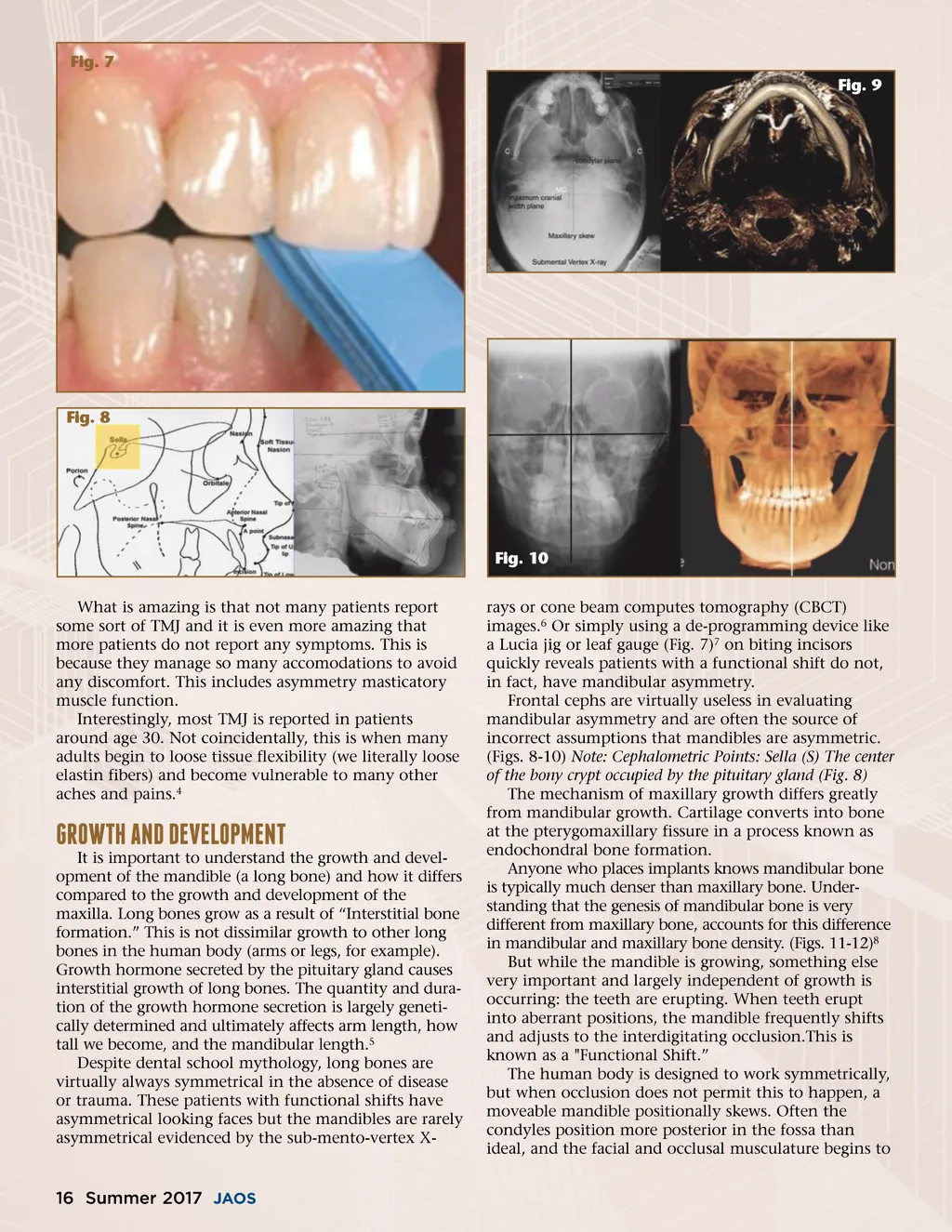
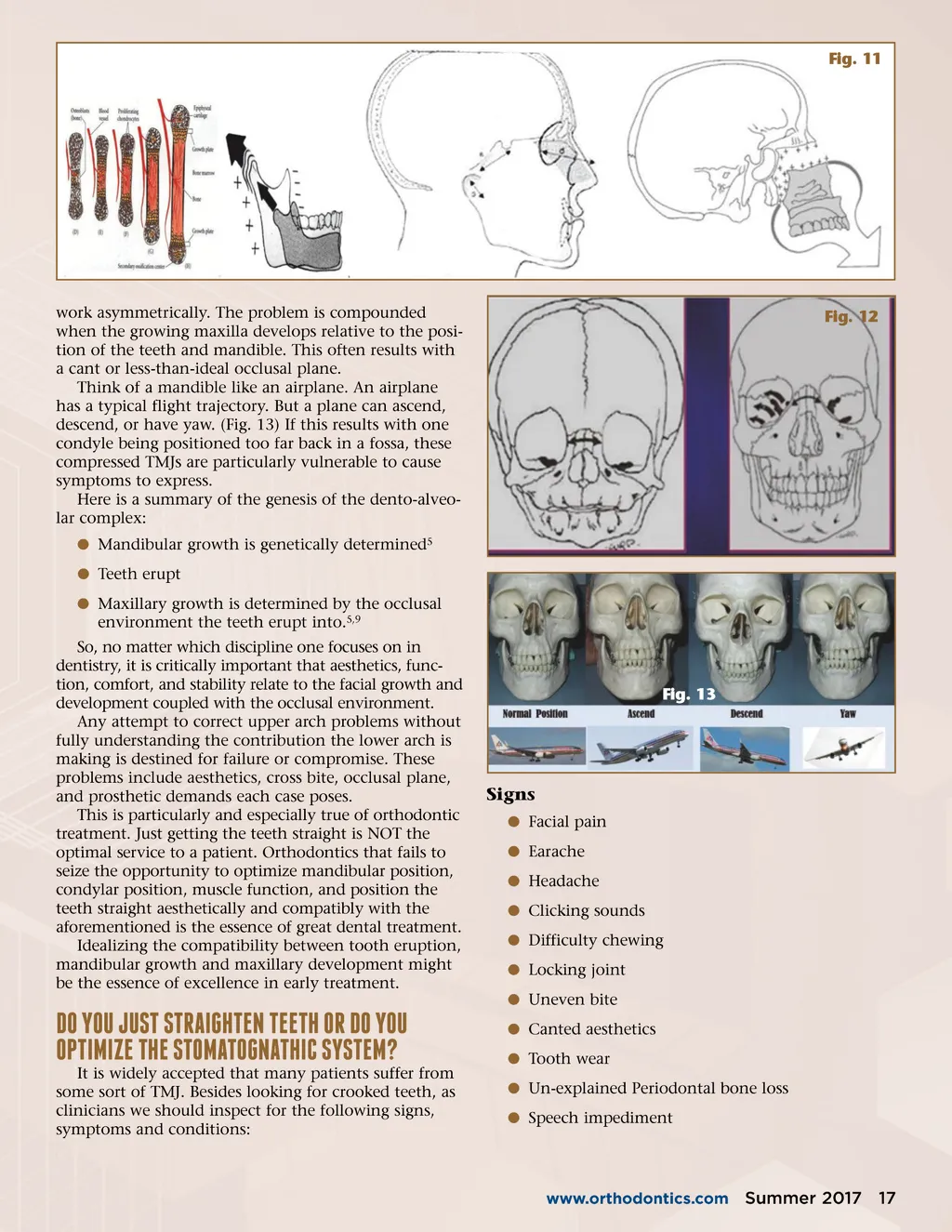
Fig. 7 Fig. 9 Fig. 8 Fig. 10 What is amazing is that not many patients report some sort of TMJ and it is even more amazing that more patients do not report any symptoms. This is because they manage so many accomodations to avoid any discomfort. This includes asymmetry masticatory muscle function. Interestingly, most TMJ is reported in patients around age 30. Not coincidentally, this is when many adults begin to loose tissue flexibility (we literally loose elastin fibers) and become vulnerable to many other aches and pains. 4 rays or cone beam computes tomography (CBCT) images. 6 Or simply using a de-programming device like a Lucia jig or leaf gauge (Fig. 7) 7 on biting incisors quickly reveals patients with a functional shift do not, in fact, have mandibular asymmetry. Frontal cephs are virtually useless in evaluating mandibular asymmetry and are often the source of incorrect assumptions that mandibles are asymmetric. (Figs. 8-10) Note: Cephalometric Points: Sella (S) The center of the bony crypt occupied by the pituitary gland (Fig. 8) The mechanism of maxillary growth differs greatly from mandibular growth. Cartilage converts into bone at the pterygomaxillary fissure in a process known as endochondral bone formation. Anyone who places implants knows mandibular bone is typically much denser than maxillary bone. Under-standing that the genesis of mandibular bone is very different from maxillary bone, accounts for this difference in mandibular and maxillary bone density. (Figs. 11-12) 8 But while the mandible is growing, something else very important and largely independent of growth is occurring: the teeth are erupting. When teeth erupt into aberrant positions, the mandible frequently shifts and adjusts to the interdigitating occlusion.This is known as a "Functional Shift.” The human body is designed to work symmetrically, but when occlusion does not permit this to happen, a moveable mandible positionally skews. Often the condyles position more posterior in the fossa than ideal, and the facial and occlusal musculature begins to It is important to understand the growth and devel-opment of the mandible (a long bone) and how it differs compared to the growth and development of the maxilla. Long bones grow as a result of “Interstitial bone formation.” This is not dissimilar growth to other long bones in the human body (arms or legs, for example). Growth hormone secreted by the pituitary gland causes interstitial growth of long bones. The quantity and dura-tion of the growth hormone secretion is largely geneti-cally determined and ultimately affects arm length, how tall we become, and the mandibular length. 5 Despite dental school mythology, long bones are virtually always symmetrical in the absence of disease or trauma. These patients with functional shifts have asymmetrical looking faces but the mandibles are rarely asymmetrical evidenced by the sub-mento-vertex X-gRoWTh AND DEvElopMENT 16 Summer 2017 JAOS
Journal of the American Orthodontic Society Summer 2017/Buyer's Guide: Page 16