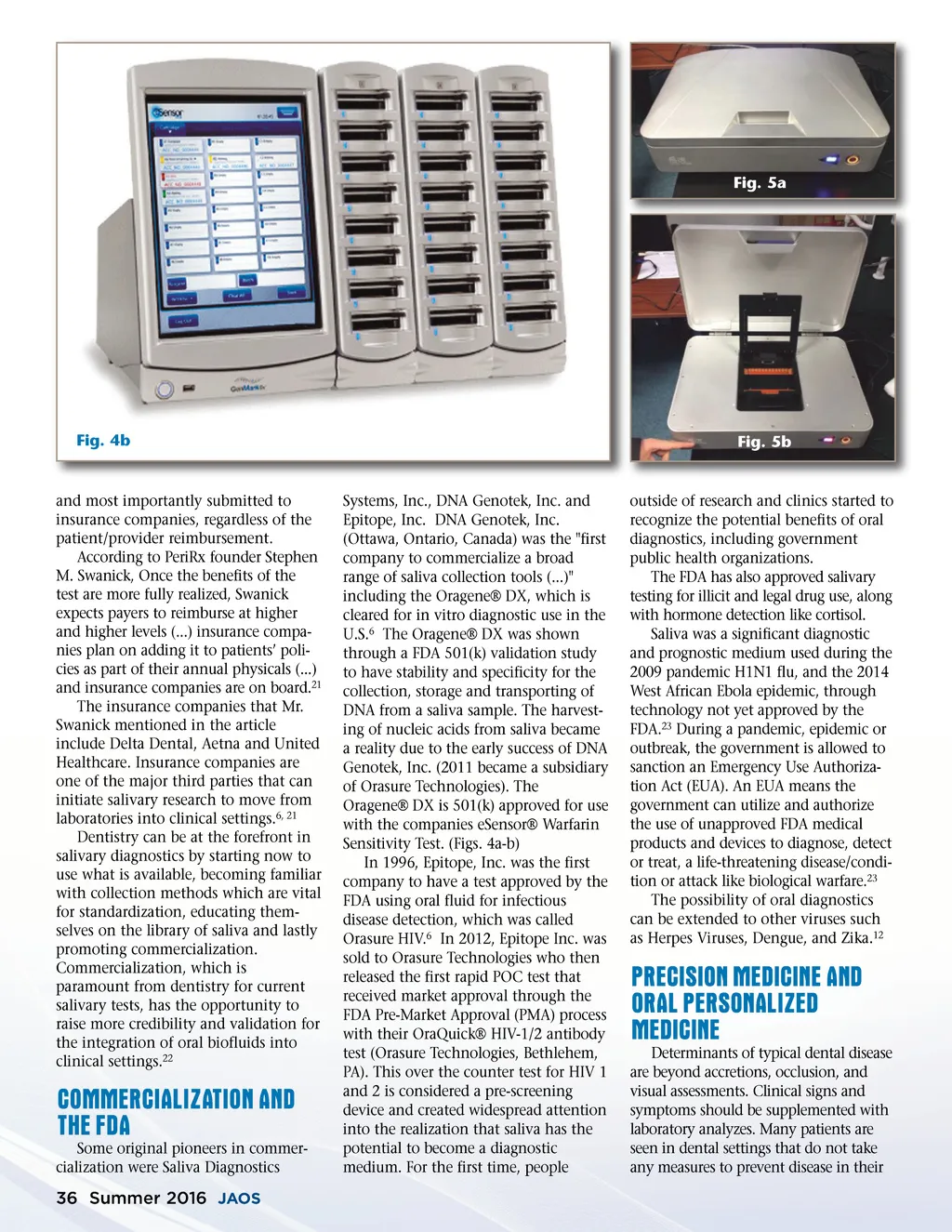
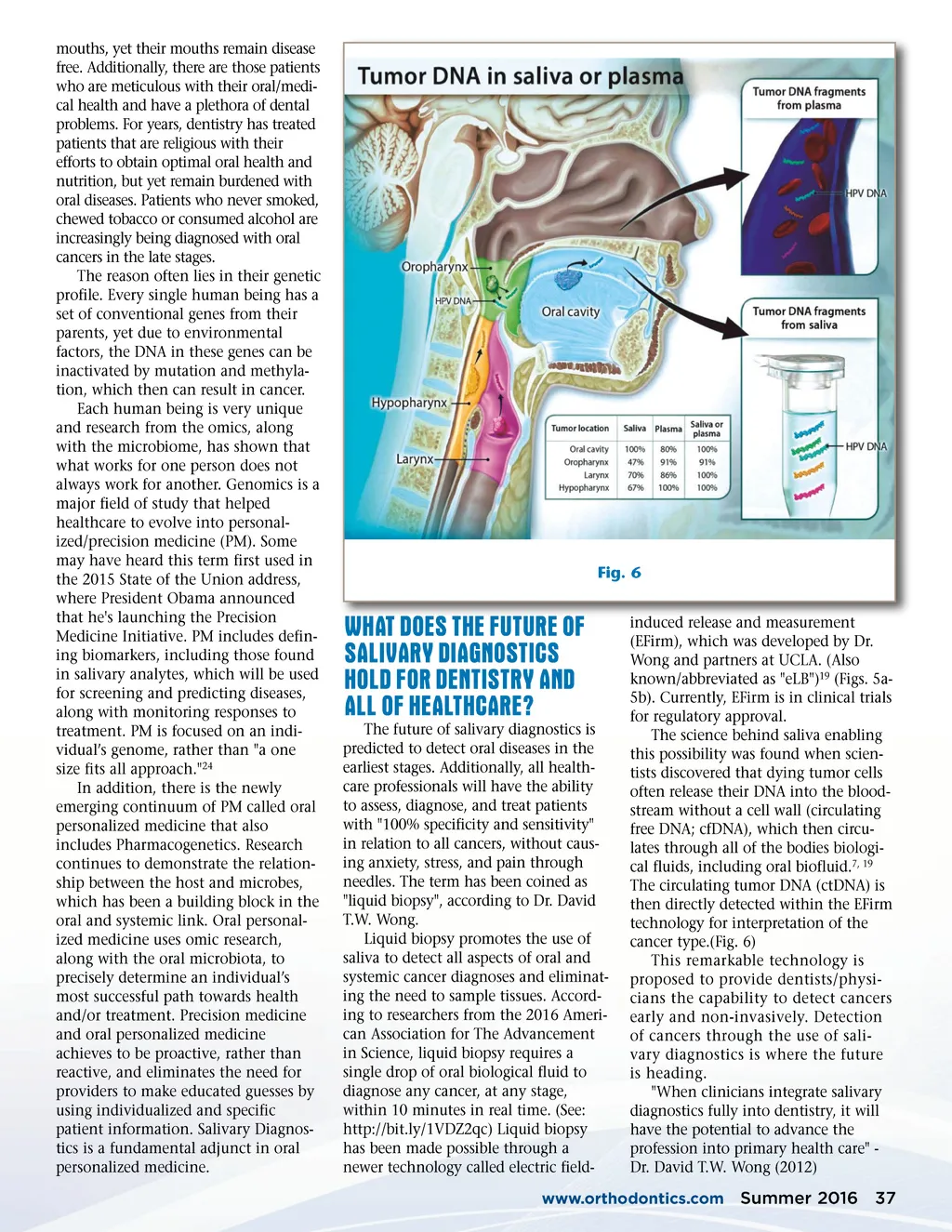
Fig. 5a Fig. 4b Fig. 5b and most importantly submitted to insurance companies, regardless of the patient/provider reimbursement. According to PeriRx founder Stephen M. Swanick, Once the benefits of the test are more fully realized, Swanick expects payers to reimburse at higher and higher levels (...) insurance compa-nies plan on adding it to patients’ poli-cies as part of their annual physicals (...) and insurance companies are on board. 21 The insurance companies that Mr. Swanick mentioned in the article include Delta Dental, Aetna and United Healthcare. Insurance companies are one of the major third parties that can initiate salivary research to move from laboratories into clinical settings. 6, 21 Dentistry can be at the forefront in salivary diagnostics by starting now to use what is available, becoming familiar with collection methods which are vital for standardization, educating them-selves on the library of saliva and lastly promoting commercialization. Commercialization, which is paramount from dentistry for current salivary tests, has the opportunity to raise more credibility and validation for the integration of oral biofluids into clinical settings. 22 COMMERCIALIZATION AND THE FDA Some original pioneers in commer-cialization were Saliva Diagnostics Systems, Inc., DNA Genotek, Inc. and Epitope, Inc. DNA Genotek, Inc. (Ottawa, Ontario, Canada) was the "first company to commercialize a broad range of saliva collection tools (...)" including the Oragene® DX, which is cleared for in vitro diagnostic use in the U.S. 6 The Oragene® DX was shown through a FDA 501(k) validation study to have stability and specificity for the collection, storage and transporting of DNA from a saliva sample. The harvest-ing of nucleic acids from saliva became a reality due to the early success of DNA Genotek, Inc. (2011 became a subsidiary of Orasure Technologies). The Oragene® DX is 501(k) approved for use with the companies eSensor® Warfarin Sensitivity Test. (Figs. 4a-b) In 1996, Epitope, Inc. was the first company to have a test approved by the FDA using oral fluid for infectious disease detection, which was called Orasure HIV. 6 In 2012, Epitope Inc. was sold to Orasure Technologies who then released the first rapid POC test that received market approval through the FDA Pre-Market Approval (PMA) process with their OraQuick® HIV-1/2 antibody test (Orasure Technologies, Bethlehem, PA). This over the counter test for HIV 1 and 2 is considered a pre-screening device and created widespread attention into the realization that saliva has the potential to become a diagnostic medium. For the first time, people outside of research and clinics started to recognize the potential benefits of oral diagnostics, including government public health organizations. The FDA has also approved salivary testing for illicit and legal drug use, along with hormone detection like cortisol. Saliva was a significant diagnostic and prognostic medium used during the 2009 pandemic H1N1 flu, and the 2014 West African Ebola epidemic, through technology not yet approved by the FDA. 23 During a pandemic, epidemic or outbreak, the government is allowed to sanction an Emergency Use Authoriza-tion Act (EUA). An EUA means the government can utilize and authorize the use of unapproved FDA medical products and devices to diagnose, detect or treat, a life-threatening disease/condi-tion or attack like biological warfare. 23 The possibility of oral diagnostics can be extended to other viruses such as Herpes Viruses, Dengue, and Zika. 12 PRECISION MEDICINE AND ORAL PERSONALIZED MEDICINE Determinants of typical dental disease are beyond accretions, occlusion, and visual assessments. Clinical signs and symptoms should be supplemented with laboratory analyzes. Many patients are seen in dental settings that do not take any measures to prevent disease in their 36 Summer 2016 JAOS
Journal of the American Orthodontic Society Summer 2016 / Buyer's Guide: Page 36