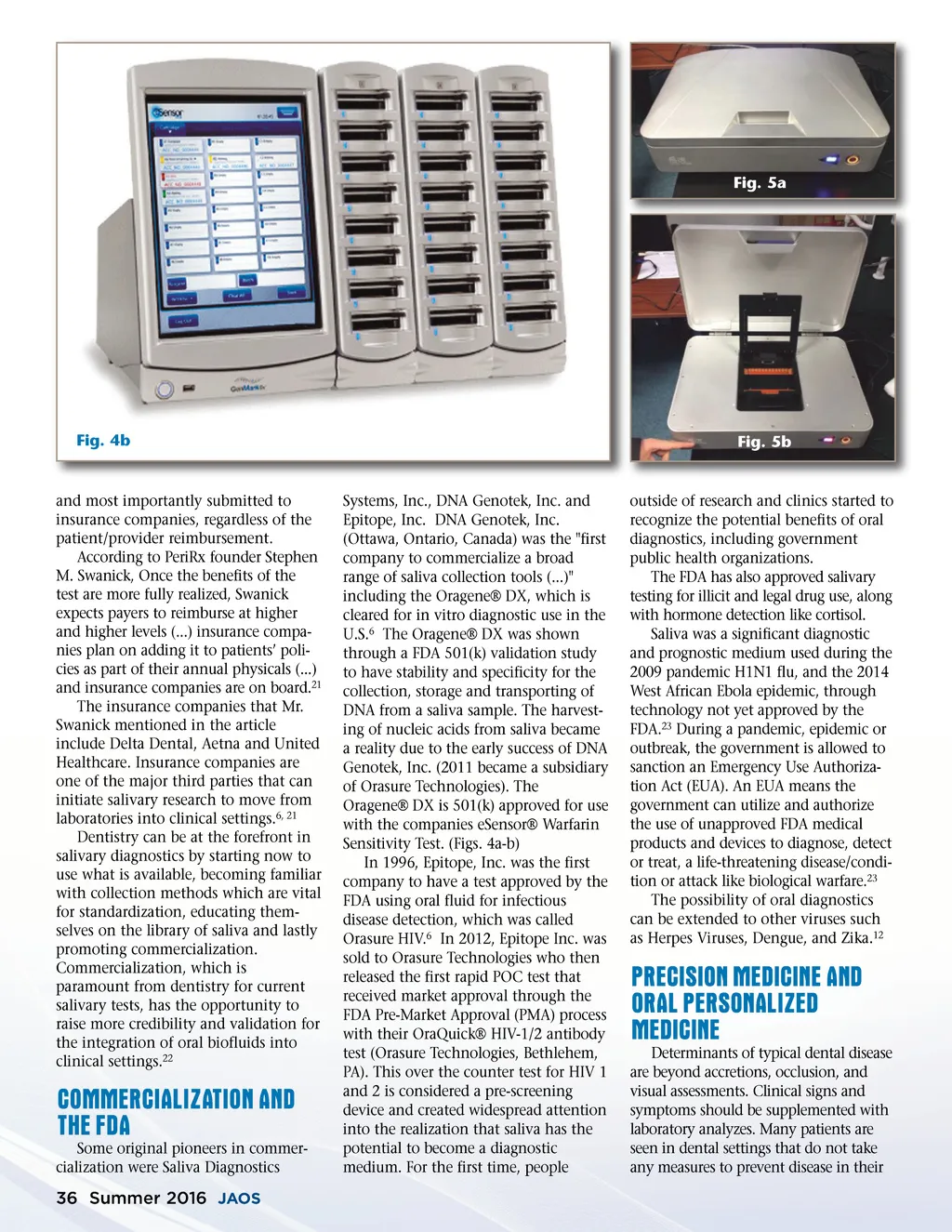
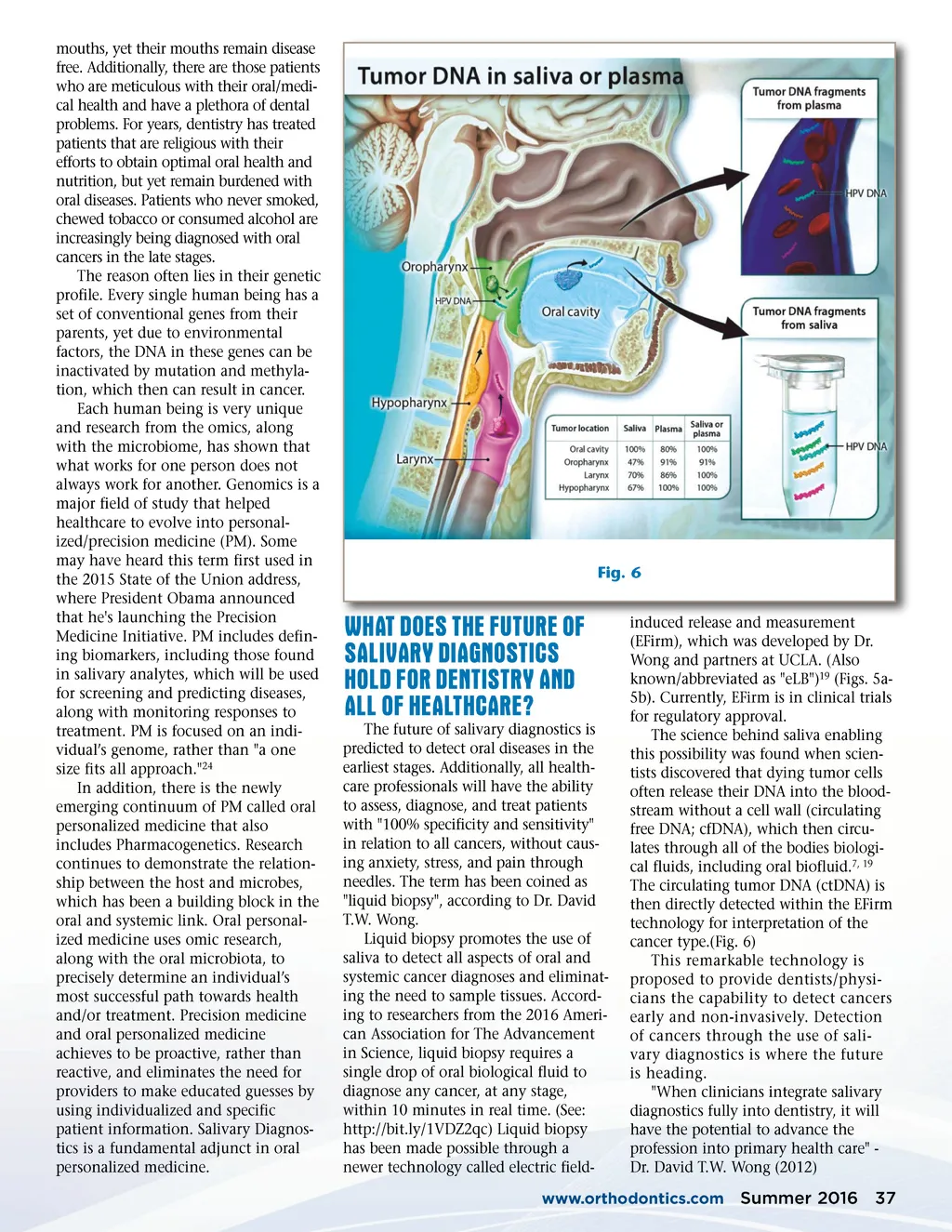
mouths, yet their mouths remain disease free. Additionally, there are those patients who are meticulous with their oral/medi-cal health and have a plethora of dental problems. For years, dentistry has treated patients that are religious with their efforts to obtain optimal oral health and nutrition, but yet remain burdened with oral diseases. Patients who never smoked, chewed tobacco or consumed alcohol are increasingly being diagnosed with oral cancers in the late stages. The reason often lies in their genetic profile. Every single human being has a set of conventional genes from their parents, yet due to environmental factors, the DNA in these genes can be inactivated by mutation and methyla-tion, which then can result in cancer. Each human being is very unique and research from the omics, along with the microbiome, has shown that what works for one person does not always work for another. Genomics is a major field of study that helped healthcare to evolve into personal-ized/precision medicine (PM). Some may have heard this term first used in the 2015 State of the Union address, where President Obama announced that he's launching the Precision Medicine Initiative. PM includes defin-ing biomarkers, including those found in salivary analytes, which will be used for screening and predicting diseases, along with monitoring responses to treatment. PM is focused on an indi-vidual’s genome, rather than "a one size fits all approach." 24 In addition, there is the newly emerging continuum of PM called oral personalized medicine that also includes Pharmacogenetics. Research continues to demonstrate the relation-ship between the host and microbes, which has been a building block in the oral and systemic link. Oral personal-ized medicine uses omic research, along with the oral microbiota, to precisely determine an individual’s most successful path towards health and/or treatment. Precision medicine and oral personalized medicine achieves to be proactive, rather than reactive, and eliminates the need for providers to make educated guesses by using individualized and specific patient information. Salivary Diagnos-tics is a fundamental adjunct in oral personalized medicine. Fig. 6 WHAT DOES THE FUTURE OF SALIVARY DIAGNOSTICS HOLD FOR DENTISTRY AND ALL OF HEALTHCARE? The future of salivary diagnostics is predicted to detect oral diseases in the earliest stages. Additionally, all health-care professionals will have the ability to assess, diagnose, and treat patients with "100% specificity and sensitivity" in relation to all cancers, without caus-ing anxiety, stress, and pain through needles. The term has been coined as "liquid biopsy", according to Dr. David T.W. Wong. Liquid biopsy promotes the use of saliva to detect all aspects of oral and systemic cancer diagnoses and eliminat-ing the need to sample tissues. Accord-ing to researchers from the 2016 Ameri-can Association for The Advancement in Science, liquid biopsy requires a single drop of oral biological fluid to diagnose any cancer, at any stage, within 10 minutes in real time. (See: http://bit.ly/1VDZ2qc) Liquid biopsy has been made possible through a newer technology called electric field-induced release and measurement (EFirm), which was developed by Dr. Wong and partners at UCLA. (Also known/abbreviated as "eLB") 19 (Figs. 5a-5b). Currently, EFirm is in clinical trials for regulatory approval. The science behind saliva enabling this possibility was found when scien-tists discovered that dying tumor cells often release their DNA into the blood-stream without a cell wall (circulating free DNA; cfDNA), which then circu-lates through all of the bodies biologi-cal fluids, including oral biofluid. 7, 19 The circulating tumor DNA (ctDNA) is then directly detected within the EFirm technology for interpretation of the cancer type.(Fig. 6) This remarkable technology is proposed to provide dentists/physi-cians the capability to detect cancers early and non-invasively. Detection of cancers through the use of sali-vary diagnostics is where the future is heading. "When clinicians integrate salivary diagnostics fully into dentistry, it will have the potential to advance the profession into primary health care" -Dr. David T.W. Wong (2012) www.orthodontics.com Summer 2016 37
Journal of the American Orthodontic Society Summer 2016 / Buyer's Guide: Page 37