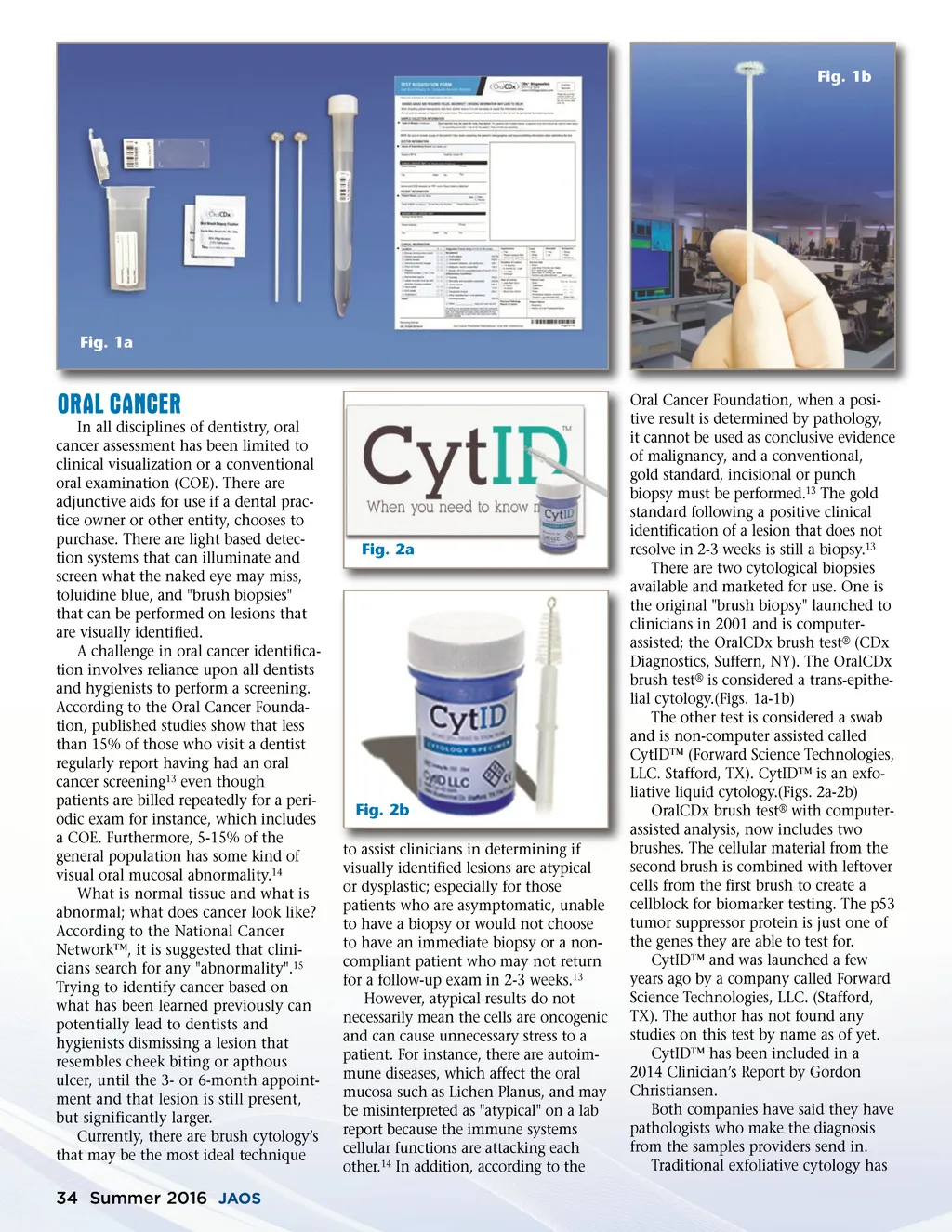
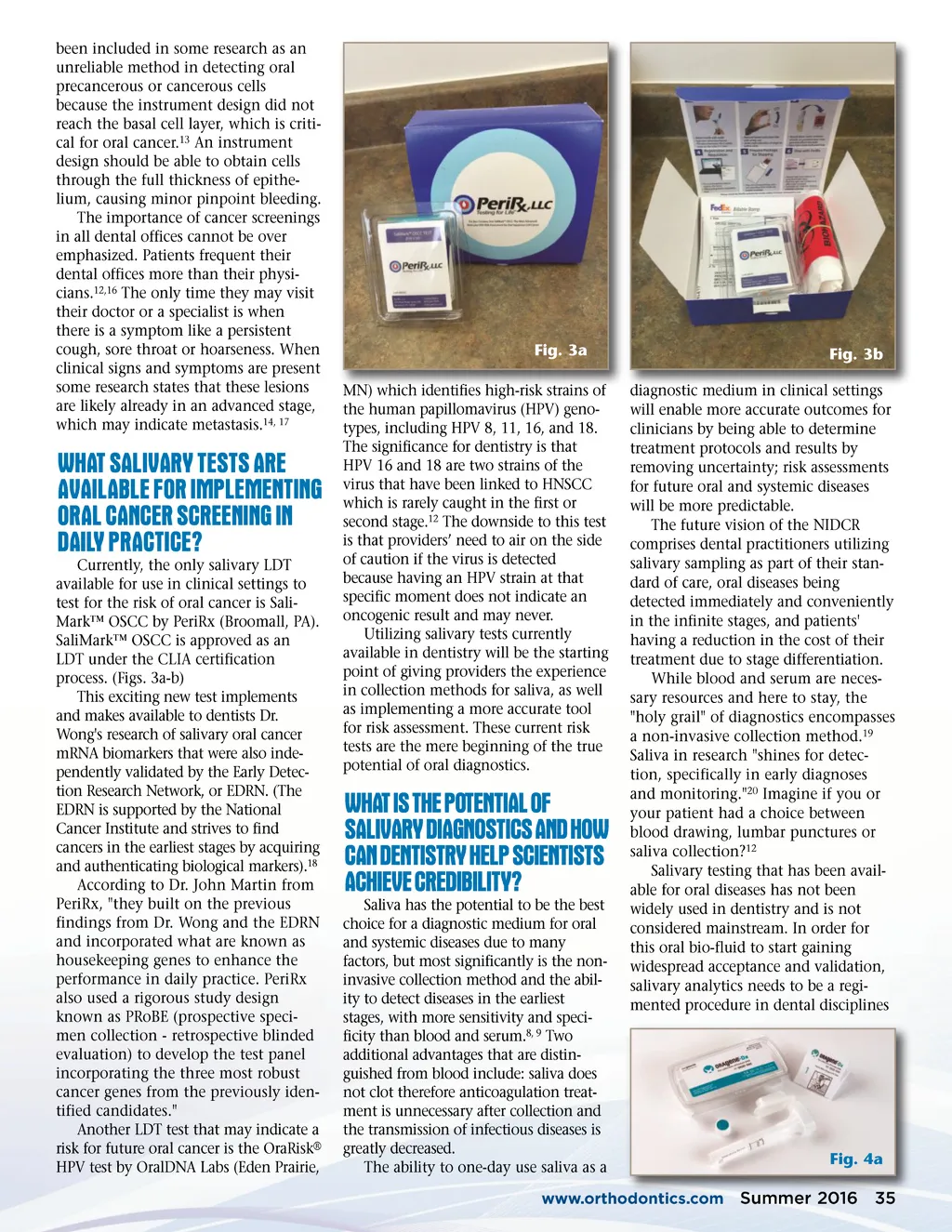
been included in some research as an unreliable method in detecting oral precancerous or cancerous cells because the instrument design did not reach the basal cell layer, which is criti-cal for oral cancer. 13 An instrument design should be able to obtain cells through the full thickness of epithe-lium, causing minor pinpoint bleeding. The importance of cancer screenings in all dental offices cannot be over emphasized. Patients frequent their dental offices more than their physi-cians. 12,16 The only time they may visit their doctor or a specialist is when there is a symptom like a persistent cough, sore throat or hoarseness. When clinical signs and symptoms are present some research states that these lesions are likely already in an advanced stage, which may indicate metastasis. 14, 17 Fig. 3a MN) which identifies high-risk strains of the human papillomavirus (HPV) geno-types, including HPV 8, 11, 16, and 18. The significance for dentistry is that HPV 16 and 18 are two strains of the virus that have been linked to HNSCC which is rarely caught in the first or second stage. 12 The downside to this test is that providers’ need to air on the side of caution if the virus is detected because having an HPV strain at that specific moment does not indicate an oncogenic result and may never. Utilizing salivary tests currently available in dentistry will be the starting point of giving providers the experience in collection methods for saliva, as well as implementing a more accurate tool for risk assessment. These current risk tests are the mere beginning of the true potential of oral diagnostics. Fig. 3b diagnostic medium in clinical settings will enable more accurate outcomes for clinicians by being able to determine treatment protocols and results by removing uncertainty; risk assessments for future oral and systemic diseases will be more predictable. The future vision of the NIDCR comprises dental practitioners utilizing salivary sampling as part of their stan-dard of care, oral diseases being detected immediately and conveniently in the infinite stages, and patients' having a reduction in the cost of their treatment due to stage differentiation. While blood and serum are neces-sary resources and here to stay, the "holy grail" of diagnostics encompasses a non-invasive collection method. 19 Saliva in research "shines for detec-tion, specifically in early diagnoses and monitoring." 20 Imagine if you or your patient had a choice between blood drawing, lumbar punctures or saliva collection? 12 Salivary testing that has been avail-able for oral diseases has not been widely used in dentistry and is not considered mainstream. In order for this oral bio-fluid to start gaining widespread acceptance and validation, salivary analytics needs to be a regi-mented procedure in dental disciplines WHAT SALIVARY TESTS ARE AVAILABLE FOR IMPLEMENTING ORAL CANCER SCREENING IN DAILY PRACTICE? Currently, the only salivary LDT available for use in clinical settings to test for the risk of oral cancer is Sali-Mark™ OSCC by PeriRx (Broomall, PA). SaliMark™ OSCC is approved as an LDT under the CLIA certification process. (Figs. 3a-b) This exciting new test implements and makes available to dentists Dr. Wong's research of salivary oral cancer mRNA biomarkers that were also inde-pendently validated by the Early Detec-tion Research Network, or EDRN. (The EDRN is supported by the National Cancer Institute and strives to find cancers in the earliest stages by acquiring and authenticating biological markers). 18 According to Dr. John Martin from PeriRx, "they built on the previous findings from Dr. Wong and the EDRN and incorporated what are known as housekeeping genes to enhance the performance in daily practice. PeriRx also used a rigorous study design known as PRoBE (prospective speci-men collection -retrospective blinded evaluation) to develop the test panel incorporating the three most robust cancer genes from the previously iden-tified candidates." Another LDT test that may indicate a risk for future oral cancer is the OraRisk ® HPV test by OralDNA Labs (Eden Prairie, WHAT IS THE POTENTIAL OF SALIVARY DIAGNOSTICS AND HOW CAN DENTISTRY HELP SCIENTISTS ACHIEVE CREDIBILITY? Saliva has the potential to be the best choice for a diagnostic medium for oral and systemic diseases due to many factors, but most significantly is the non-invasive collection method and the abil-ity to detect diseases in the earliest stages, with more sensitivity and speci-ficity than blood and serum. 8, 9 Two additional advantages that are distin-guished from blood include: saliva does not clot therefore anticoagulation treat-ment is unnecessary after collection and the transmission of infectious diseases is greatly decreased. The ability to one-day use saliva as a Fig. 4a www.orthodontics.com Summer 2016 35
Journal of the American Orthodontic Society Summer 2016 / Buyer's Guide: Page 35