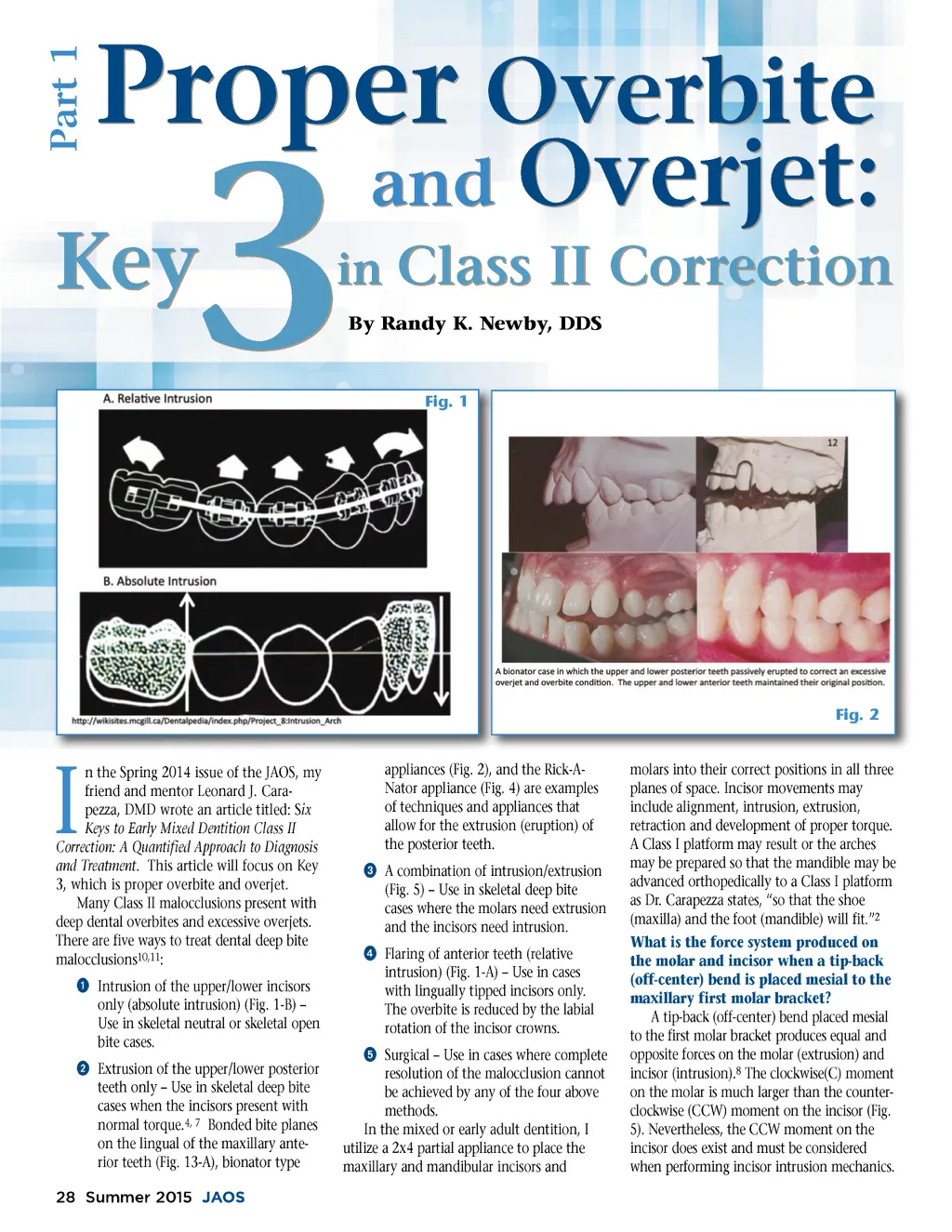
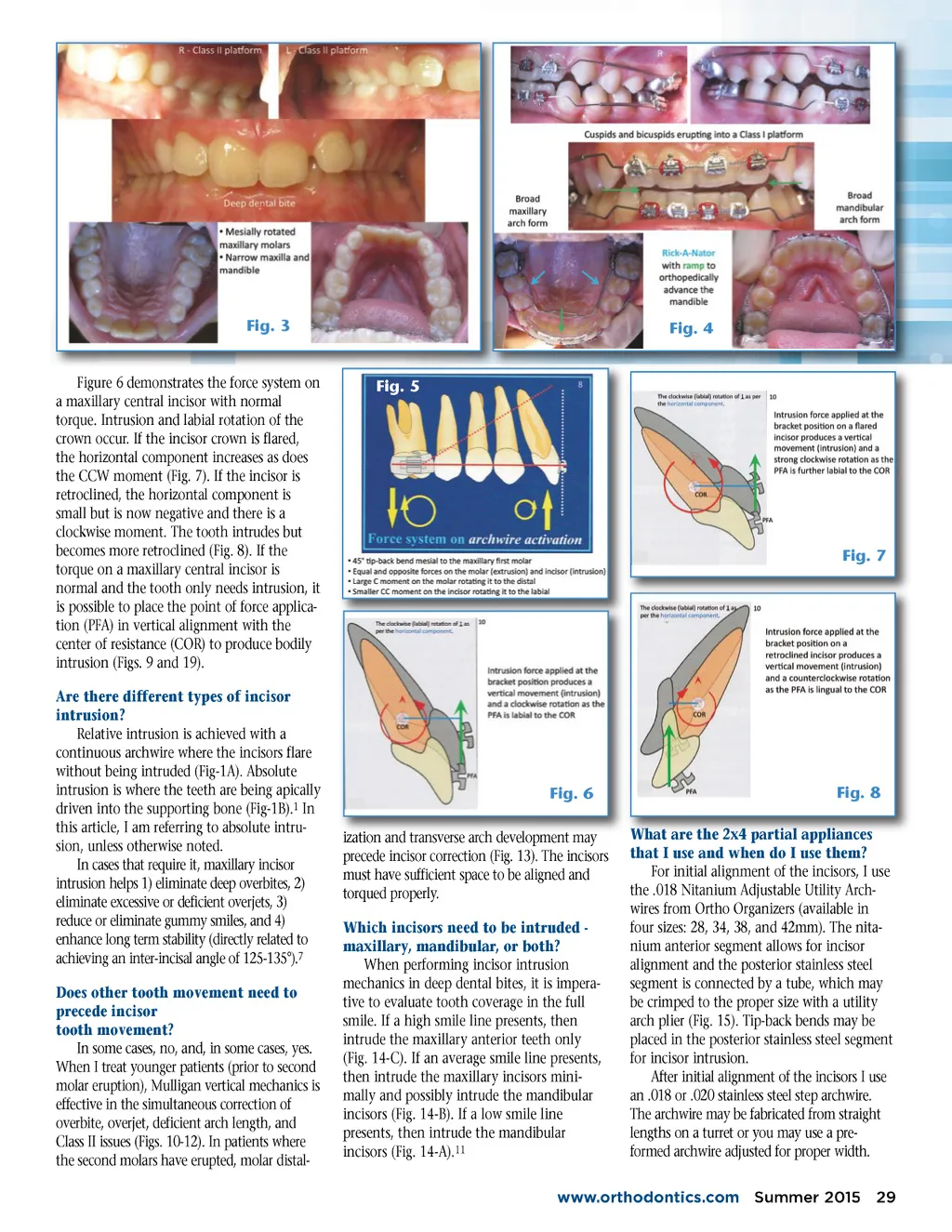
Fig. 3 Fig. 4 Figure 6 demonstrates the force system on a maxillary central incisor with normal torque. Intrusion and labial rotation of the crown occur. If the incisor crown is flared, the horizontal component increases as does the CCW moment (Fig. 7). If the incisor is retroclined, the horizontal component is small but is now negative and there is a clockwise moment. The tooth intrudes but becomes more retroclined (Fig. 8). If the torque on a maxillary central incisor is normal and the tooth only needs intrusion, it is possible to place the point of force applica-tion (PFA) in vertical alignment with the center of resistance (COR) to produce bodily intrusion (Figs. 9 and 19). Are there different types of incisor intrusion? Relative intrusion is achieved with a continuous archwire where the incisors flare without being intruded (Fig-1A). Absolute intrusion is where the teeth are being apically driven into the supporting bone (Fig-1B). 1 In this article, I am referring to absolute intru-sion, unless otherwise noted. In cases that require it, maxillary incisor intrusion helps 1) eliminate deep overbites, 2) eliminate excessive or deficient overjets, 3) reduce or eliminate gummy smiles, and 4) enhance long term stability (directly related to achieving an inter-incisal angle of 125-135°). 7 Does other tooth movement need to precede incisor tooth movement? In some cases, no, and, in some cases, yes. When I treat younger patients (prior to second molar eruption), Mulligan vertical mechanics is effective in the simultaneous correction of overbite, overjet, deficient arch length, and Class II issues (Figs. 10-12). In patients where the second molars have erupted, molar distal-Fig. 5 Fig. 7 Fig. 6 ization and transverse arch development may precede incisor correction (Fig. 13). The incisors must have sufficient space to be aligned and torqued properly. Which incisors need to be intruded -maxillary, mandibular, or both? When performing incisor intrusion mechanics in deep dental bites, it is impera-tive to evaluate tooth coverage in the full smile. If a high smile line presents, then intrude the maxillary anterior teeth only (Fig. 14-C). If an average smile line presents, then intrude the maxillary incisors mini-mally and possibly intrude the mandibular incisors (Fig. 14-B). If a low smile line presents, then intrude the mandibular incisors (Fig. 14-A). 11 Fig. 8 What are the 2x4 partial appliances that I use and when do I use them? For initial alignment of the incisors, I use the .018 Nitanium Adjustable Utility Arch-wires from Ortho Organizers (available in four sizes: 28, 34, 38, and 42mm). The nita-nium anterior segment allows for incisor alignment and the posterior stainless steel segment is connected by a tube, which may be crimped to the proper size with a utility arch plier (Fig. 15). Tip-back bends may be placed in the posterior stainless steel segment for incisor intrusion. After initial alignment of the incisors I use an .018 or .020 stainless steel step archwire. The archwire may be fabricated from straight lengths on a turret or you may use a pre-formed archwire adjusted for proper width. www.orthodontics.com Summer 2015 29
Journal of the American Orthodontic Society Summer 2015-Buyer's Guide: Page 29