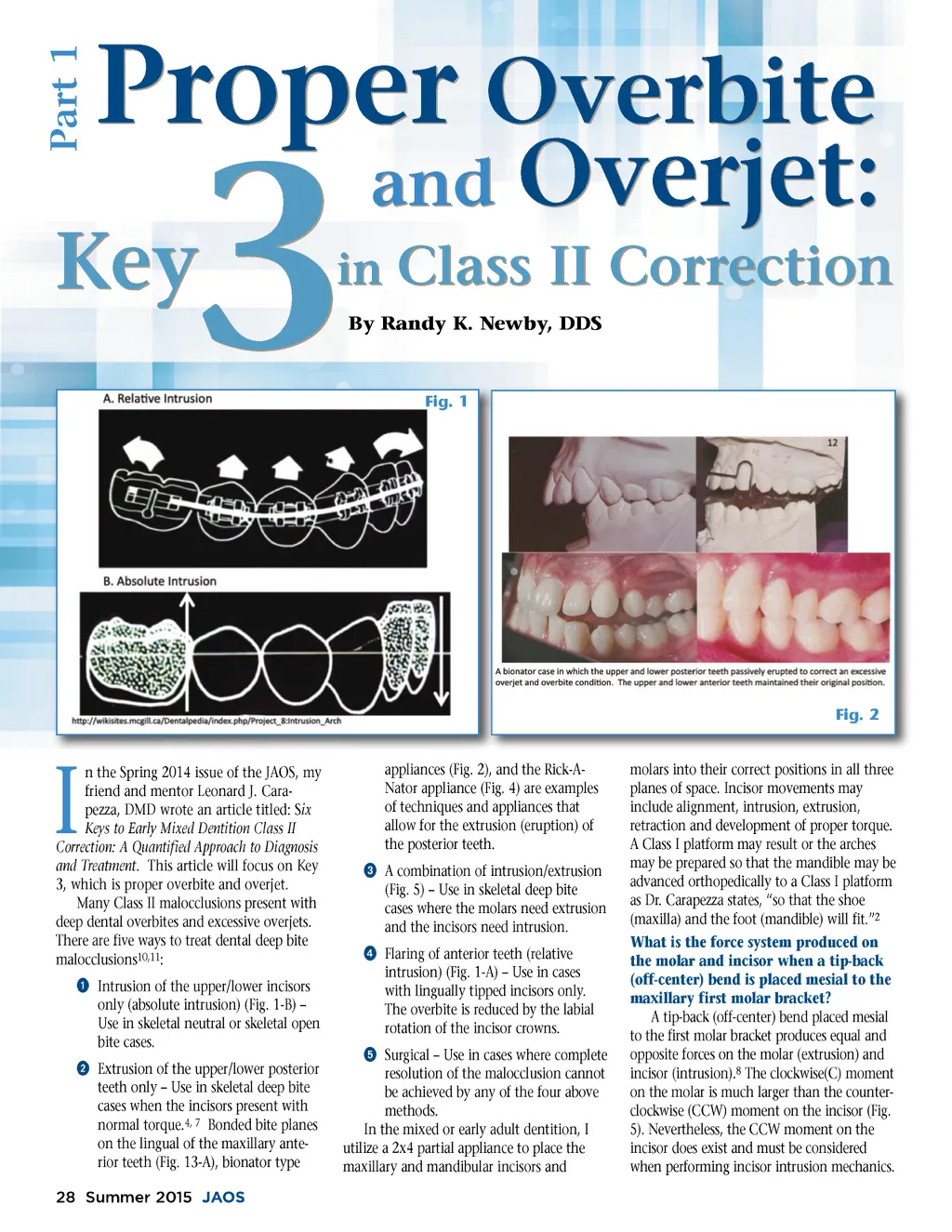
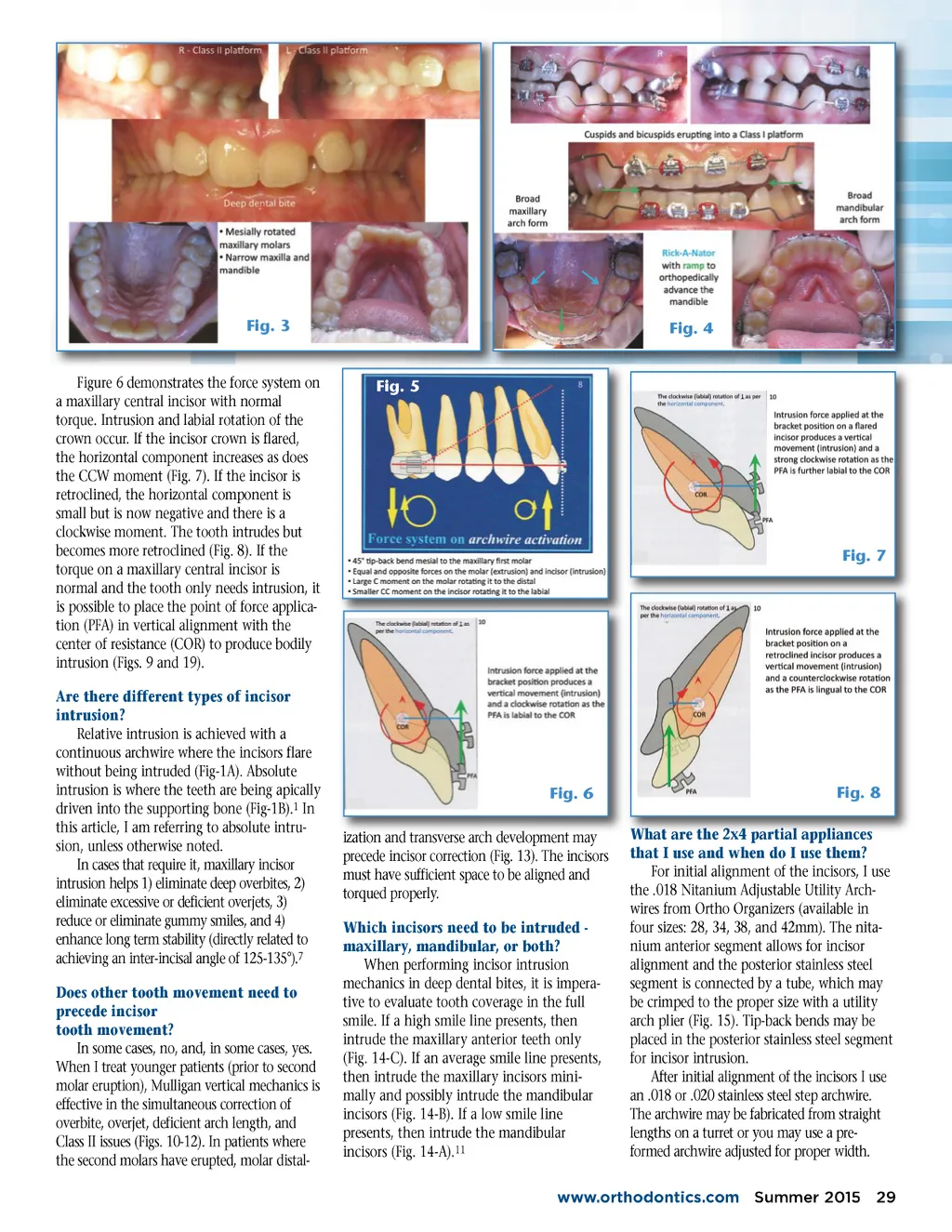
Part 1 Proper Overbite Key 3 and Overjet: II Correction in Class Fig. 1 By Randy K. Newby, DDS Fig. 2 I n the Spring 2014 issue of the JAOS, my friend and mentor Leonard J. Cara-pezza, DMD wrote an article titled: S ix Keys to Early Mixed Dentition Class II Correction: A Quantified Approach to Diagnosis and Treatment . This article will focus on Key 3, which is proper overbite and overjet. Many Class II malocclusions present with deep dental overbites and excessive overjets. There are five ways to treat dental deep bite malocclusions 10,11 : ᕡ Intrusion of the upper/lower incisors only (absolute intrusion) (Fig. 1-B) – Use in skeletal neutral or skeletal open bite cases. ᕢ Extrusion of the upper/lower posterior teeth only – Use in skeletal deep bite cases when the incisors present with normal torque. 4, 7 Bonded bite planes on the lingual of the maxillary ante-rior teeth (Fig. 13-A), bionator type appliances (Fig. 2), and the Rick-A-Nator appliance (Fig. 4) are examples of techniques and appliances that allow for the extrusion (eruption) of the posterior teeth. ᕣ A combination of intrusion/extrusion (Fig. 5) – Use in skeletal deep bite cases where the molars need extrusion and the incisors need intrusion. ᕤ Flaring of anterior teeth (relative intrusion) (Fig. 1-A) – Use in cases with lingually tipped incisors only. The overbite is reduced by the labial rotation of the incisor crowns. ᕥ Surgical – Use in cases where complete resolution of the malocclusion cannot be achieved by any of the four above methods. In the mixed or early adult dentition, I utilize a 2x4 partial appliance to place the maxillary and mandibular incisors and molars into their correct positions in all three planes of space. Incisor movements may include alignment, intrusion, extrusion, retraction and development of proper torque. A Class I platform may result or the arches may be prepared so that the mandible may be advanced orthopedically to a Class I platform as Dr. Carapezza states, “so that the shoe (maxilla) and the foot (mandible) will fit.” 2 What is the force system produced on the molar and incisor when a tip-back (off-center) bend is placed mesial to the maxillary first molar bracket? A tip-back (off-center) bend placed mesial to the first molar bracket produces equal and opposite forces on the molar (extrusion) and incisor (intrusion). 8 The clockwise(C) moment on the molar is much larger than the counter-clockwise (CCW) moment on the incisor (Fig. 5). Nevertheless, the CCW moment on the incisor does exist and must be considered when performing incisor intrusion mechanics. 28 Summer 2015 JAOS
Journal of the American Orthodontic Society Summer 2015-Buyer's Guide: Page 28