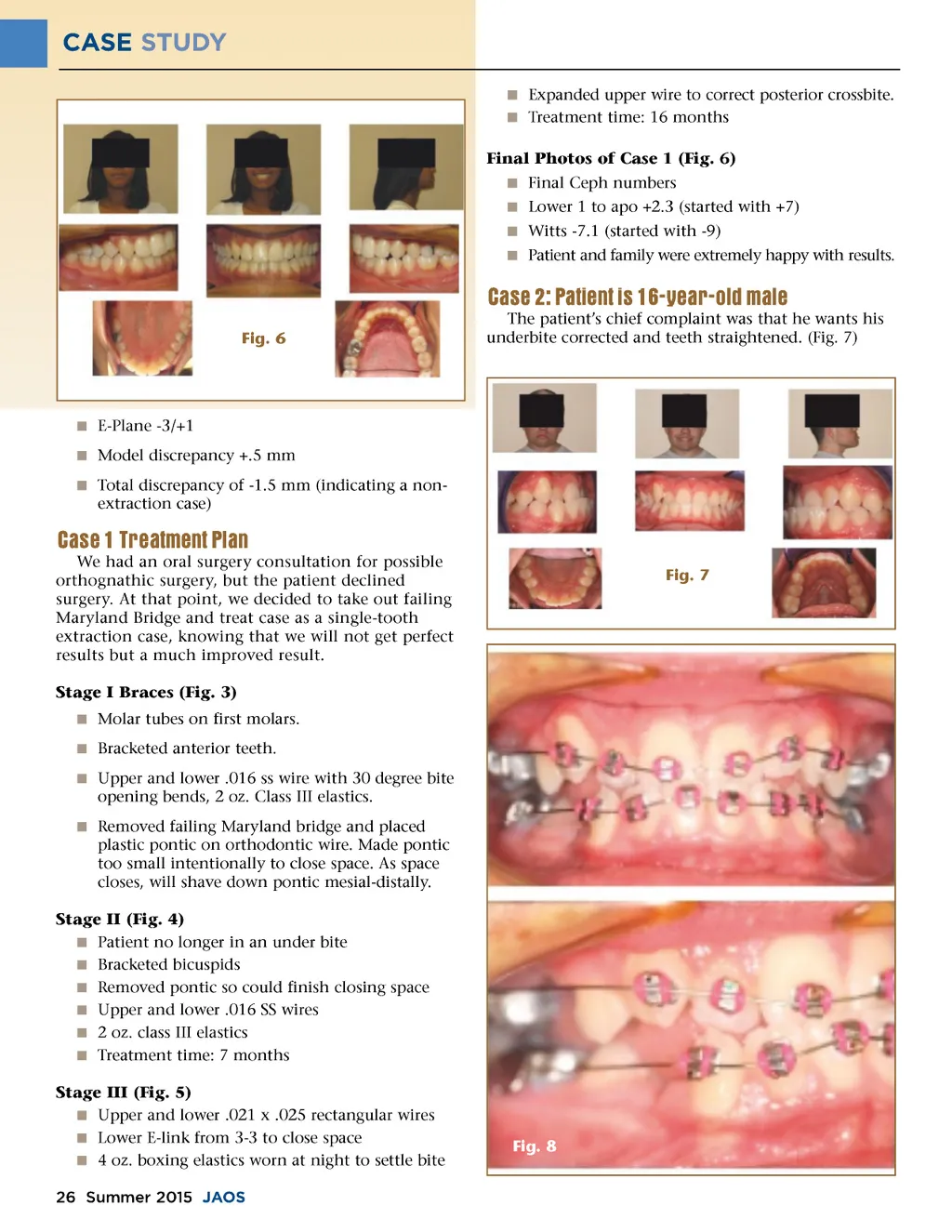
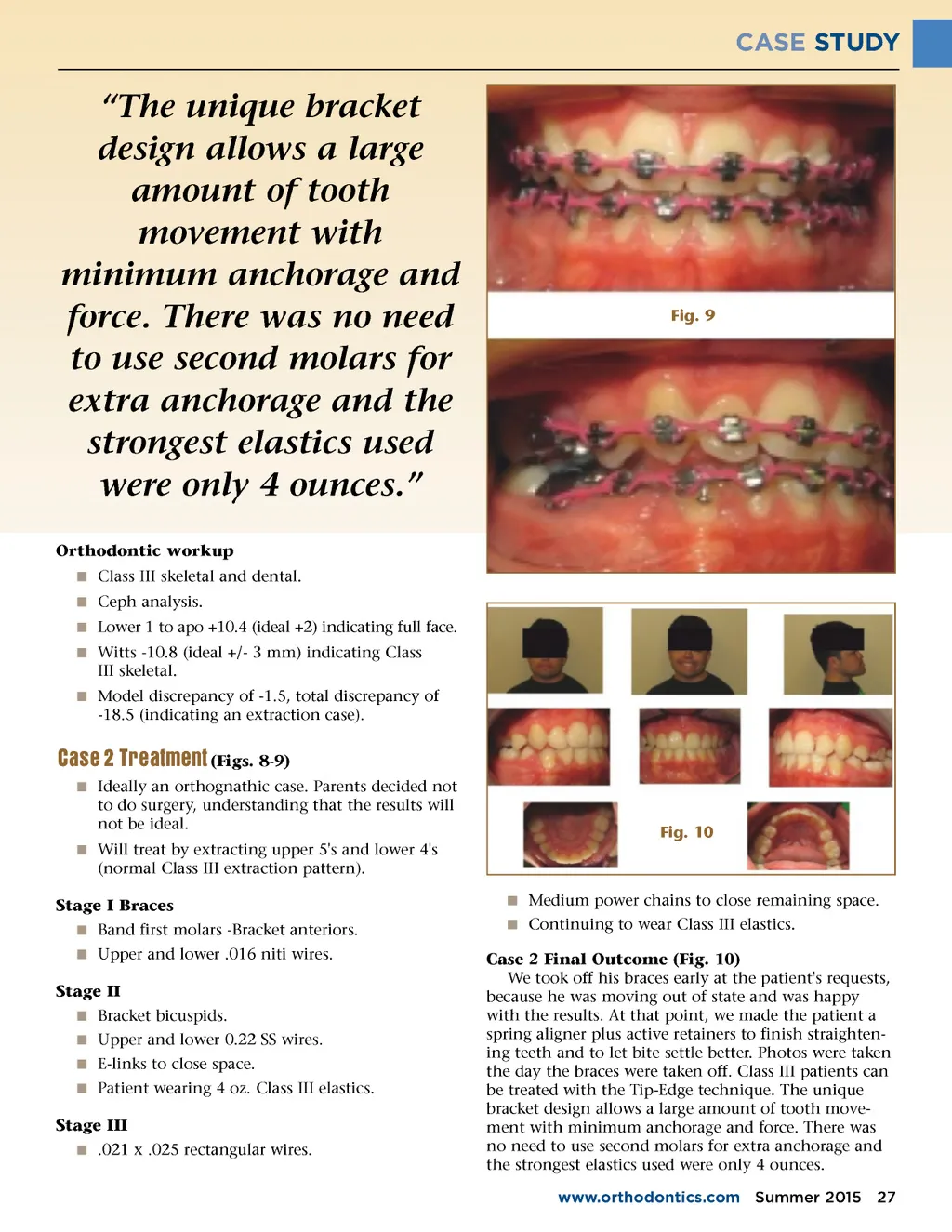
CASE STUDY “The unique bracket design allows a large amount of tooth movement with minimum anchorage and force. There was no need to use second molars for extra anchorage and the strongest elastics used were only 4 ounces.” Orthodontic workup Class III skeletal and dental. Ceph analysis. Lower 1 to apo +10.4 (ideal +2) indicating full face. Witts -10.8 (ideal +/-3 mm) indicating Class III skeletal. Model discrepancy of -1.5, total discrepancy of -18.5 (indicating an extraction case). Fig. 9 Case 2 Treatment (Figs. 8-9) Ideally an orthognathic case. Parents decided not to do surgery, understanding that the results will not be ideal. Will treat by extracting upper 5's and lower 4's (normal Class III extraction pattern). Stage I Braces Band first molars -Bracket anteriors. Upper and lower .016 niti wires. Stage II Bracket bicuspids. Upper and lower 0.22 SS wires. E-links to close space. Patient wearing 4 oz. Class III elastics. Stage III .021 x .025 rectangular wires. Fig. 10 Medium power chains to close remaining space. Continuing to wear Class III elastics. Case 2 Final Outcome (Fig. 10) We took off his braces early at the patient's requests, because he was moving out of state and was happy with the results. At that point, we made the patient a spring aligner plus active retainers to finish straighten-ing teeth and to let bite settle better. Photos were taken the day the braces were taken off. Class III patients can be treated with the Tip-Edge technique. The unique bracket design allows a large amount of tooth move-ment with minimum anchorage and force. There was no need to use second molars for extra anchorage and the strongest elastics used were only 4 ounces. www.orthodontics.com Summer 2015 27
Journal of the American Orthodontic Society Summer 2015-Buyer's Guide: Page 27