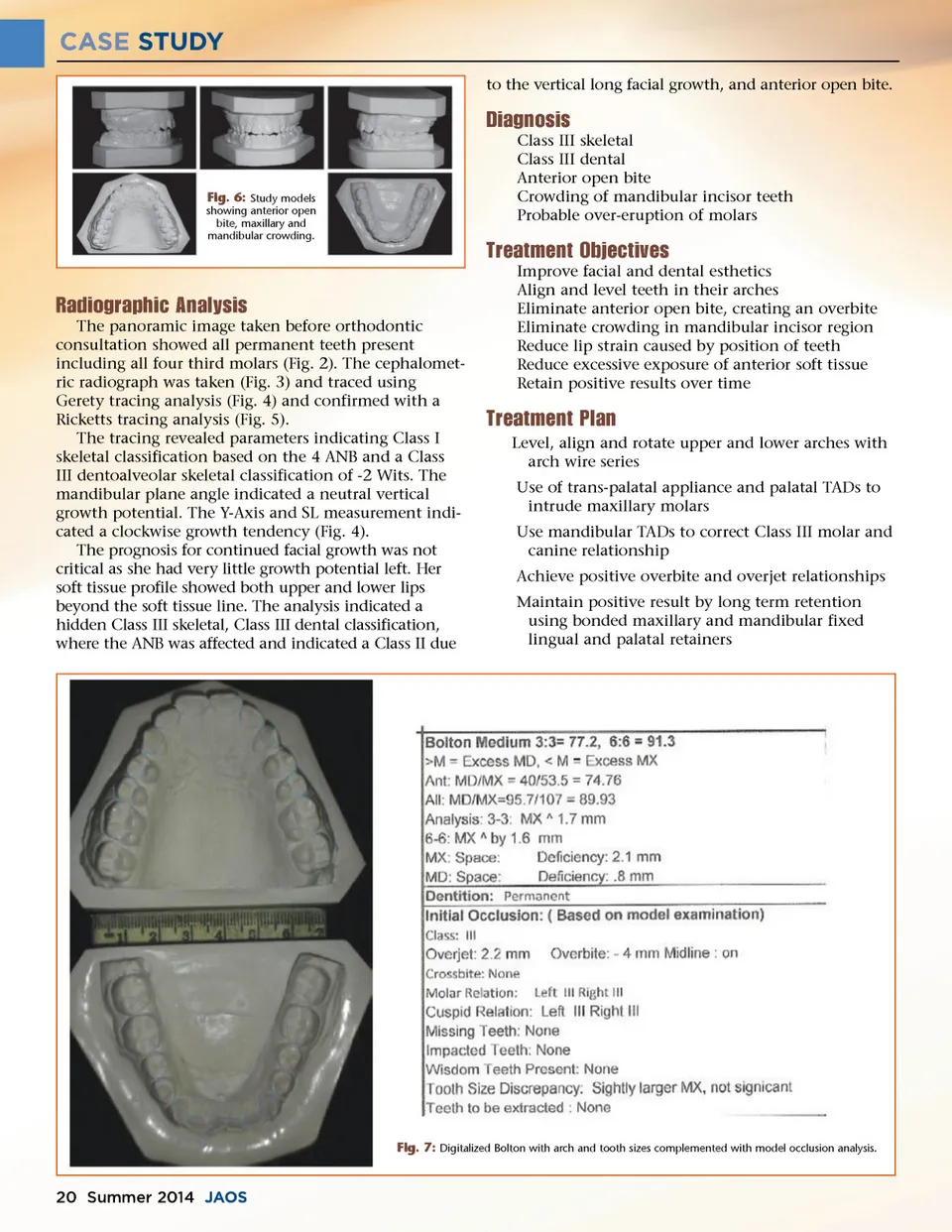
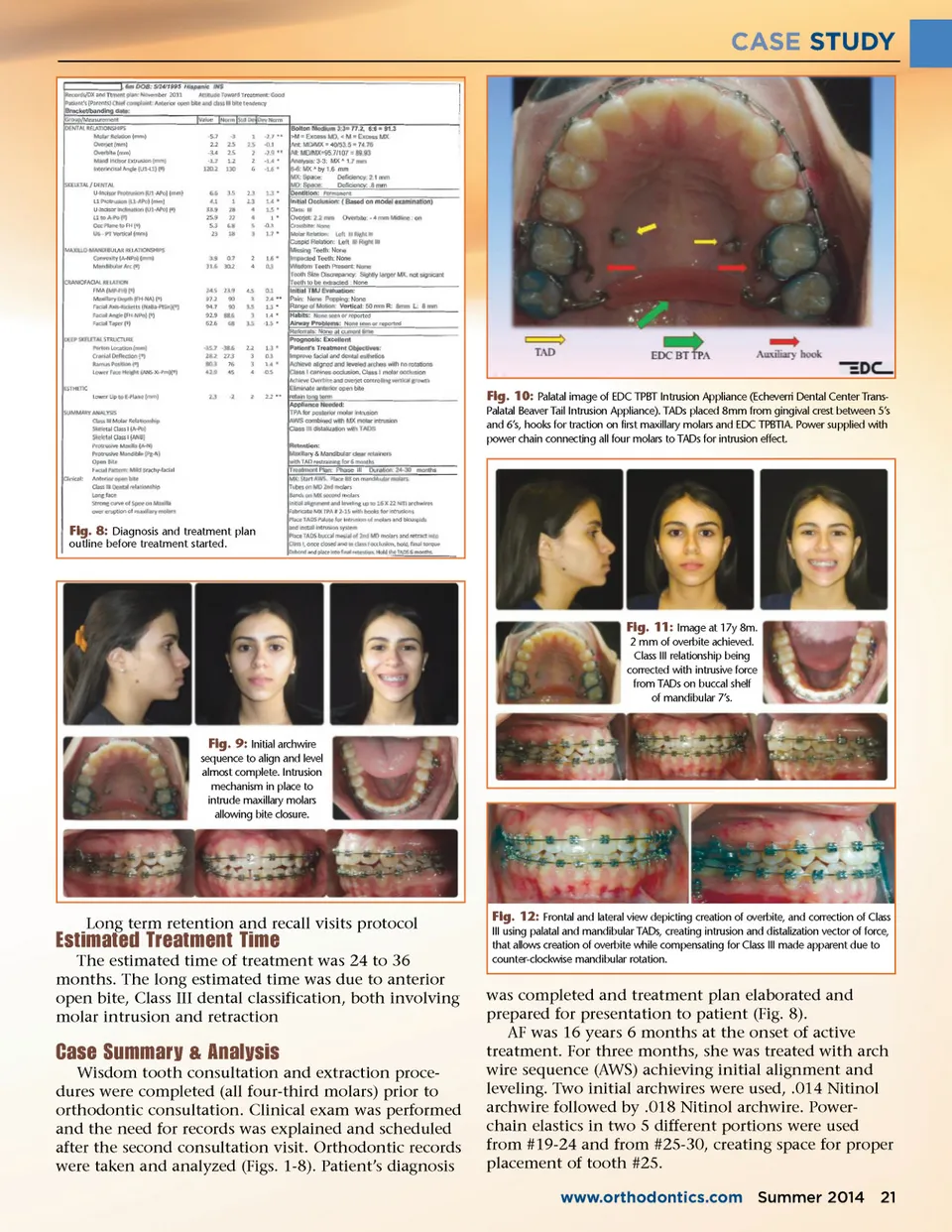
CASE STUDY Fig. 10: Palatal image of EDC TPBT Intrusion Appliance (Echeverri Dental Center Trans-Palatal Beaver Tail Intrusion Appliance). TADs placed 8mm from gingival crest between 5’s and 6’s, hooks for traction on first maxillary molars and EDC TPBTIA. Power supplied with power chain connecting all four molars to TADs for intrusion effect. Fig. 8: Diagnosis and treatment plan outline before treatment started. Fig. 11: Image at 17y 8m. 2 mm of overbite achieved. Class III relationship being corrected with intrusive force from TADs on buccal shelf of mandibular 7’s. Fig. 9: Initial archwire sequence to align and level almost complete. Intrusion mechanism in place to intrude maxillary molars allowing bite closure. Estimated Treatment Time Long term retention and recall visits protocol The estimated time of treatment was 24 to 36 months. The long estimated time was due to anterior open bite, Class III dental classification, both involving molar intrusion and retraction Fig. 12: Frontal and lateral view depicting creation of overbite, and correction of Class III using palatal and mandibular TADs, creating intrusion and distalization vector of force, that allows creation of overbite while compensating for Class III made apparent due to counter-clockwise mandibular rotation. Case Summary & Analysis Wisdom tooth consultation and extraction proce-dures were completed (all four-third molars) prior to orthodontic consultation. Clinical exam was performed and the need for records was explained and scheduled after the second consultation visit. Orthodontic records were taken and analyzed (Figs. 1-8). Patient’s diagnosis was completed and treatment plan elaborated and prepared for presentation to patient (Fig. 8). AF was 16 years 6 months at the onset of active treatment. For three months, she was treated with arch wire sequence (AWS) achieving initial alignment and leveling. Two initial archwires were used, .014 Nitinol archwire followed by .018 Nitinol archwire. Power-chain elastics in two 5 different portions were used from #19-24 and from #25-30, creating space for proper placement of tooth #25. www.orthodontics.com Summer 2014 21
Journal of the American Orthodontic Society Summer 2014 / Buyer's Guide: Page 21