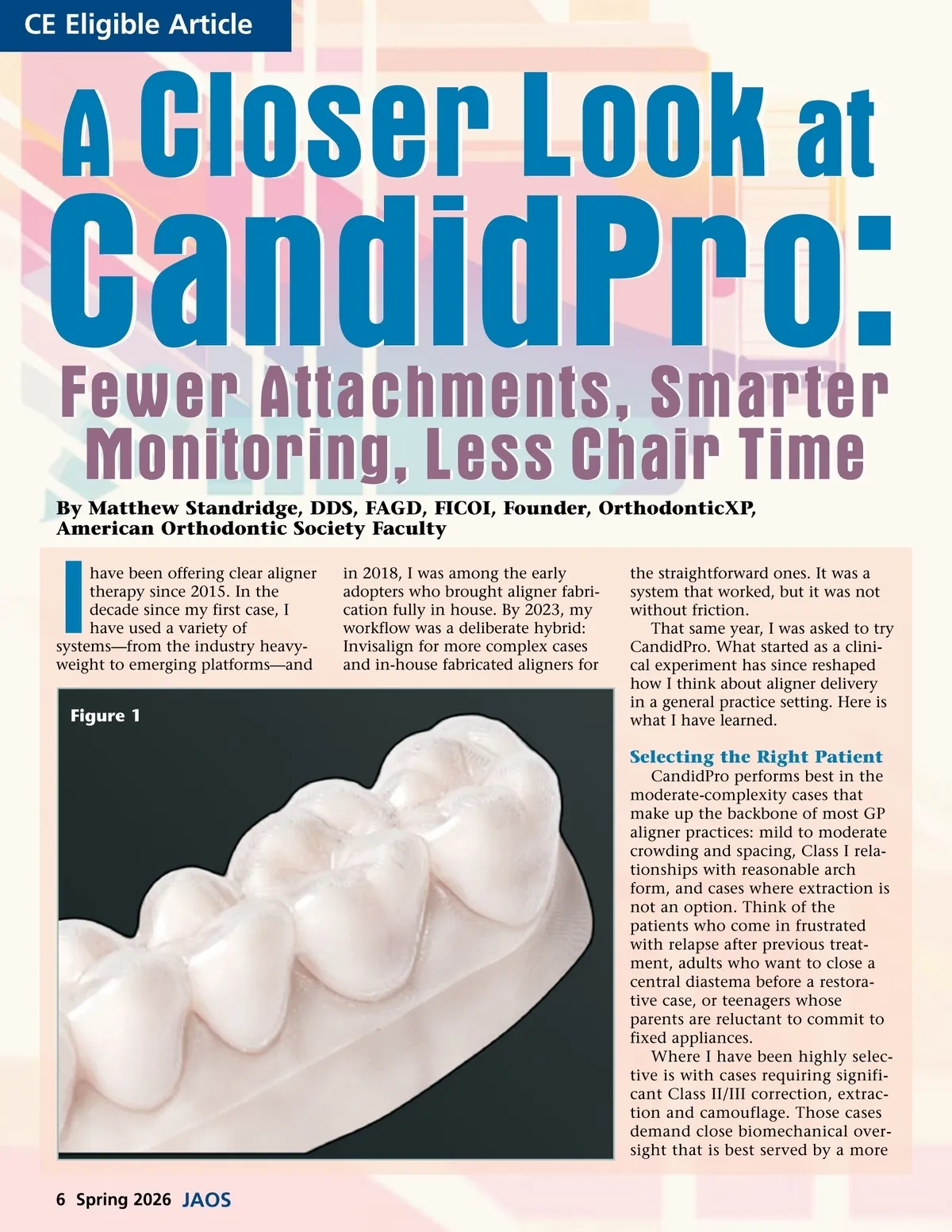
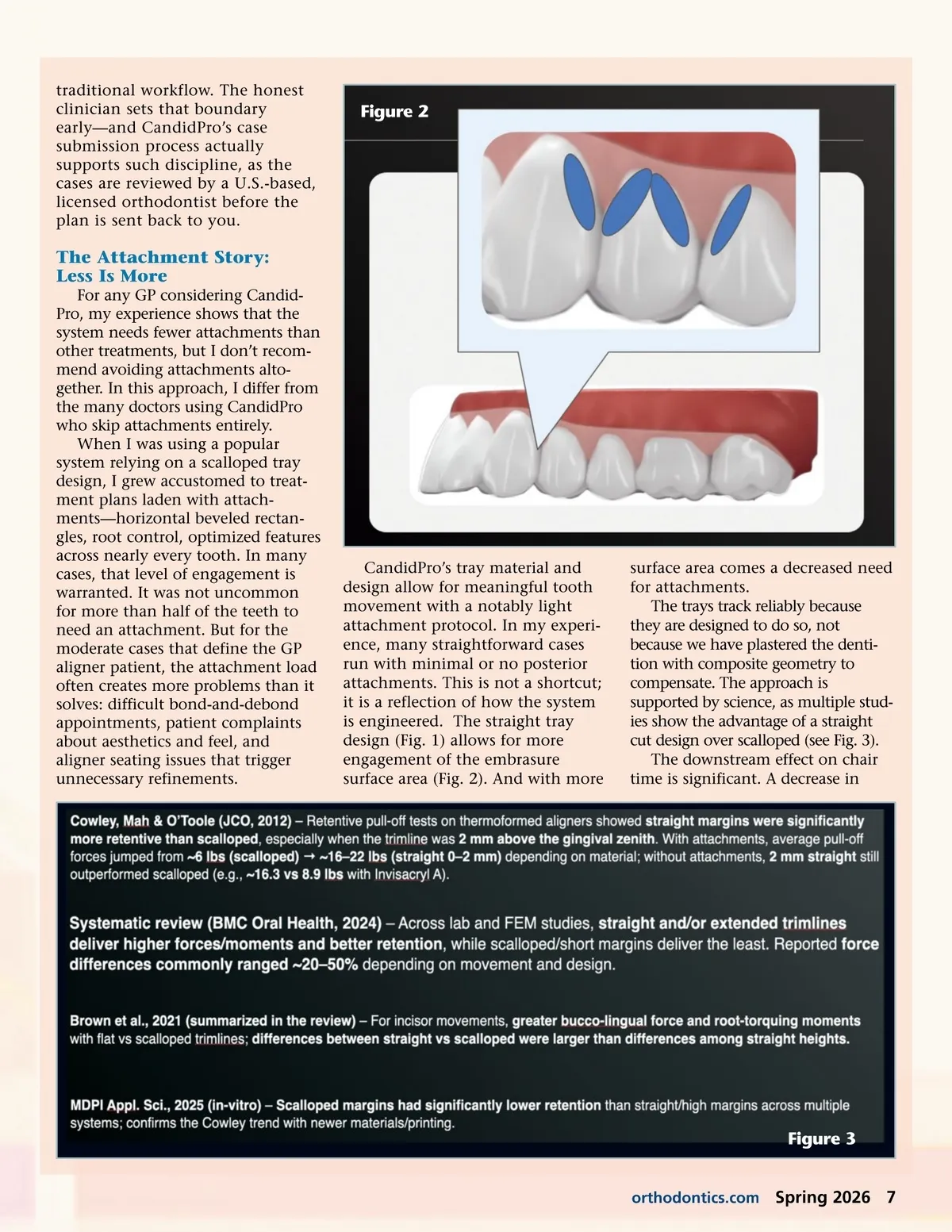
traditional workflow. The honest clinician sets that boundary early—and CandidPro’s case submission process actually supports such discipline, as the cases are reviewed by a U.S.-based, licensed orthodontist before the plan is sent back to you. Figure 2 The Attachment Story: Less Is More For any GP considering Candid-Pro, my experience shows that the system needs fewer attachments than other treatments, but I don’t recom-mend avoiding attachments alto-gether. In this approach, I differ from the many doctors using CandidPro who skip attachments entirely. When I was using a popular system relying on a scalloped tray design, I grew accustomed to treat-ment plans laden with attach-ments—horizontal beveled rectan-gles, root control, optimized features across nearly every tooth. In many cases, that level of engagement is warranted. It was not uncommon for more than half of the teeth to need an attachment. But for the moderate cases that define the GP aligner patient, the attachment load often creates more problems than it solves: difficult bond-and-debond appointments, patient complaints about aesthetics and feel, and aligner seating issues that trigger unnecessary refinements. CandidPro’s tray material and design allow for meaningful tooth movement with a notably light attachment protocol. In my experi-ence, many straightforward cases run with minimal or no posterior attachments. This is not a shortcut; it is a reflection of how the system is engineered. The straight tray design (Fig. 1) allows for more engagement of the embrasure surface area (Fig. 2). And with more surface area comes a decreased need for attachments. The trays track reliably because they are designed to do so, not because we have plastered the denti-tion with composite geometry to compensate. The approach is supported by science, as multiple stud-ies show the advantage of a straight cut design over scalloped (see Fig. 3). The downstream effect on chair time is significant. A decrease in Figure 3 orthodontics.com Spring 2026 7
Journal of the American Orthodontic Society Spring 2026: Page 7