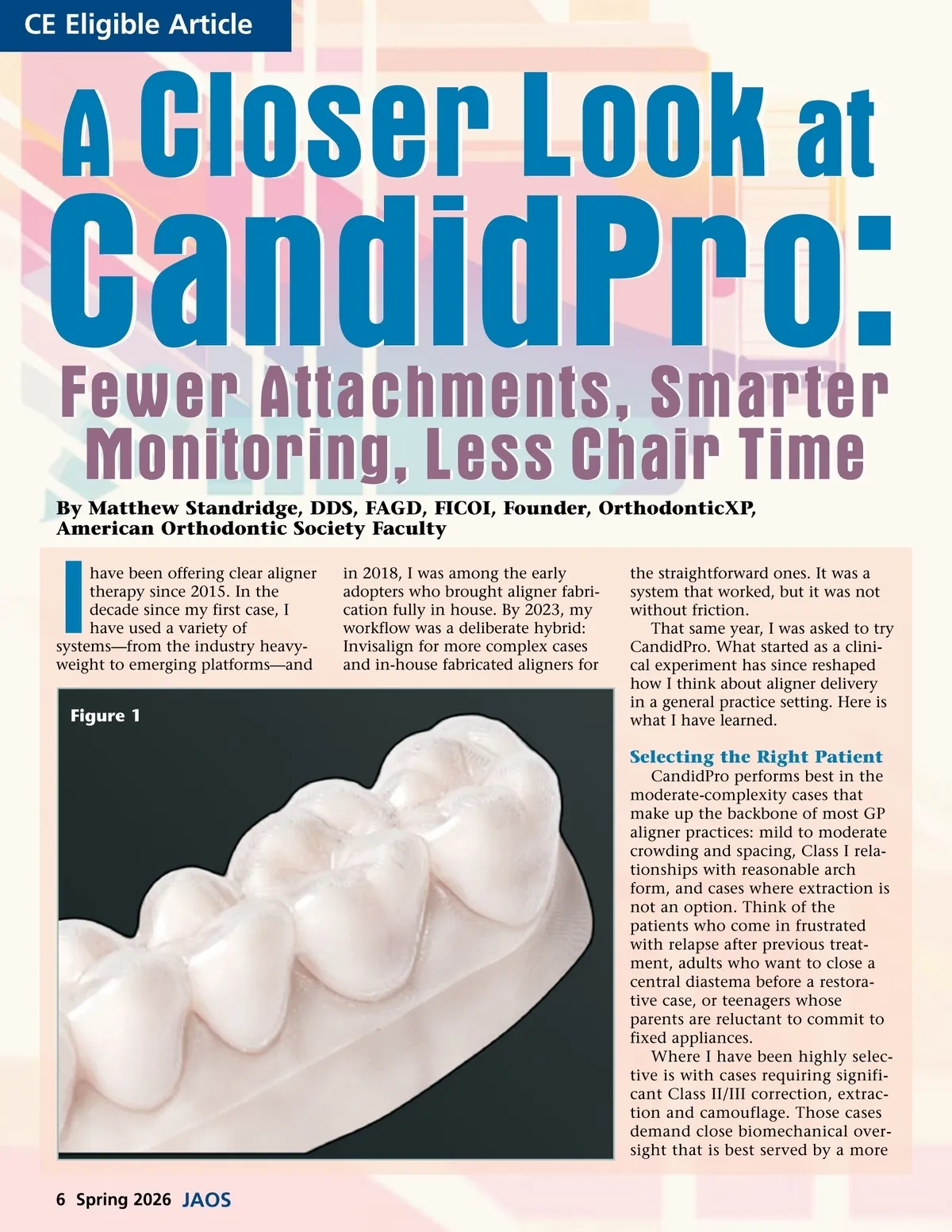
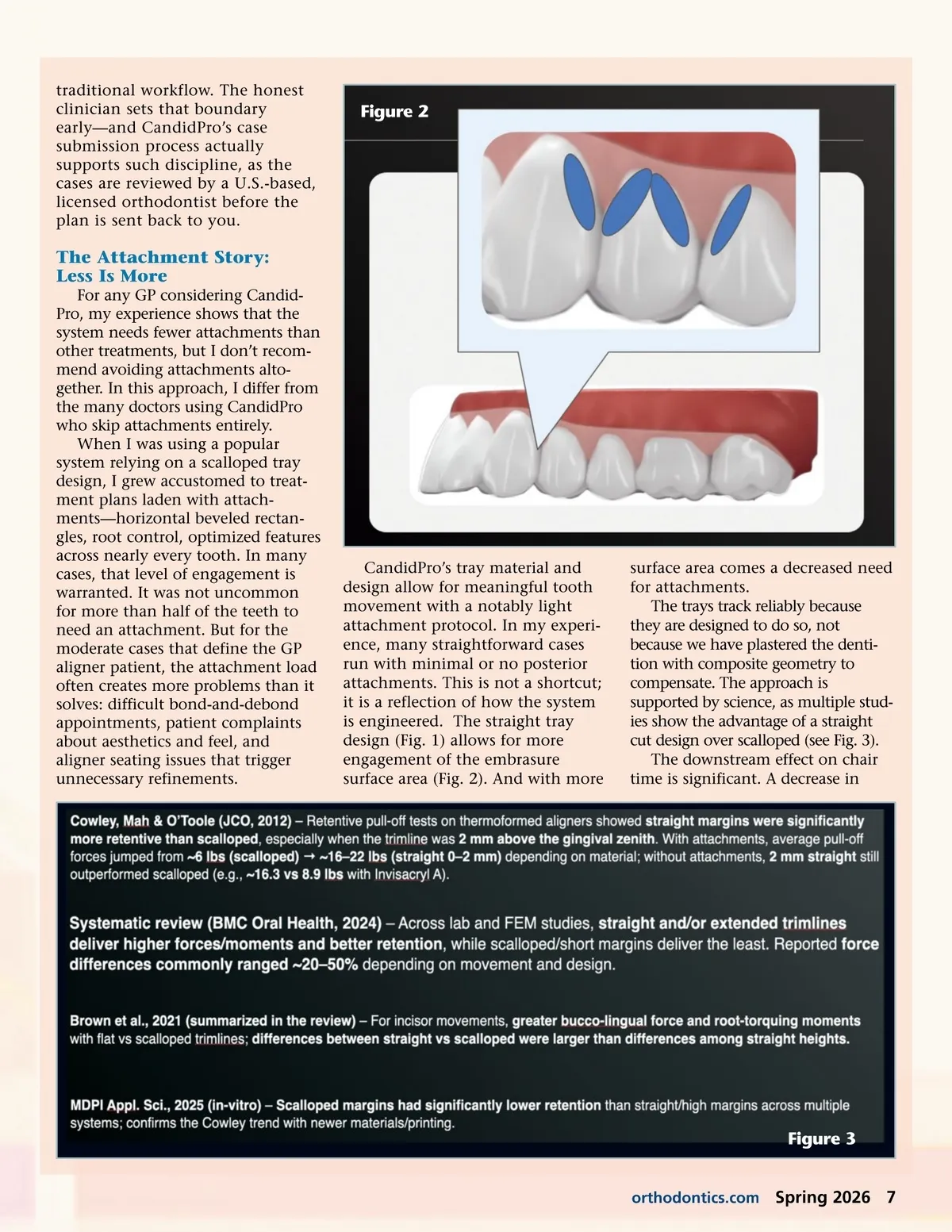
CE Eligible Article A Closer Look at CandidPro: Fewer Attachments, Smarter Monitoring, Less Chair Time By Matthew Standridge, DDS, FAGD, FICOI, Founder, OrthodonticXP, American Orthodontic Society Faculty I have been offering clear aligner therapy since 2015. In the decade since my first case, I have used a variety of systems—from the industry heavy-weight to emerging platforms—and in 2018, I was among the early adopters who brought aligner fabri-cation fully in house. By 2023, my workflow was a deliberate hybrid: Invisalign for more complex cases and in-house fabricated aligners for Figure 1 the straightforward ones. It was a system that worked, but it was not without friction. That same year, I was asked to try CandidPro. What started as a clini-cal experiment has since reshaped how I think about aligner delivery in a general practice setting. Here is what I have learned. Selecting the Right Patient CandidPro performs best in the moderate-complexity cases that make up the backbone of most GP aligner practices: mild to moderate crowding and spacing, Class I rela-tionships with reasonable arch form, and cases where extraction is not an option. Think of the patients who come in frustrated with relapse after previous treat-ment, adults who want to close a central diastema before a restora-tive case, or teenagers whose parents are reluctant to commit to fixed appliances. Where I have been highly selec-tive is with cases requiring signifi-cant Class II/III correction, extrac-tion and camouflage. Those cases demand close biomechanical over-sight that is best served by a more 6 Spring 2026 JAOS
Journal of the American Orthodontic Society Spring 2026: Page 6