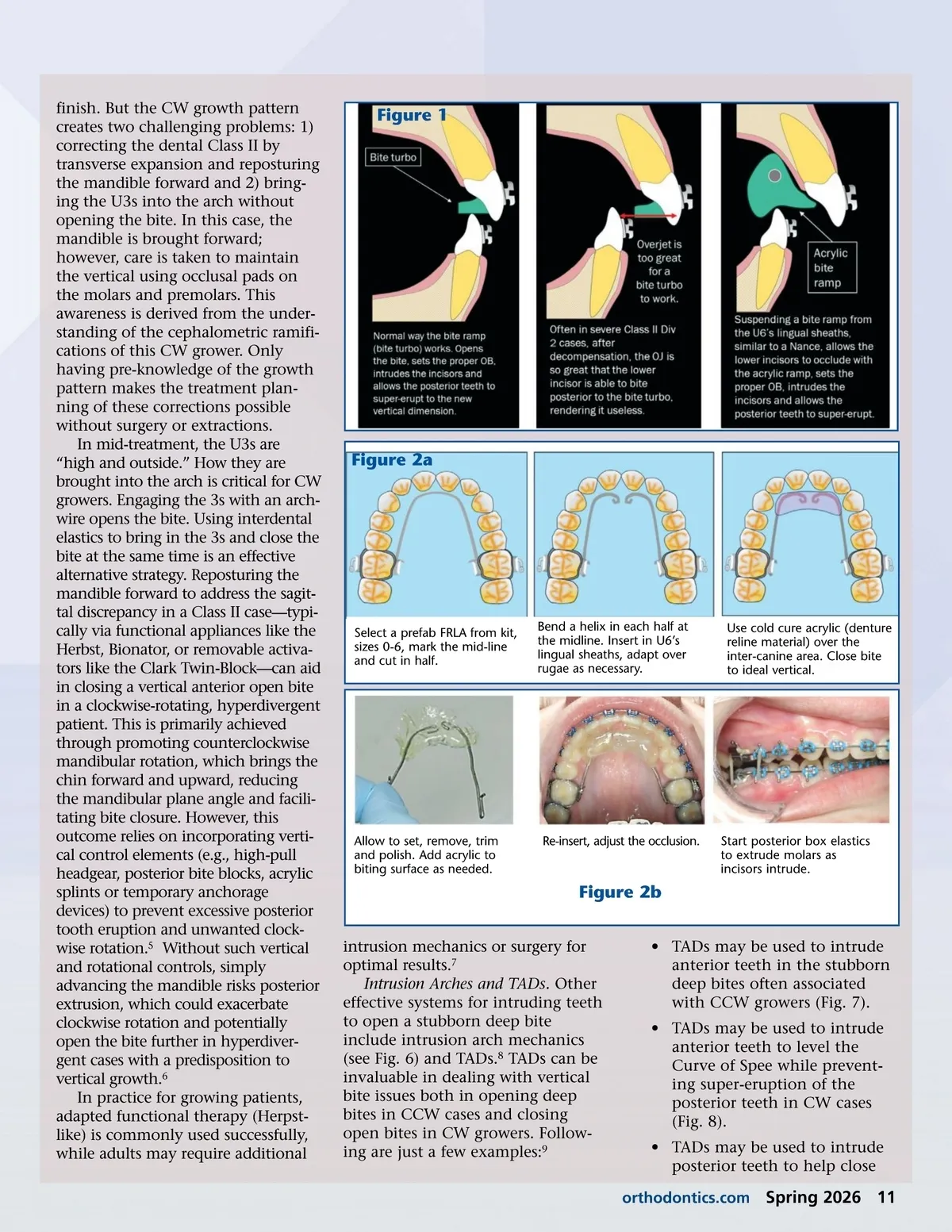
finish. But the CW growth pattern creates two challenging problems: 1) correcting the dental Class II by transverse expansion and reposturing the mandible forward and 2) bring-ing the U3s into the arch without opening the bite. In this case, the mandible is brought forward; however, care is taken to maintain the vertical using occlusal pads on the molars and premolars. This awareness is derived from the under-standing of the cephalometric ramifi-cations of this CW grower. Only having pre-knowledge of the growth pattern makes the treatment plan-ning of these corrections possible without surgery or extractions. In mid-treatment, the U3s are “high and outside.” How they are brought into the arch is critical for CW growers. Engaging the 3s with an arch-wire opens the bite. Using interdental elastics to bring in the 3s and close the bite at the same time is an effective alternative strategy. Reposturing the mandible forward to address the sagit-tal discrepancy in a Class II case—typi-cally via functional appliances like the Herbst, Bionator, or removable activa-tors like the Clark Twin-Block—can aid in closing a vertical anterior open bite in a clockwise-rotating, hyperdivergent patient. This is primarily achieved through promoting counterclockwise mandibular rotation, which brings the chin forward and upward, reducing the mandibular plane angle and facili-tating bite closure. However, this outcome relies on incorporating verti-cal control elements (e.g., high-pull headgear, posterior bite blocks, acrylic splints or temporary anchorage devices) to prevent excessive posterior tooth eruption and unwanted clock-wise rotation. 5 Without such vertical and rotational controls, simply advancing the mandible risks posterior extrusion, which could exacerbate clockwise rotation and potentially open the bite further in hyperdiver-gent cases with a predisposition to vertical growth. 6 In practice for growing patients, adapted functional therapy (Herpst-like) is commonly used successfully, while adults may require additional Figure 1 Figure 2a Select a prefab FRLA from kit, sizes 0-6, mark the mid-line and cut in half. Bend a helix in each half at the midline. Insert in U6’s lingual sheaths, adapt over rugae as necessary. Use cold cure acrylic (denture reline material) over the inter-canine area. Close bite to ideal vertical. Allow to set, remove, trim and polish. Add acrylic to biting surface as needed. Re-insert, adjust the occlusion. Start posterior box elastics to extrude molars as incisors intrude. Figure 2b intrusion mechanics or surgery for optimal results. 7 Intrusion Arches and TADs. Other effective systems for intruding teeth to open a stubborn deep bite include intrusion arch mechanics (see Fig. 6) and TADs. 8 TADs can be invaluable in dealing with vertical bite issues both in opening deep bites in CCW cases and closing open bites in CW growers. Follow-ing are just a few examples: 9 • TADs may be used to intrude anterior teeth in the stubborn deep bites often associated with CCW growers (Fig. 7). • TADs may be used to intrude anterior teeth to level the Curve of Spee while prevent-ing super-eruption of the posterior teeth in CW cases (Fig. 8). • TADs may be used to intrude posterior teeth to help close orthodontics.com Spring 2026 11
Journal of the American Orthodontic Society Spring 2026: Page 11