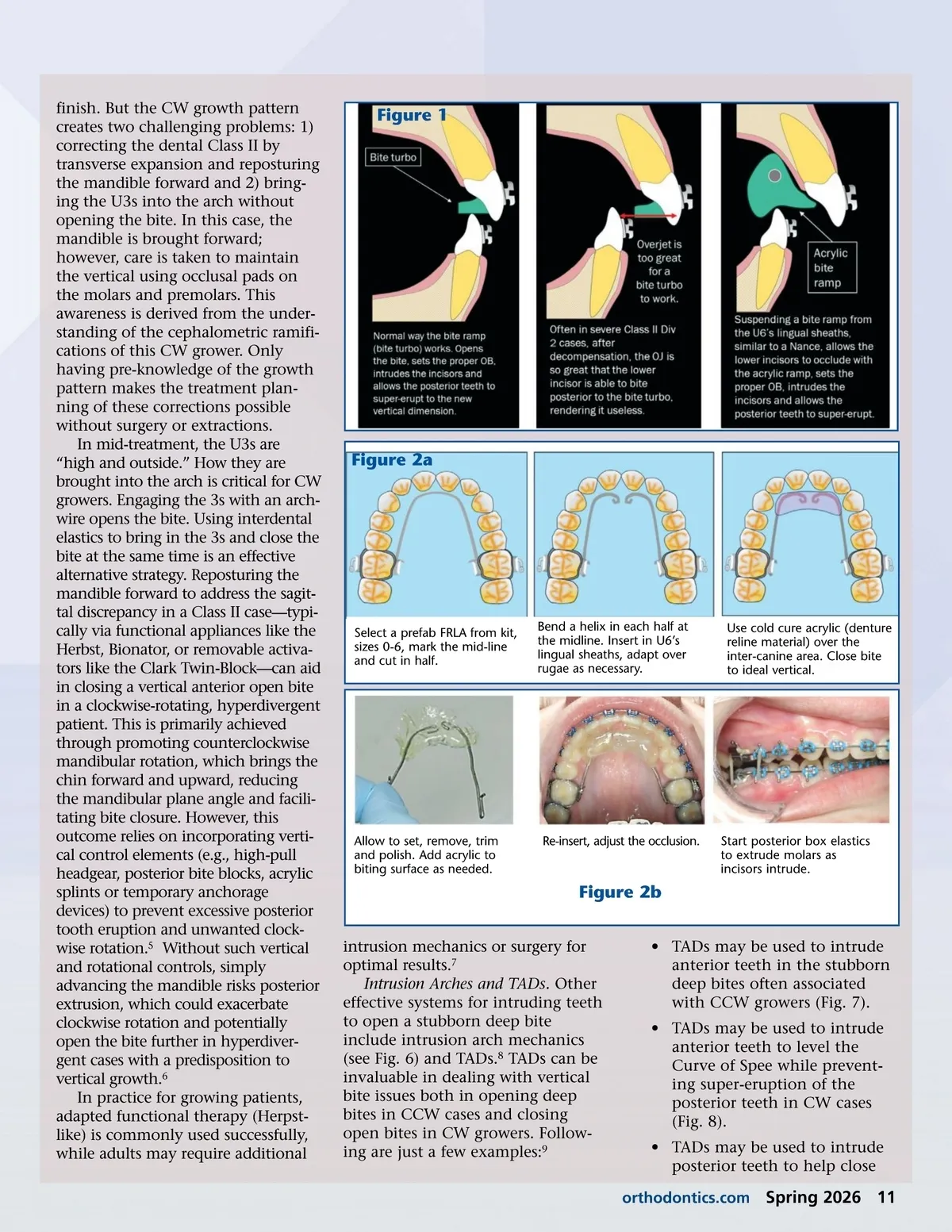
CE Eligible Article THE ENDURING VALUE OF CEPHALOMETRIC ANALYSIS IN ORTHODONTIC TREATMENT PLANNING: Insights Into Growth Patterns for Conventional Comprehensive Fixed-Appliance Therapy-Part 2 By Brad Williams, DDS Editor’s Note: This is the continuation of a two-part series on cephalometric analysis. Part 1 appeared in the Winter 2026 issue of JAOS . B uilding on the founda-tional role of cephalomet-ric analysis established in Part 1 of this series, this article explores advanced applica-tions for managing complex orthodontic cases with conventional fixed appliances. While Part 1 emphasized the importance of identifying mandibu-lar growth patterns—clockwise (CW) hyperdivergent and counterclock-wise (CCW) hypodivergent—for overbite management in neutral growers and decision-making regard-ing treatment or referral, Part 2 explores tailored strategies for addressing overbite in CW and CCW growers, transverse arch expansion, mandibular and maxillary reposi-tioning, and the feasibility of molar distalization. These approaches, informed by cephalometric metrics such as mandibular plane angle, gonial angle and occlusal plane incli-nation, enable precise, evidence-based interventions that account for growth patterns' impact on treat-ment stability and outcomes. 1 By examining the techniques, this arti-cle challenges the oversimplification of orthodontic continuing educa-tion, advocating for comprehensive cephalometric training to optimize non-surgical treatment planning for general practitioners. Alternative Approaches In Part 1, we examined the bene-fits of bite turbos in opening deep bites in neutral and CCW growers. Although the bite turbo (Fig.1) is an effective solution for stubborn deep bite cases, it does not always work. In cases with significant OJ (>6mm), which often occur in Class II cases and particularly Division 2 cases after decompensation, the bite turbo will not contact the lower incisors. Instead, they will close posterior to them. This requires another approach. 2 Acrylic Bite Plate. The acrylic bite plate is a modification of the Rickana-tor or Nance appliance. Fabricated at chairside, in the mouth, the acrylic bite plate is a simple solution to the overjet dilemma we often encounter with bite turbos (Fig. 2). In the exam-ple shown in Fig. 3, a CCW grower has an extreme deep OB with >6mm OJ and constricted premaxilla. AC upper wires with lower utility arch wires with tip-back (like an intrusion arch) are employed to intrude the lower incisors without success. Bite turbos will not work due to the OJ conditions. An acrylic bite plate is therefore added, and after three months, the Curve of Spee is increas-ingly level. At this point, the arches are expanded with a broad arch form wire series, intended to allow repos-turing with distalization of the maxil-lary teeth to obtain Class I occlusion and stabilize the vertical. Overbite Management in CCW Growers. In the example shown in Fig. 5, a cephalometric analysis reveals a CCW, hypodivergent growth pattern: Gonial angle 110°, SN-GoGn 14°, Y-axis 63° with 100% OB. In treatment planning, based on the CCW pattern, the bite is expected to resist bite opening mechanics and probably will not respond to the straight wire series and AC/RC but will require a more aggressive strategy. 3 Overbite Management in CW Grow-ers. In this example, a cephalometric analysis reveals a CW, hyperdivergent growth pattern: SN-GoGn 45°, Y-axis 75°, Gonial angle 128° with 25% OB. In treatment planning, based on the CW pattern, the bite is expected to open in a conventional straight wire series. The parents refuse orthog-nathic surgery and desire a camou-flage, non-surgical solution if possi-ble. 4 On its face, there is nothing remarkable about this case or its 10 Spring 2026 JAOS
Journal of the American Orthodontic Society Spring 2026: Page 10