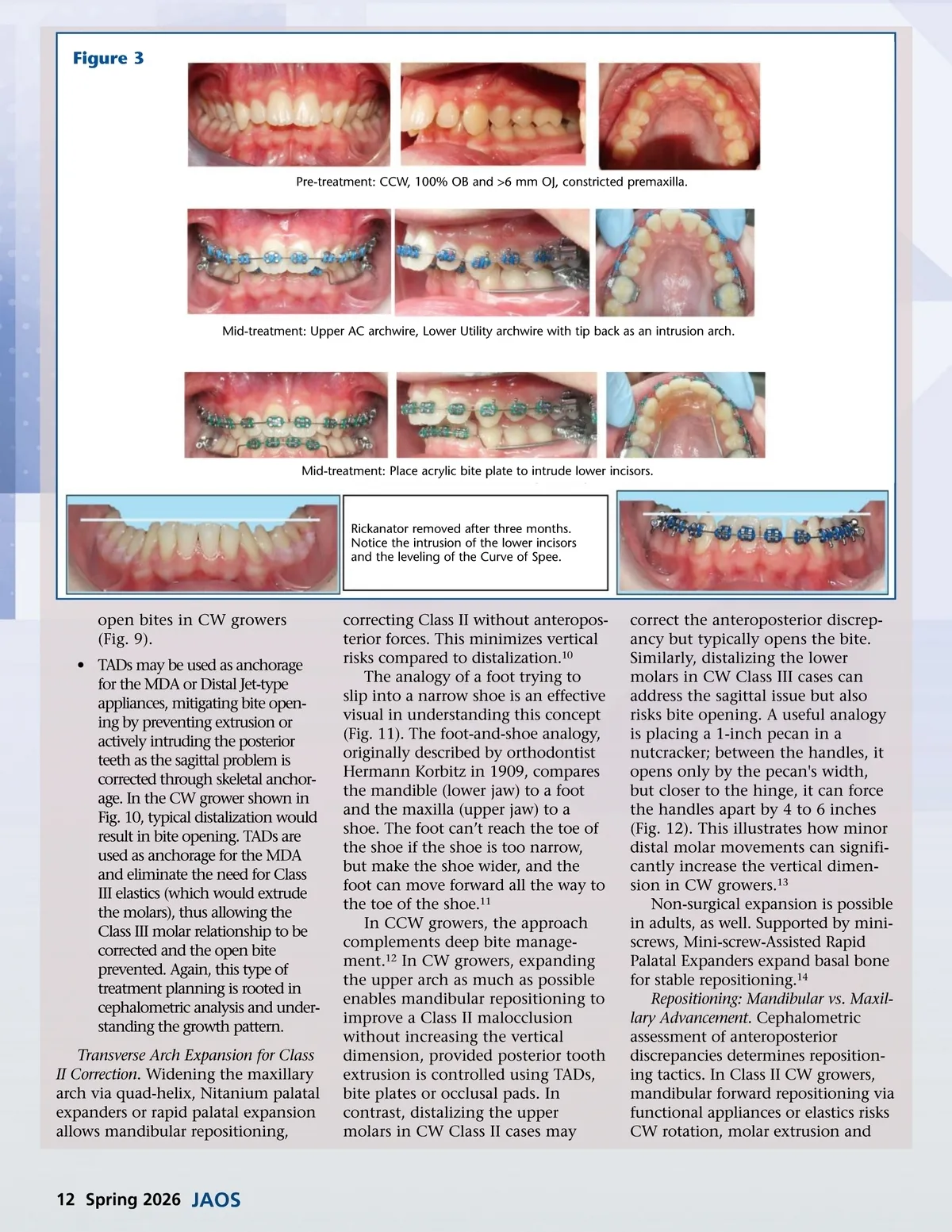
Figure 3 Pre-treatment: CCW, 100% OB and >6 mm OJ, constricted premaxilla. Mid-treatment: Upper AC archwire, Lower Utility archwire with tip back as an intrusion arch. Mid-treatment: Place acrylic bite plate to intrude lower incisors. Rickanator removed after three months. Notice the intrusion of the lower incisors and the leveling of the Curve of Spee. open bites in CW growers (Fig. 9). • TADs may be used as anchorage for the MDA or Distal Jet-type appliances, mitigating bite open-ing by preventing extrusion or actively intruding the posterior teeth as the sagittal problem is corrected through skeletal anchor-age. In the CW grower shown in Fig. 10, typical distalization would result in bite opening. TADs are used as anchorage for the MDA and eliminate the need for Class III elastics (which would extrude the molars), thus allowing the Class III molar relationship to be corrected and the open bite prevented. Again, this type of treatment planning is rooted in cephalometric analysis and under-standing the growth pattern. Transverse Arch Expansion for Class II Correction . Widening the maxillary arch via quad-helix, Nitanium palatal expanders or rapid palatal expansion allows mandibular repositioning, correcting Class II without anteropos-terior forces. This minimizes vertical risks compared to distalization. 10 The analogy of a foot trying to slip into a narrow shoe is an effective visual in understanding this concept (Fig. 11). The foot-and-shoe analogy, originally described by orthodontist Hermann Korbitz in 1909, compares the mandible (lower jaw) to a foot and the maxilla (upper jaw) to a shoe. The foot can’t reach the toe of the shoe if the shoe is too narrow, but make the shoe wider, and the foot can move forward all the way to the toe of the shoe. 11 In CCW growers, the approach complements deep bite manage-ment. 12 In CW growers, expanding the upper arch as much as possible enables mandibular repositioning to improve a Class II malocclusion without increasing the vertical dimension, provided posterior tooth extrusion is controlled using TADs, bite plates or occlusal pads. In contrast, distalizing the upper molars in CW Class II cases may correct the anteroposterior discrep-ancy but typically opens the bite. Similarly, distalizing the lower molars in CW Class III cases can address the sagittal issue but also risks bite opening. A useful analogy is placing a 1-inch pecan in a nutcracker; between the handles, it opens only by the pecan's width, but closer to the hinge, it can force the handles apart by 4 to 6 inches (Fig. 12). This illustrates how minor distal molar movements can signifi-cantly increase the vertical dimen-sion in CW growers. 13 Non-surgical expansion is possible in adults, as well. Supported by mini-screws, Mini-screw-Assisted Rapid Palatal Expanders expand basal bone for stable repositioning. 14 Repositioning: Mandibular vs. Maxil-lary Advancement . Cephalometric assessment of anteroposterior discrepancies determines reposition-ing tactics. In Class II CW growers, mandibular forward repositioning via functional appliances or elastics risks CW rotation, molar extrusion and 12 Spring 2026 JAOS
Journal of the American Orthodontic Society Spring 2026: Page 12