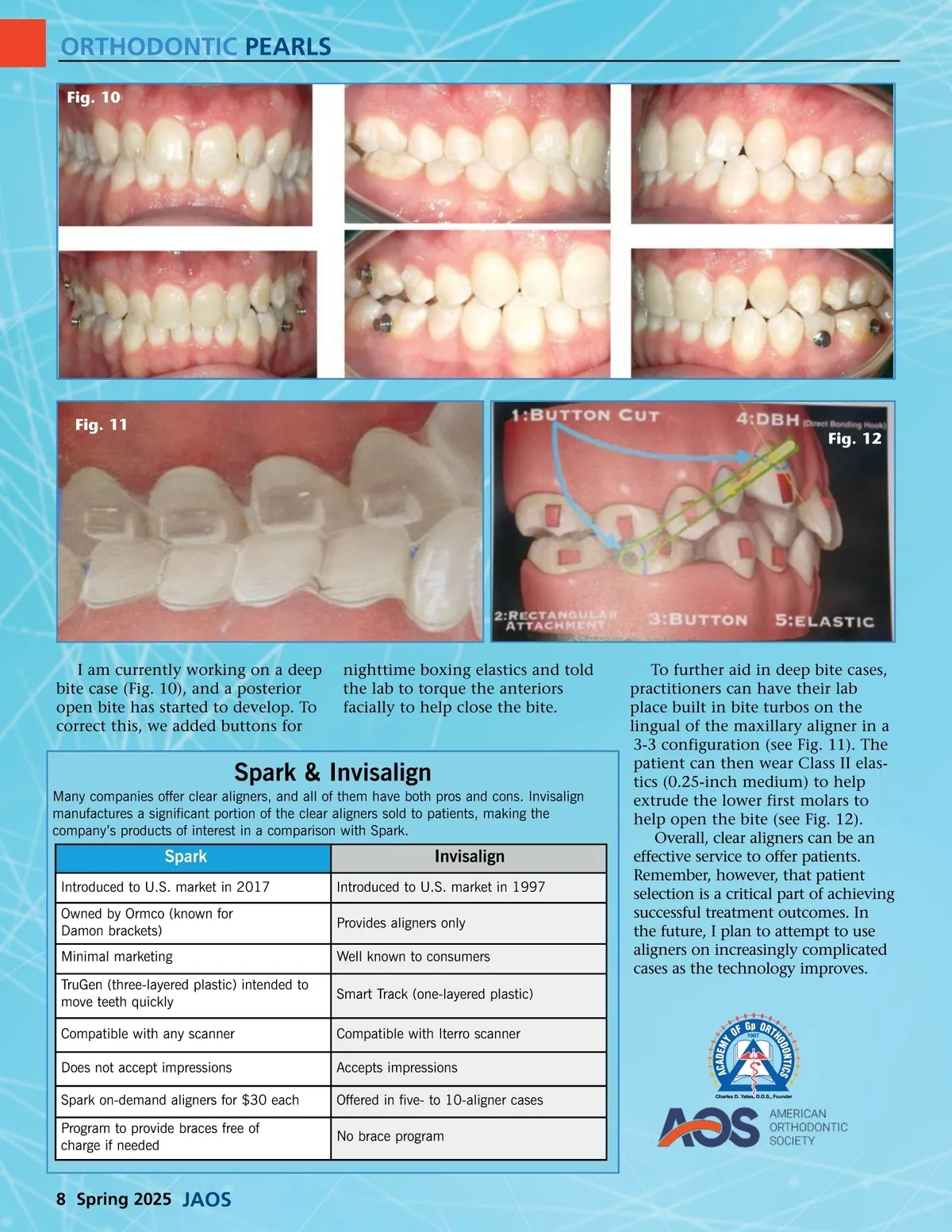
ORTHODONTIC PEARLS Fig. 10 Fig. 11 Fig. 12 I am currently working on a deep bite case (Fig. 10), and a posterior open bite has started to develop. To correct this, we added buttons for nighttime boxing elastics and told the lab to torque the anteriors facially to help close the bite. Spark & Invisalign Many companies offer clear aligners, and all of them have both pros and cons. Invisalign manufactures a significant portion of the clear aligners sold to patients, making the company’s products of interest in a comparison with Spark. Spark Introduced to U.S. market in 2017 Owned by Ormco (known for Damon brackets) Minimal marketing TruGen (three-layered plastic) intended to move teeth quickly Compatible with any scanner Does not accept impressions Spark on-demand aligners for $30 each Program to provide braces free of charge if needed Invisalign Introduced to U.S. market in 1997 Provides aligners only Well known to consumers Smart Track (one-layered plastic) Compatible with Iterro scanner Accepts impressions Offered in five-to 10-aligner cases No brace program To further aid in deep bite cases, practitioners can have their lab place built in bite turbos on the lingual of the maxillary aligner in a 3-3 configuration (see Fig. 11). The patient can then wear Class II elas-tics (0.25-inch medium) to help extrude the lower first molars to help open the bite (see Fig. 12). Overall, clear aligners can be an effective service to offer patients. Remember, however, that patient selection is a critical part of achieving successful treatment outcomes. In the future, I plan to attempt to use aligners on increasingly complicated cases as the technology improves. 8 Spring 2025 JAOS
Journal of the American Orthodontic Society Spring 2025: Page 8