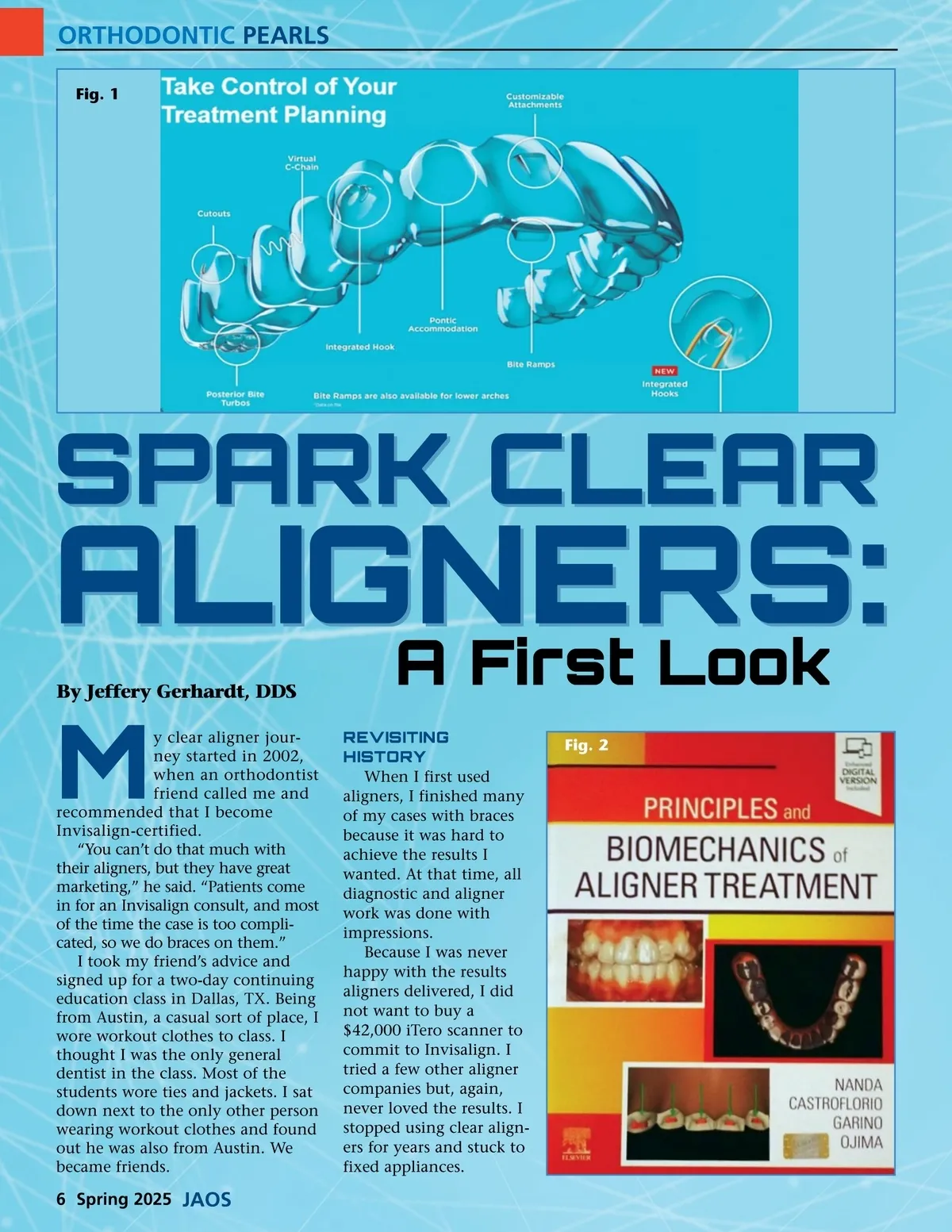
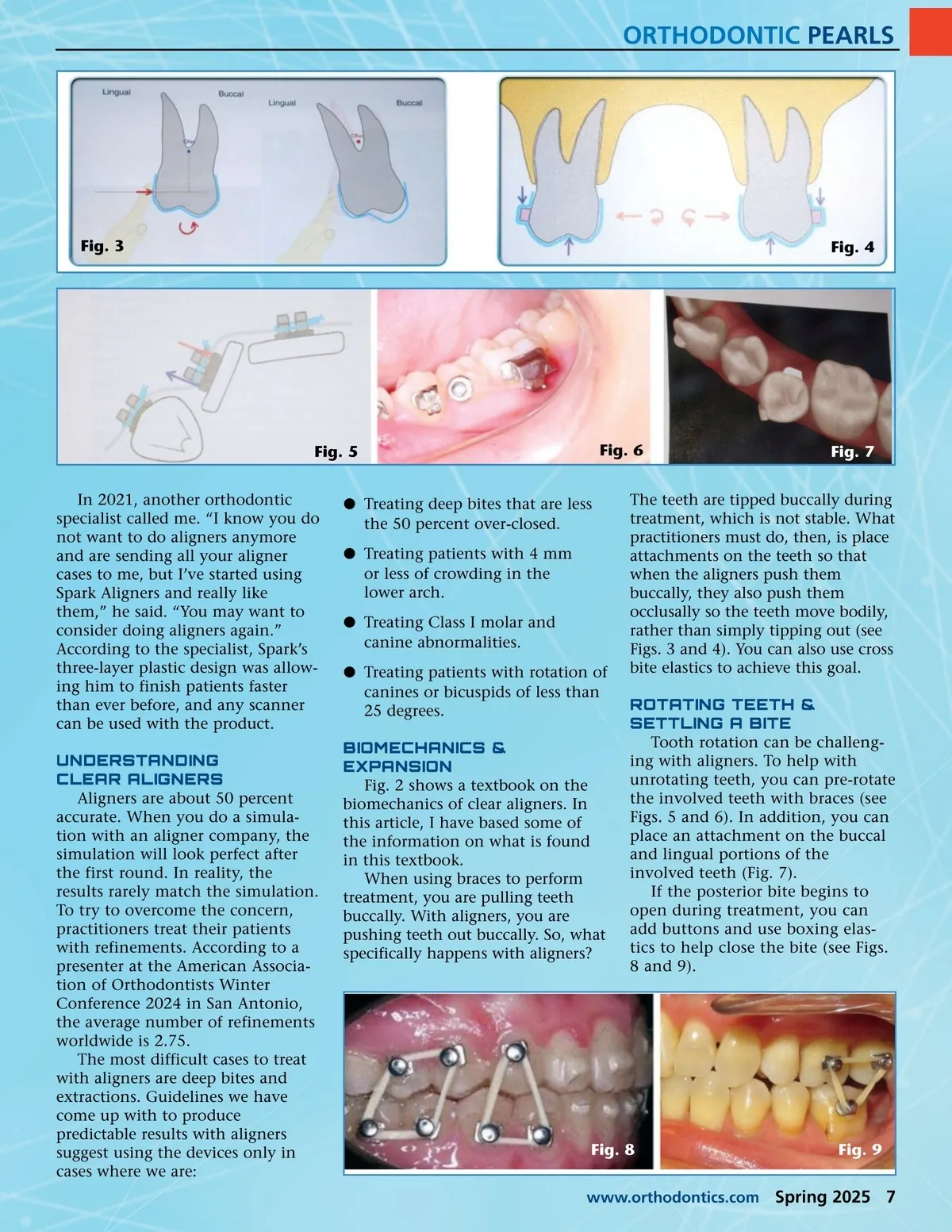
ORTHODONTIC PEARLS Fig. 3 Fig. 4 Fig. 5 In 2021, another orthodontic specialist called me. “I know you do not want to do aligners anymore and are sending all your aligner cases to me, but I’ve started using Spark Aligners and really like them,” he said. “You may want to consider doing aligners again.” According to the specialist, Spark’s three-layer plastic design was allow-ing him to finish patients faster than ever before, and any scanner can be used with the product. Unde r S t and i ng Clea r al i gne r S Aligners are about 50 percent accurate. When you do a simula-tion with an aligner company, the simulation will look perfect after the first round. In reality, the results rarely match the simulation. To try to overcome the concern, practitioners treat their patients with refinements. According to a presenter at the American Associa-tion of Orthodontists Winter Conference 2024 in San Antonio, the average number of refinements worldwide is 2.75. The most difficult cases to treat with aligners are deep bites and extractions. Guidelines we have come up with to produce predictable results with aligners suggest using the devices only in cases where we are: b Treating deep bites that are less the 50 percent over-closed. b Treating patients with 4 mm or less of crowding in the lower arch. b Treating Class I molar and canine abnormalities. Fig. 6 Fig. 7 b Treating patients with rotation of canines or bicuspids of less than 25 degrees. B io MeCHan i CS & expanS io n Fig. 2 shows a textbook on the biomechanics of clear aligners. In this article, I have based some of the information on what is found in this textbook. When using braces to perform treatment, you are pulling teeth buccally. With aligners, you are pushing teeth out buccally. So, what specifically happens with aligners? The teeth are tipped buccally during treatment, which is not stable. What practitioners must do, then, is place attachments on the teeth so that when the aligners push them buccally, they also push them occlusally so the teeth move bodily, rather than simply tipping out (see Figs. 3 and 4). You can also use cross bite elastics to achieve this goal. rot a ti ng t ee t H & Se tt l i ng a B it e Tooth rotation can be challeng-ing with aligners. To help with unrotating teeth, you can pre-rotate the involved teeth with braces (see Figs. 5 and 6). In addition, you can place an attachment on the buccal and lingual portions of the involved teeth (Fig. 7). If the posterior bite begins to open during treatment, you can add buttons and use boxing elas-tics to help close the bite (see Figs. 8 and 9). Fig. 8 www.orthodontics.com Fig. 9 Spring 2025 7
Journal of the American Orthodontic Society Spring 2025: Page 7