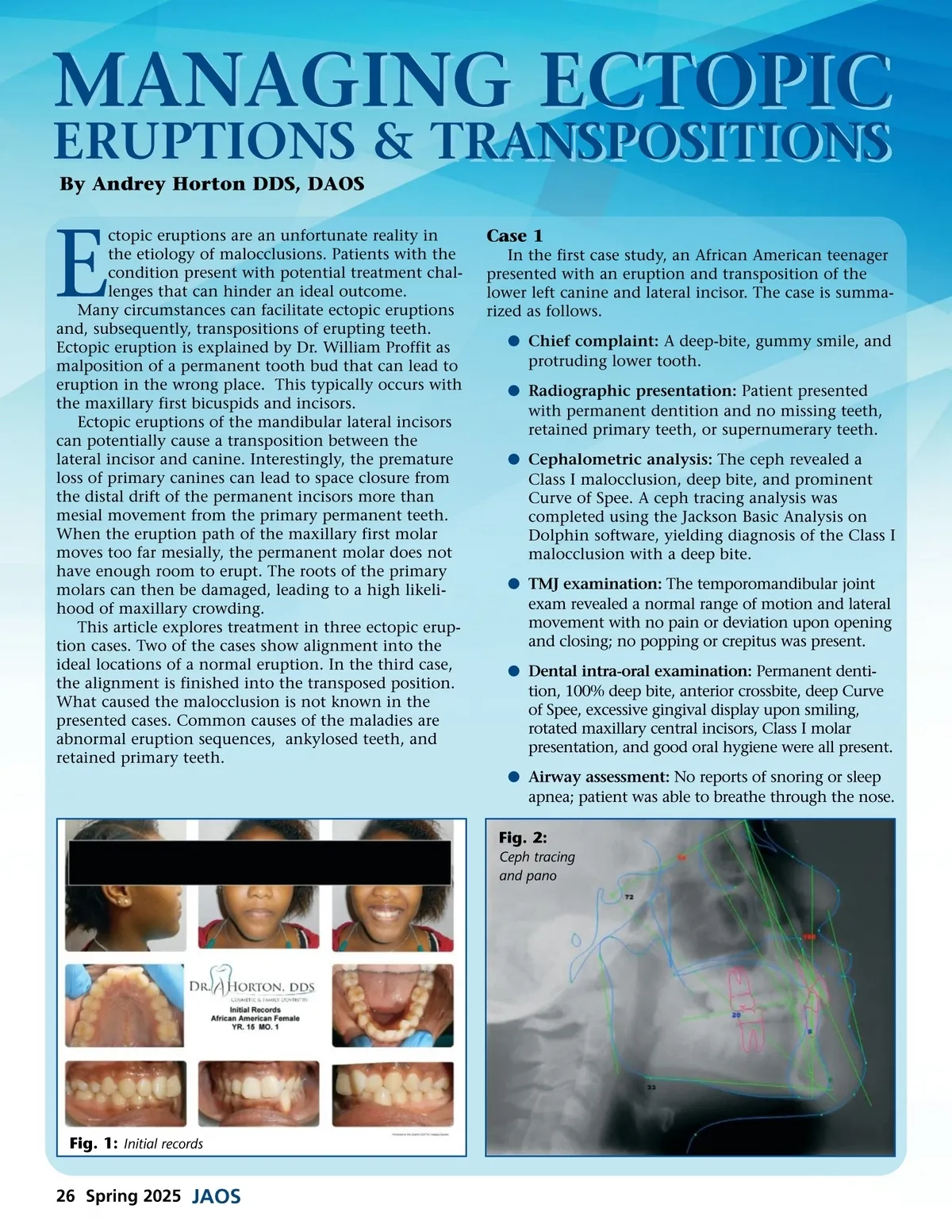
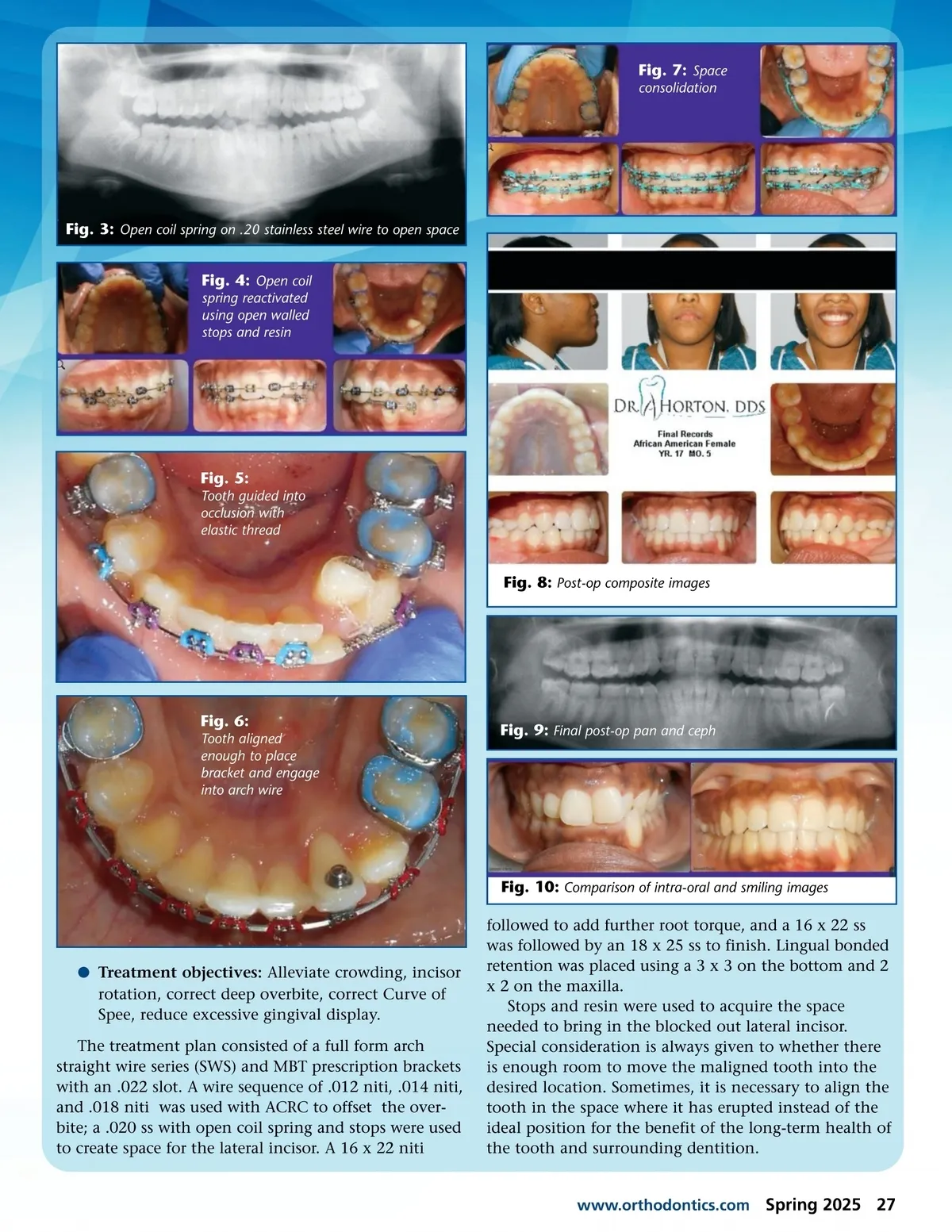
Fig. 7: Space consolidation Fig. 3: Open coil spring on .20 stainless steel wire to open space Fig. 4: Open coil spring reactivated using open walled stops and resin Fig. 5: Tooth guided into occlusion with elastic thread Fig. 8: Post-op composite images Fig. 6: Tooth aligned enough to place bracket and engage into arch wire Fig. 9: Final post-op pan and ceph Fig. 10: Comparison of intra-oral and smiling images followed to add further root torque, and a 16 x 22 ss was followed by an 18 x 25 ss to finish. Lingual bonded retention was placed using a 3 x 3 on the bottom and 2 x 2 on the maxilla. Stops and resin were used to acquire the space needed to bring in the blocked out lateral incisor. Special consideration is always given to whether there is enough room to move the maligned tooth into the desired location. Sometimes, it is necessary to align the tooth in the space where it has erupted instead of the ideal position for the benefit of the long-term health of the tooth and surrounding dentition. b Treatment objectives: Alleviate crowding, incisor rotation, correct deep overbite, correct Curve of Spee, reduce excessive gingival display. The treatment plan consisted of a full form arch straight wire series (SWS) and MBT prescription brackets with an .022 slot. A wire sequence of .012 niti, .014 niti, and .018 niti was used with ACRC to offset the over-bite; a .020 ss with open coil spring and stops were used to create space for the lateral incisor. A 16 x 22 niti www.orthodontics.com Spring 2025 27
Journal of the American Orthodontic Society Spring 2025: Page 27