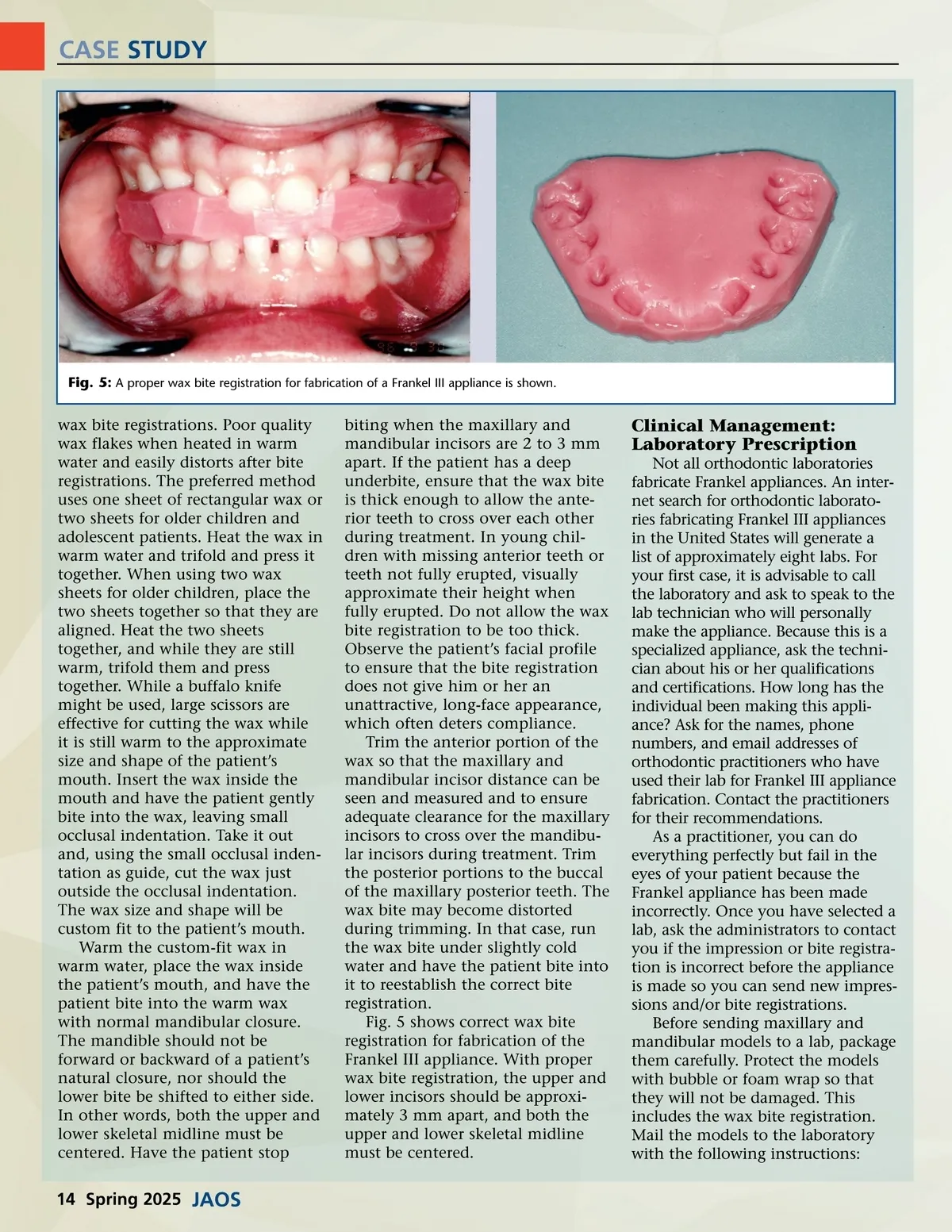
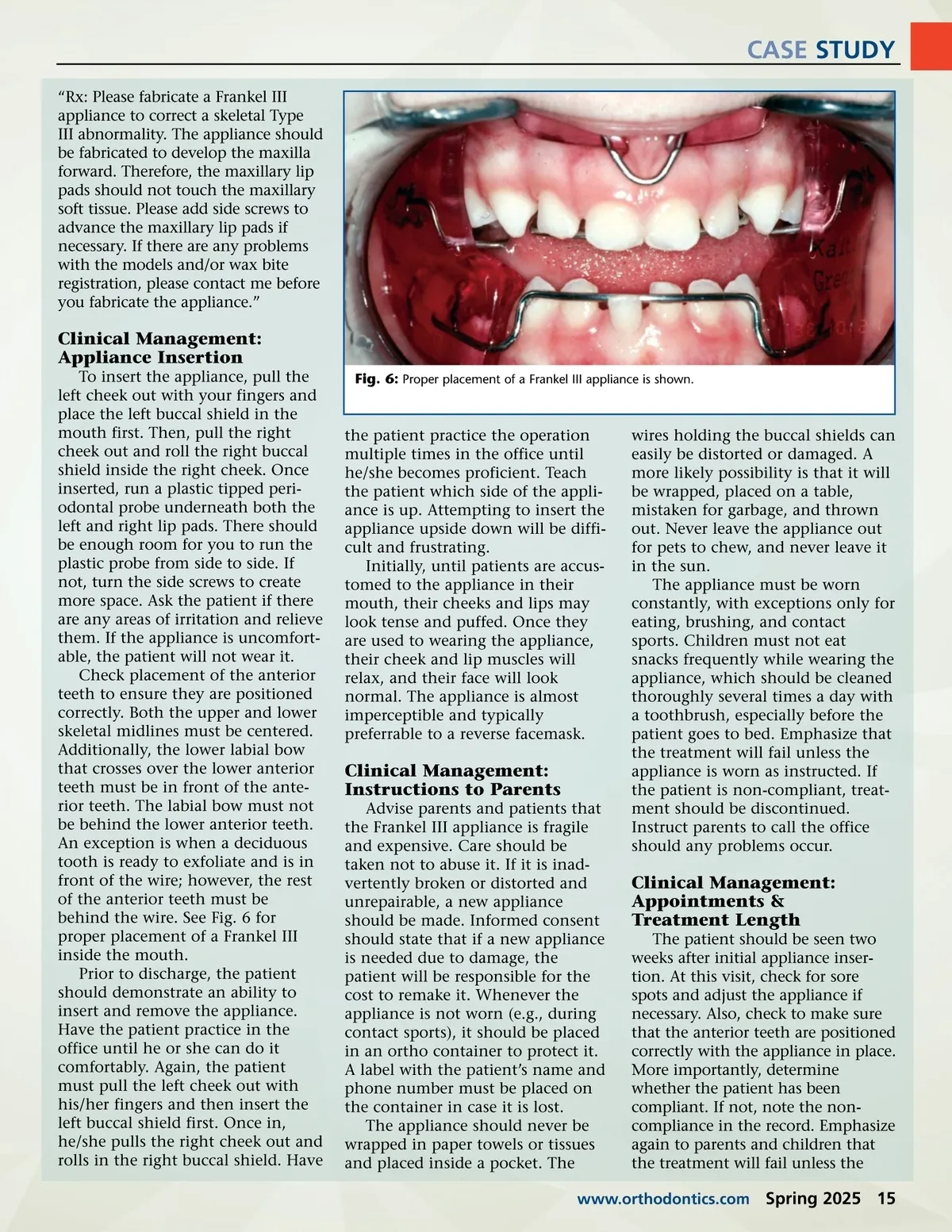
CASE STUDY “Rx: Please fabricate a Frankel III appliance to correct a skeletal Type III abnormality. The appliance should be fabricated to develop the maxilla forward. Therefore, the maxillary lip pads should not touch the maxillary soft tissue. Please add side screws to advance the maxillary lip pads if necessary. If there are any problems with the models and/or wax bite registration, please contact me before you fabricate the appliance.” Clinical Management: Appliance Insertion To insert the appliance, pull the left cheek out with your fingers and place the left buccal shield in the mouth first. Then, pull the right cheek out and roll the right buccal shield inside the right cheek. Once inserted, run a plastic tipped peri-odontal probe underneath both the left and right lip pads. There should be enough room for you to run the plastic probe from side to side. If not, turn the side screws to create more space. Ask the patient if there are any areas of irritation and relieve them. If the appliance is uncomfort-able, the patient will not wear it. Check placement of the anterior teeth to ensure they are positioned correctly. Both the upper and lower skeletal midlines must be centered. Additionally, the lower labial bow that crosses over the lower anterior teeth must be in front of the ante-rior teeth. The labial bow must not be behind the lower anterior teeth. An exception is when a deciduous tooth is ready to exfoliate and is in front of the wire; however, the rest of the anterior teeth must be behind the wire. See Fig. 6 for proper placement of a Frankel III inside the mouth. Prior to discharge, the patient should demonstrate an ability to insert and remove the appliance. Have the patient practice in the office until he or she can do it comfortably. Again, the patient must pull the left cheek out with his/her fingers and then insert the left buccal shield first. Once in, he/she pulls the right cheek out and rolls in the right buccal shield. Have Fig. 6: Proper placement of a Frankel III appliance is shown. the patient practice the operation multiple times in the office until he/she becomes proficient. Teach the patient which side of the appli-ance is up. Attempting to insert the appliance upside down will be diffi-cult and frustrating. Initially, until patients are accus-tomed to the appliance in their mouth, their cheeks and lips may look tense and puffed. Once they are used to wearing the appliance, their cheek and lip muscles will relax, and their face will look normal. The appliance is almost imperceptible and typically preferrable to a reverse facemask. Clinical Management: Instructions to Parents Advise parents and patients that the Frankel III appliance is fragile and expensive. Care should be taken not to abuse it. If it is inad-vertently broken or distorted and unrepairable, a new appliance should be made. Informed consent should state that if a new appliance is needed due to damage, the patient will be responsible for the cost to remake it. Whenever the appliance is not worn (e.g., during contact sports), it should be placed in an ortho container to protect it. A label with the patient’s name and phone number must be placed on the container in case it is lost. The appliance should never be wrapped in paper towels or tissues and placed inside a pocket. The wires holding the buccal shields can easily be distorted or damaged. A more likely possibility is that it will be wrapped, placed on a table, mistaken for garbage, and thrown out. Never leave the appliance out for pets to chew, and never leave it in the sun. The appliance must be worn constantly, with exceptions only for eating, brushing, and contact sports. Children must not eat snacks frequently while wearing the appliance, which should be cleaned thoroughly several times a day with a toothbrush, especially before the patient goes to bed. Emphasize that the treatment will fail unless the appliance is worn as instructed. If the patient is non-compliant, treat-ment should be discontinued. Instruct parents to call the office should any problems occur. Clinical Management: Appointments & Treatment Length The patient should be seen two weeks after initial appliance inser-tion. At this visit, check for sore spots and adjust the appliance if necessary. Also, check to make sure that the anterior teeth are positioned correctly with the appliance in place. More importantly, determine whether the patient has been compliant. If not, note the non-compliance in the record. Emphasize again to parents and children that the treatment will fail unless the www.orthodontics.com Spring 2025 15
Journal of the American Orthodontic Society Spring 2025: Page 15