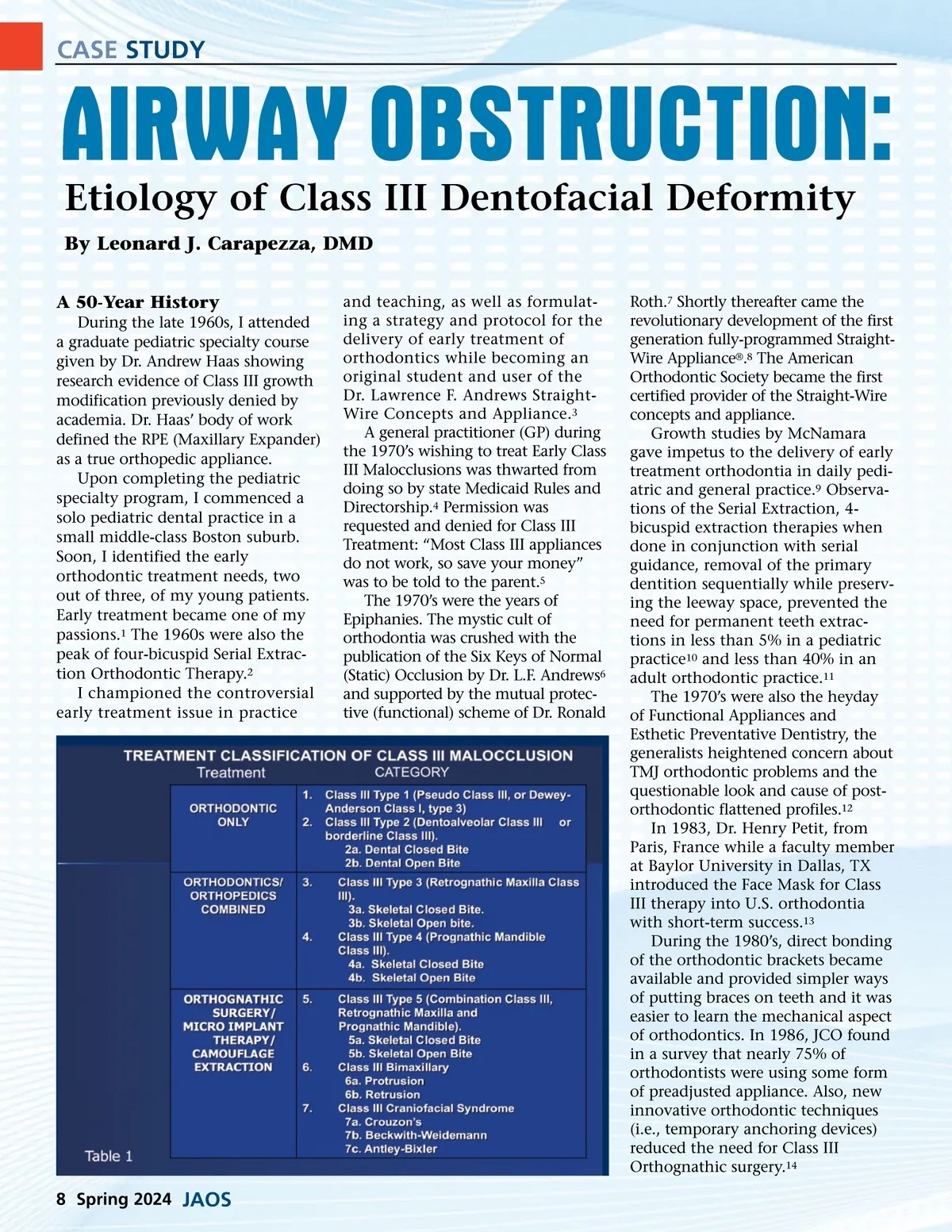
CASE STUDY AIRWAY OBSTRUCTION: Etiology of Class III Dentofacial Deformity By Leonard J. Carapezza, DMD A 50-Year History During the late 1960s, I attended a graduate pediatric specialty course given by Dr. Andrew Haas showing research evidence of Class III growth modification previously denied by academia. Dr. Haas’ body of work defined the RPE (Maxillary Expander) as a true orthopedic appliance. Upon completing the pediatric specialty program, I commenced a solo pediatric dental practice in a small middle-class Boston suburb. Soon, I identified the early orthodontic treatment needs, two out of three, of my young patients. Early treatment became one of my passions. 1 The 1960s were also the peak of four-bicuspid Serial Extrac-tion Orthodontic Therapy. 2 I championed the controversial early treatment issue in practice and teaching, as well as formulat-ing a strategy and protocol for the delivery of early treatment of orthodontics while becoming an original student and user of the Dr. Lawrence F. Andrews Straight-Wire Concepts and Appliance. 3 A general practitioner (GP) during the 1970’s wishing to treat Early Class III Malocclusions was thwarted from doing so by state Medicaid Rules and Directorship. 4 Permission was requested and denied for Class III Treatment: “Most Class III appliances do not work, so save your money” was to be told to the parent. 5 The 1970’s were the years of Epiphanies. The mystic cult of orthodontia was crushed with the publication of the Six Keys of Normal (Static) Occlusion by Dr. L.F. Andrews 6 and supported by the mutual protec-tive (functional) scheme of Dr. Ronald Roth. 7 Shortly thereafter came the revolutionary development of the first generation fully-programmed Straight-Wire Appliance ® . 8 The American Orthodontic Society became the first certified provider of the Straight-Wire concepts and appliance. Growth studies by McNamara gave impetus to the delivery of early treatment orthodontia in daily pedi-atric and general practice. 9 Observa-tions of the Serial Extraction, 4-bicuspid extraction therapies when done in conjunction with serial guidance, removal of the primary dentition sequentially while preserv-ing the leeway space, prevented the need for permanent teeth extrac-tions in less than 5% in a pediatric practice 10 and less than 40% in an adult orthodontic practice. 11 The 1970’s were also the heyday of Functional Appliances and Esthetic Preventative Dentistry, the generalists heightened concern about TMJ orthodontic problems and the questionable look and cause of post-orthodontic flattened profiles. 12 In 1983, Dr. Henry Petit, from Paris, France while a faculty member at Baylor University in Dallas, TX introduced the Face Mask for Class III therapy into U.S. orthodontia with short-term success. 13 During the 1980’s, direct bonding of the orthodontic brackets became available and provided simpler ways of putting braces on teeth and it was easier to learn the mechanical aspect of orthodontics. In 1986, JCO found in a survey that nearly 75% of orthodontists were using some form of preadjusted appliance. Also, new innovative orthodontic techniques (i.e., temporary anchoring devices) reduced the need for Class III Orthognathic surgery. 14 8 Spring 2024 JAOS
Journal of the American Orthodontic Society Spring 2024: Page 8