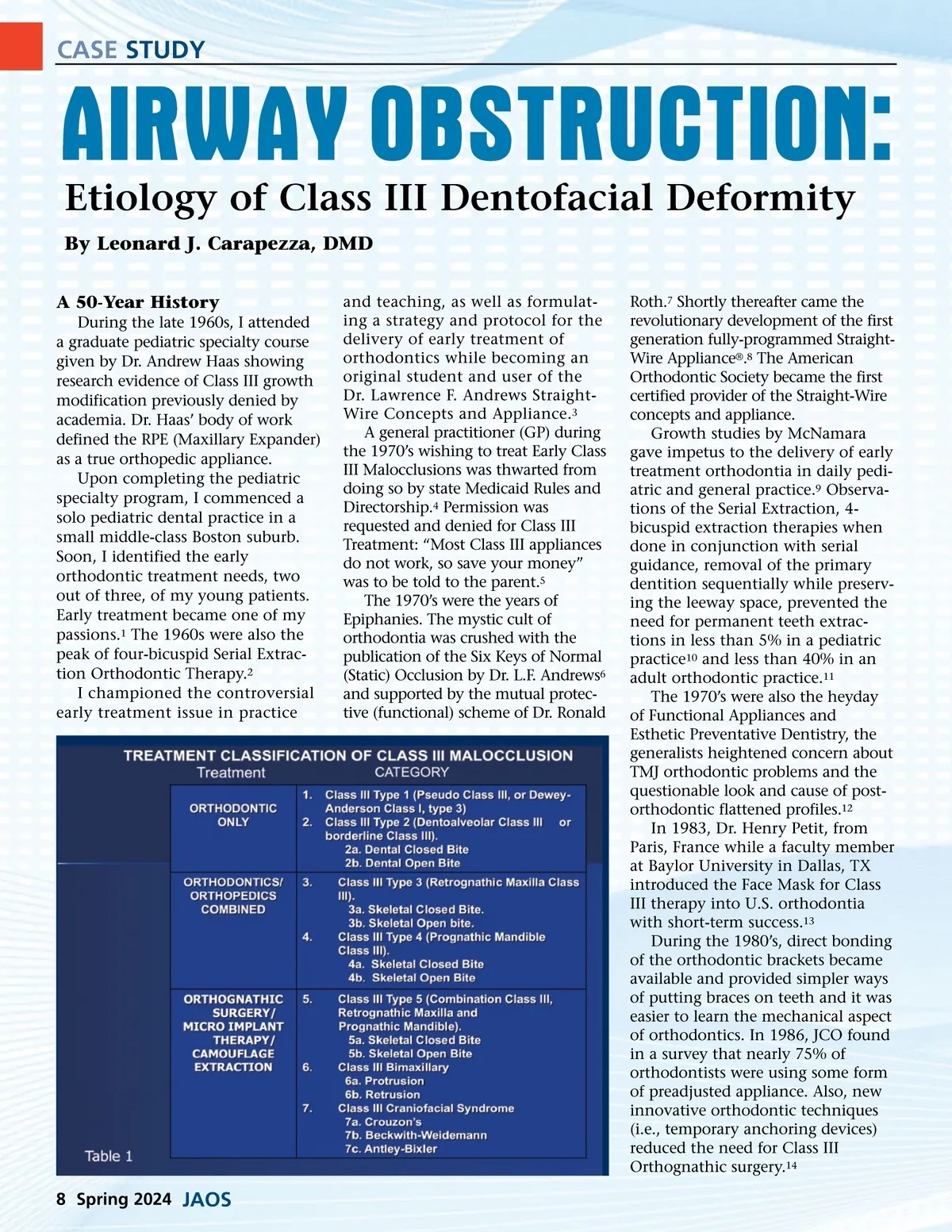
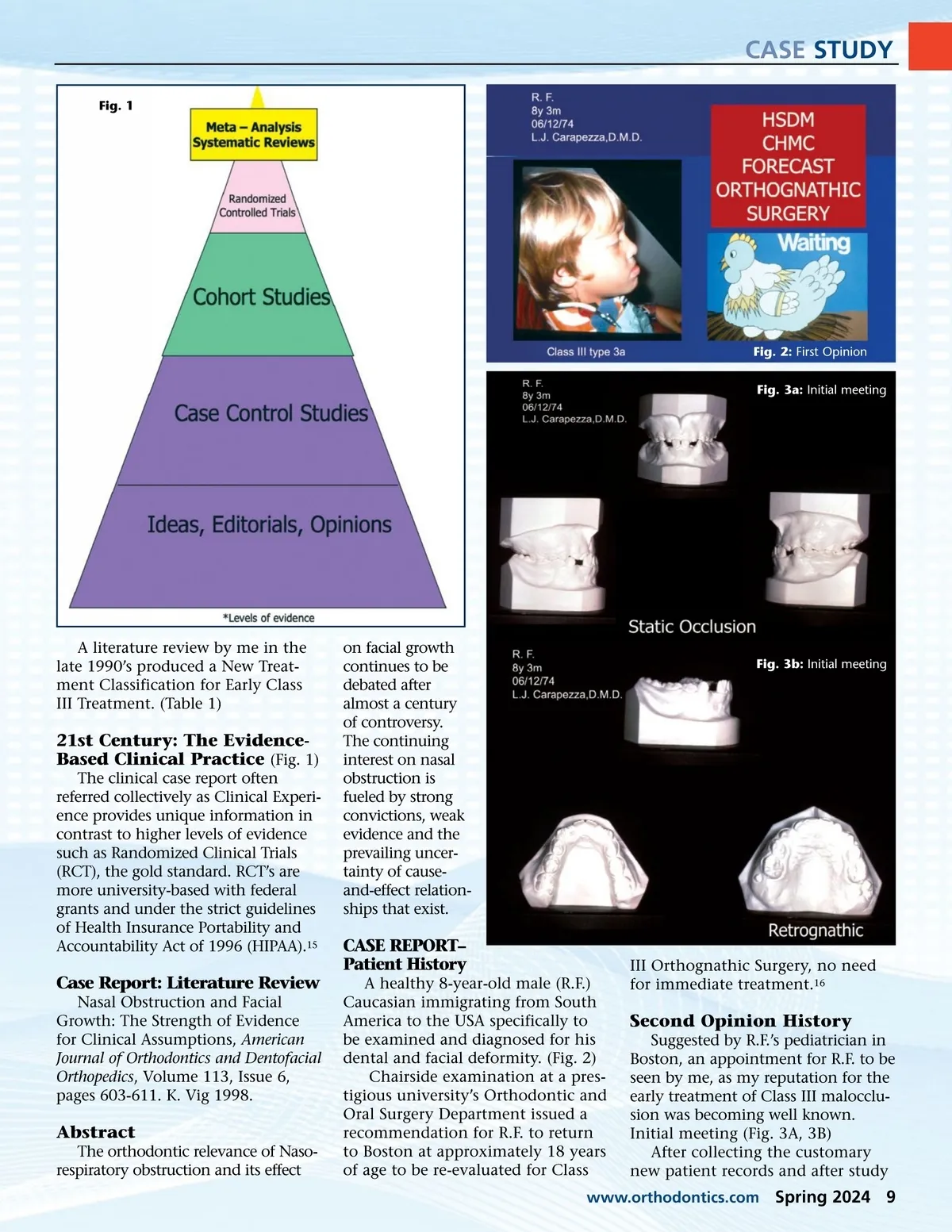
CASE STUDY Fig. 1 Fig. 2: First Opinion Fig. 3a: Initial meeting A literature review by me in the late 1990’s produced a New Treat-ment Classification for Early Class III Treatment. (Table 1) 21st Century: The Evidence-Based Clinical Practice (Fig. 1) The clinical case report often referred collectively as Clinical Experi-ence provides unique information in contrast to higher levels of evidence such as Randomized Clinical Trials (RCT), the gold standard. RCT’s are more university-based with federal grants and under the strict guidelines of Health Insurance Portability and Accountability Act of 1996 (HIPAA). 15 on facial growth continues to be debated after almost a century of controversy. The continuing interest on nasal obstruction is fueled by strong convictions, weak evidence and the prevailing uncer-tainty of cause-and-effect relation-ships that exist. Fig. 3b: Initial meeting CASE REPORT– Patient History A healthy 8-year-old male (R.F.) Caucasian immigrating from South America to the USA specifically to be examined and diagnosed for his dental and facial deformity. (Fig. 2) Chairside examination at a pres-tigious university’s Orthodontic and Oral Surgery Department issued a recommendation for R.F. to return to Boston at approximately 18 years of age to be re-evaluated for Class Case Report: Literature Review Nasal Obstruction and Facial Growth: The Strength of Evidence for Clinical Assumptions, American Journal of Orthodontics and Dentofacial Orthopedics , Volume 113, Issue 6, pages 603-611. K. Vig 1998. III Orthognathic Surgery, no need for immediate treatment. 16 Second Opinion History Suggested by R.F.’s pediatrician in Boston, an appointment for R.F. to be seen by me, as my reputation for the early treatment of Class III malocclu-sion was becoming well known. Initial meeting (Fig. 3A, 3B) After collecting the customary new patient records and after study Abstract The orthodontic relevance of Naso-respiratory obstruction and its effect www.orthodontics.com Spring 2024 9
Journal of the American Orthodontic Society Spring 2024: Page 9