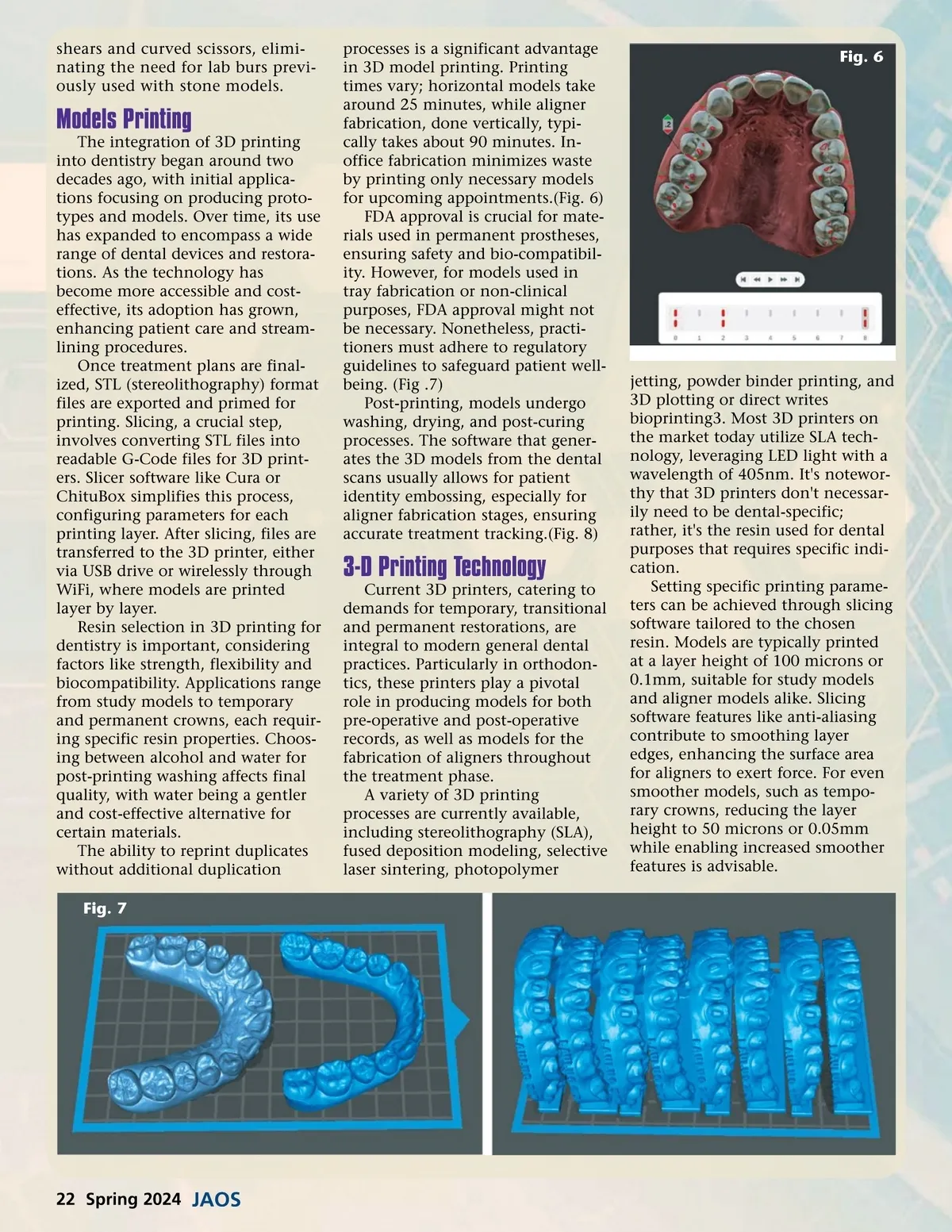
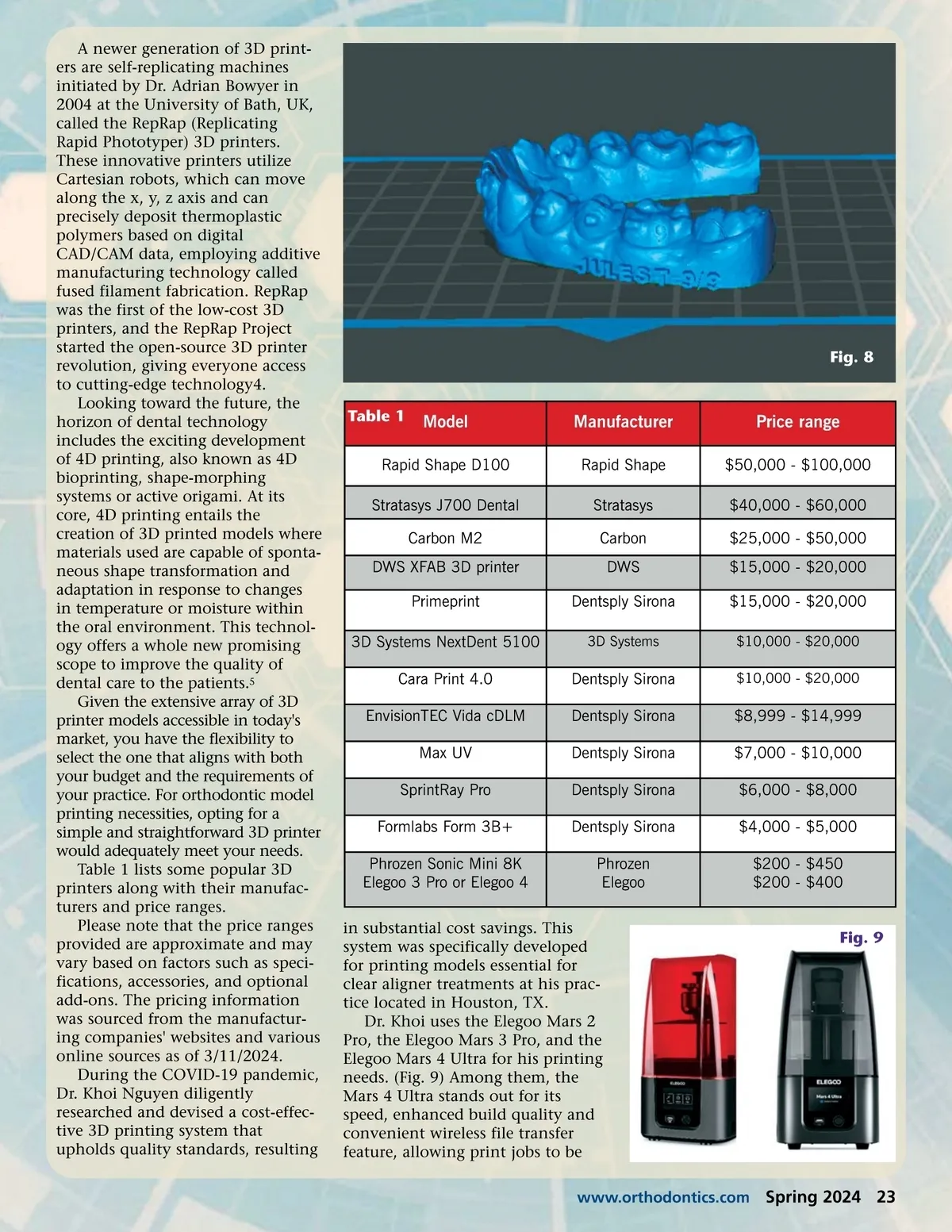
shears and curved scissors, elimi-nating the need for lab burs previ-ously used with stone models. Models Printing The integration of 3D printing into dentistry began around two decades ago, with initial applica-tions focusing on producing proto-types and models. Over time, its use has expanded to encompass a wide range of dental devices and restora-tions. As the technology has become more accessible and cost-effective, its adoption has grown, enhancing patient care and stream-lining procedures. Once treatment plans are final-ized, STL (stereolithography) format files are exported and primed for printing. Slicing, a crucial step, involves converting STL files into readable G-Code files for 3D print-ers. Slicer software like Cura or ChituBox simplifies this process, configuring parameters for each printing layer. After slicing, files are transferred to the 3D printer, either via USB drive or wirelessly through WiFi, where models are printed layer by layer. Resin selection in 3D printing for dentistry is important, considering factors like strength, flexibility and biocompatibility. Applications range from study models to temporary and permanent crowns, each requir-ing specific resin properties. Choos-ing between alcohol and water for post-printing washing affects final quality, with water being a gentler and cost-effective alternative for certain materials. The ability to reprint duplicates without additional duplication Fig. 7 processes is a significant advantage in 3D model printing. Printing times vary; horizontal models take around 25 minutes, while aligner fabrication, done vertically, typi-cally takes about 90 minutes. In-office fabrication minimizes waste by printing only necessary models for upcoming appointments.(Fig. 6) FDA approval is crucial for mate-rials used in permanent prostheses, ensuring safety and bio-compatibil-ity. However, for models used in tray fabrication or non-clinical purposes, FDA approval might not be necessary. Nonetheless, practi-tioners must adhere to regulatory guidelines to safeguard patient well-being. (Fig .7) Post-printing, models undergo washing, drying, and post-curing processes. The software that gener-ates the 3D models from the dental scans usually allows for patient identity embossing, especially for aligner fabrication stages, ensuring accurate treatment tracking.(Fig. 8) Fig. 6 3-D Printing Technology Current 3D printers, catering to demands for temporary, transitional and permanent restorations, are integral to modern general dental practices. Particularly in orthodon-tics, these printers play a pivotal role in producing models for both pre-operative and post-operative records, as well as models for the fabrication of aligners throughout the treatment phase. A variety of 3D printing processes are currently available, including stereolithography (SLA), fused deposition modeling, selective laser sintering, photopolymer jetting, powder binder printing, and 3D plotting or direct writes bioprinting3. Most 3D printers on the market today utilize SLA tech-nology, leveraging LED light with a wavelength of 405nm. It's notewor-thy that 3D printers don't necessar-ily need to be dental-specific; rather, it's the resin used for dental purposes that requires specific indi-cation. Setting specific printing parame-ters can be achieved through slicing software tailored to the chosen resin. Models are typically printed at a layer height of 100 microns or 0.1mm, suitable for study models and aligner models alike. Slicing software features like anti-aliasing contribute to smoothing layer edges, enhancing the surface area for aligners to exert force. For even smoother models, such as tempo-rary crowns, reducing the layer height to 50 microns or 0.05mm while enabling increased smoother features is advisable. 22 Spring 2024 JAOS
Journal of the American Orthodontic Society Spring 2024: Page 22