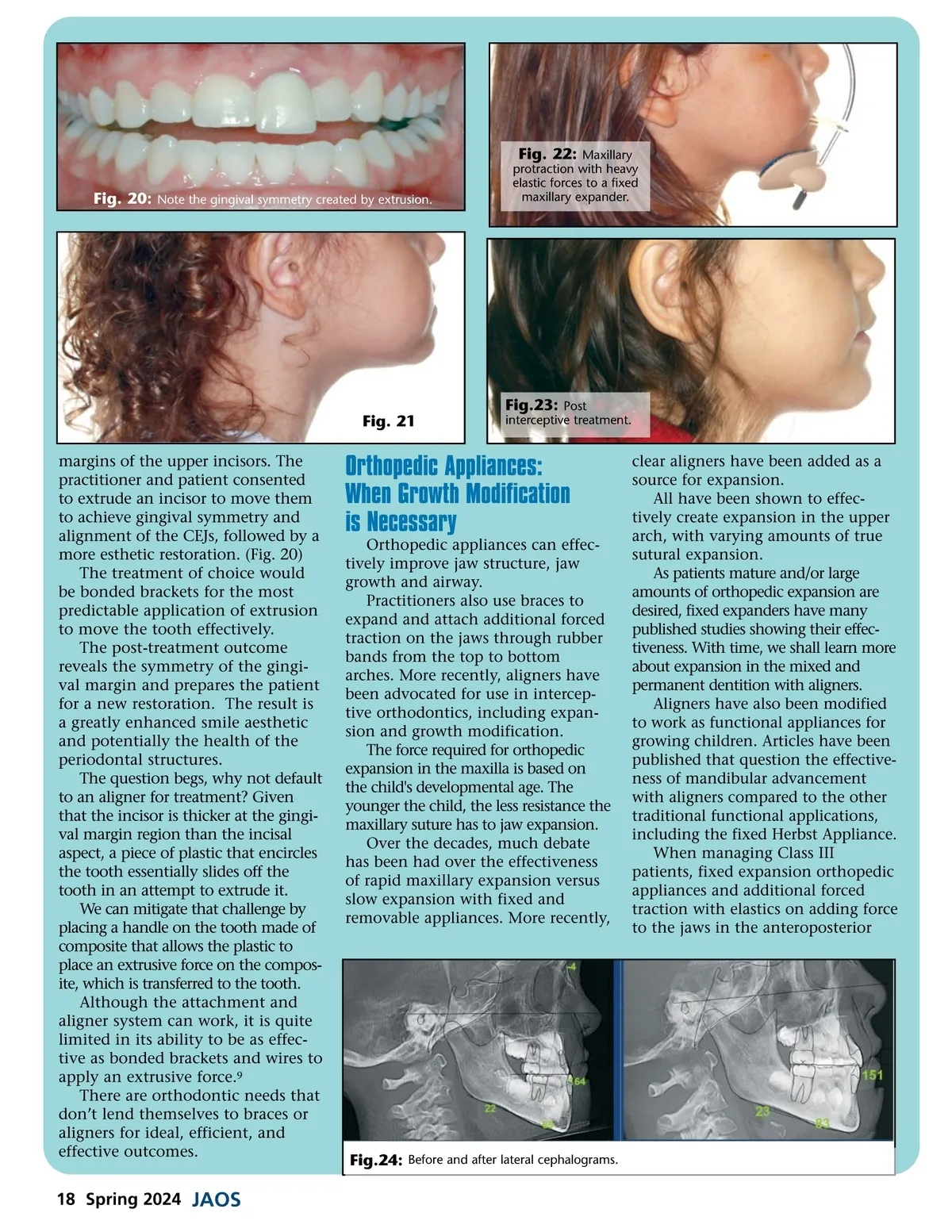
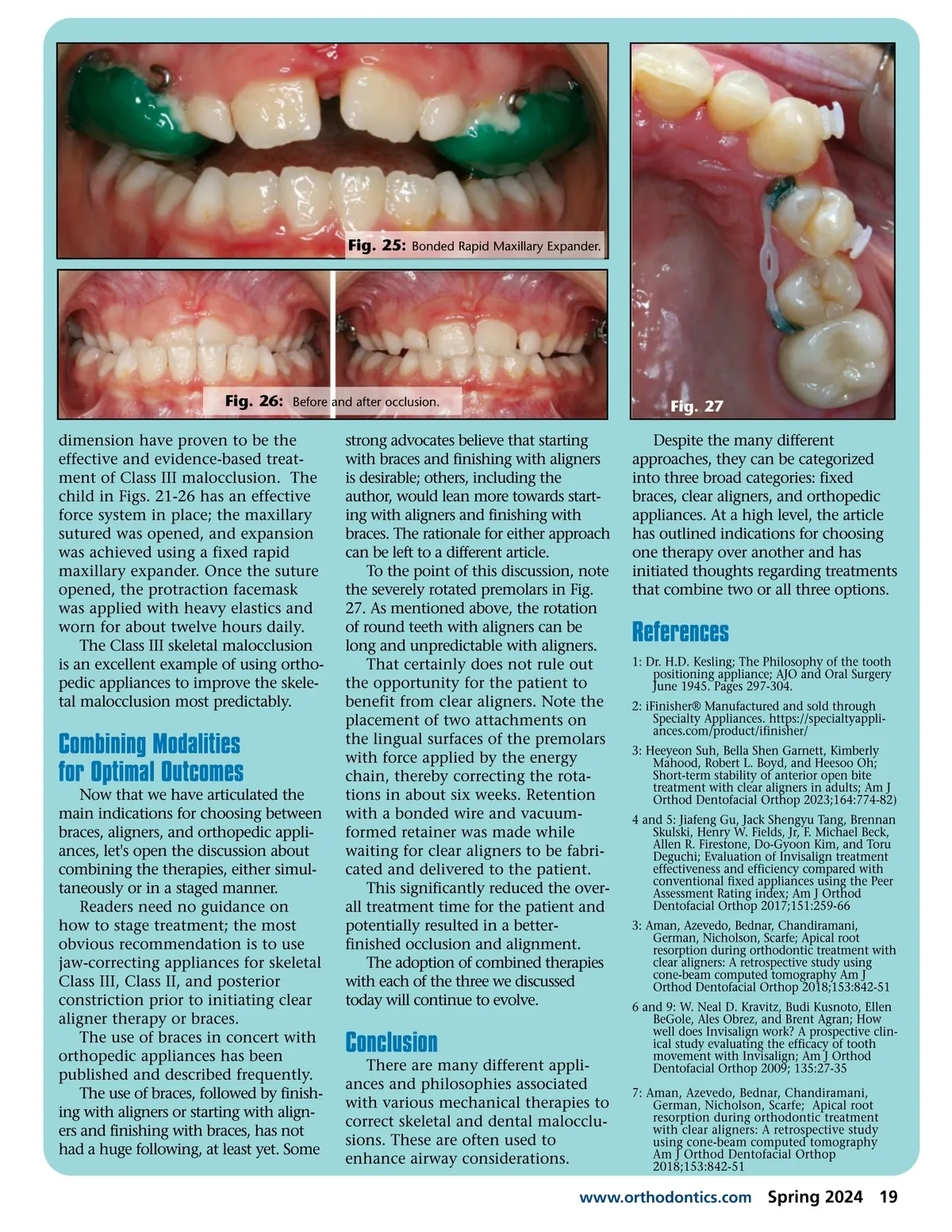
Fig. 25: Bonded Rapid Maxillary Expander. Fig. 26: Before and after occlusion. dimension have proven to be the effective and evidence-based treat-ment of Class III malocclusion. The child in Figs. 21-26 has an effective force system in place; the maxillary sutured was opened, and expansion was achieved using a fixed rapid maxillary expander. Once the suture opened, the protraction facemask was applied with heavy elastics and worn for about twelve hours daily. The Class III skeletal malocclusion is an excellent example of using ortho-pedic appliances to improve the skele-tal malocclusion most predictably. strong advocates believe that starting with braces and finishing with aligners is desirable; others, including the author, would lean more towards start-ing with aligners and finishing with braces. The rationale for either approach can be left to a different article. To the point of this discussion, note the severely rotated premolars in Fig. 27. As mentioned above, the rotation of round teeth with aligners can be long and unpredictable with aligners. That certainly does not rule out the opportunity for the patient to benefit from clear aligners. Note the placement of two attachments on the lingual surfaces of the premolars with force applied by the energy chain, thereby correcting the rota-tions in about six weeks. Retention with a bonded wire and vacuum-formed retainer was made while waiting for clear aligners to be fabri-cated and delivered to the patient. This significantly reduced the over-all treatment time for the patient and potentially resulted in a better-finished occlusion and alignment. The adoption of combined therapies with each of the three we discussed today will continue to evolve. Fig. 27 Despite the many different approaches, they can be categorized into three broad categories: fixed braces, clear aligners, and orthopedic appliances. At a high level, the article has outlined indications for choosing one therapy over another and has initiated thoughts regarding treatments that combine two or all three options. References 1: Dr. H.D. Kesling; The Philosophy of the tooth positioning appliance; AJO and Oral Surgery June 1945. Pages 297-304. 2: iFinisher® Manufactured and sold through Specialty Appliances. https://specialtyappli-ances.com/product/ifinisher/ 3: Heeyeon Suh, Bella Shen Garnett, Kimberly Mahood, Robert L. Boyd, and Heesoo Oh; Short-term stability of anterior open bite treatment with clear aligners in adults; Am J Orthod Dentofacial Orthop 2023;164:774-82) 4 and 5: Jiafeng Gu, Jack Shengyu Tang, Brennan Skulski, Henry W. Fields, Jr, F. Michael Beck, Allen R. Firestone, Do-Gyoon Kim, and Toru Deguchi; Evaluation of Invisalign treatment effectiveness and efficiency compared with conventional fixed appliances using the Peer Assessment Rating index; Am J Orthod Dentofacial Orthop 2017;151:259-66 3: Aman, Azevedo, Bednar, Chandiramani, German, Nicholson, Scarfe; Apical root resorption during orthodontic treatment with clear aligners: A retrospective study using cone-beam computed tomography Am J Orthod Dentofacial Orthop 2018;153:842-51 6 and 9: W. Neal D. Kravitz, Budi Kusnoto, Ellen BeGole, Ales Obrez, and Brent Agran; How well does Invisalign work? A prospective clin-ical study evaluating the efficacy of tooth movement with Invisalign; Am J Orthod Dentofacial Orthop 2009; 135:27-35 7: Aman, Azevedo, Bednar, Chandiramani, German, Nicholson, Scarfe; Apical root resorption during orthodontic treatment with clear aligners: A retrospective study using cone-beam computed tomography Am J Orthod Dentofacial Orthop 2018;153:842-51 Combining Modalities for Optimal Outcomes Now that we have articulated the main indications for choosing between braces, aligners, and orthopedic appli-ances, let's open the discussion about combining the therapies, either simul-taneously or in a staged manner. Readers need no guidance on how to stage treatment; the most obvious recommendation is to use jaw-correcting appliances for skeletal Class III, Class II, and posterior constriction prior to initiating clear aligner therapy or braces. The use of braces in concert with orthopedic appliances has been published and described frequently. The use of braces, followed by finish-ing with aligners or starting with align-ers and finishing with braces, has not had a huge following, at least yet. Some Conclusion There are many different appli-ances and philosophies associated with various mechanical therapies to correct skeletal and dental malocclu-sions. These are often used to enhance airway considerations. www.orthodontics.com Spring 2024 19
Journal of the American Orthodontic Society Spring 2024: Page 19