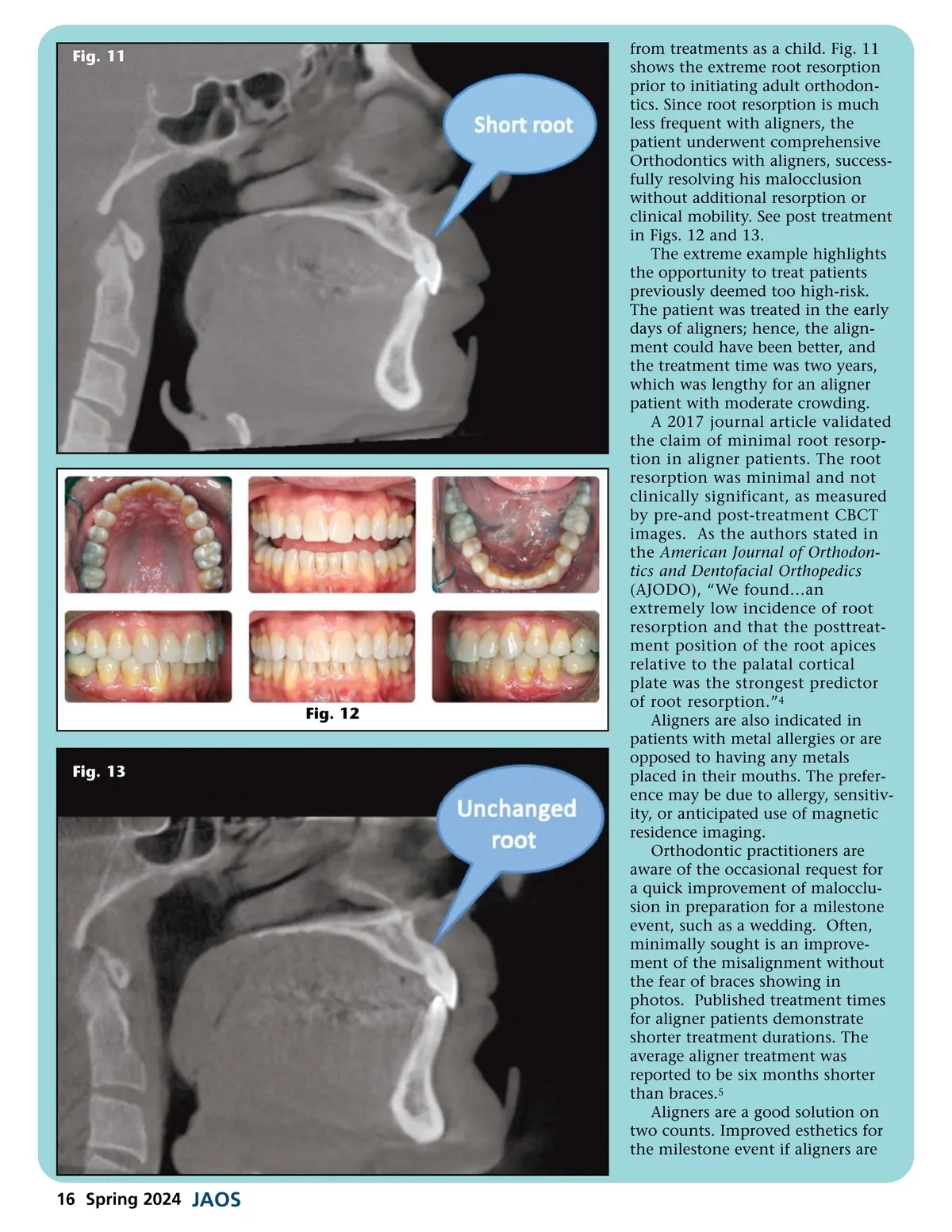
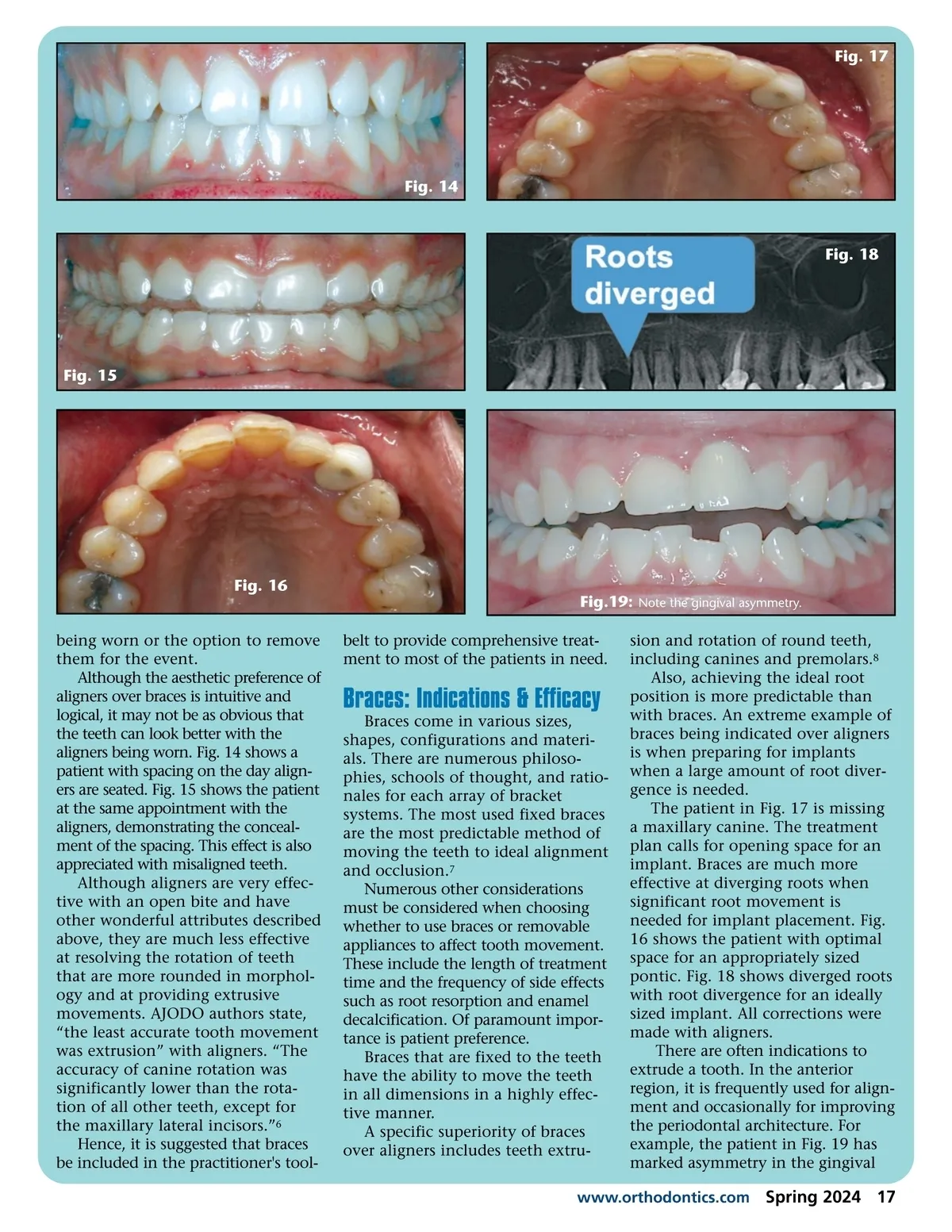
Fig. 17 Fig. 14 Fig. 18 Fig. 15 Fig. 16 Fig.19: Note the gingival asymmetry. being worn or the option to remove them for the event. Although the aesthetic preference of aligners over braces is intuitive and logical, it may not be as obvious that the teeth can look better with the aligners being worn. Fig. 14 shows a patient with spacing on the day align-ers are seated. Fig. 15 shows the patient at the same appointment with the aligners, demonstrating the conceal-ment of the spacing. This effect is also appreciated with misaligned teeth. Although aligners are very effec-tive with an open bite and have other wonderful attributes described above, they are much less effective at resolving the rotation of teeth that are more rounded in morphol-ogy and at providing extrusive movements. AJODO authors state, “the least accurate tooth movement was extrusion” with aligners. “The accuracy of canine rotation was significantly lower than the rota-tion of all other teeth, except for the maxillary lateral incisors.” 6 Hence, it is suggested that braces be included in the practitioner's tool-belt to provide comprehensive treat-ment to most of the patients in need. sion and rotation of round teeth, including canines and premolars. 8 Also, achieving the ideal root position is more predictable than with braces. An extreme example of braces being indicated over aligners is when preparing for implants when a large amount of root diver-gence is needed. The patient in Fig. 17 is missing a maxillary canine. The treatment plan calls for opening space for an implant. Braces are much more effective at diverging roots when significant root movement is needed for implant placement. Fig. 16 shows the patient with optimal space for an appropriately sized pontic. Fig. 18 shows diverged roots with root divergence for an ideally sized implant. All corrections were made with aligners. There are often indications to extrude a tooth. In the anterior region, it is frequently used for align-ment and occasionally for improving the periodontal architecture. For example, the patient in Fig. 19 has marked asymmetry in the gingival Braces: Indications & Efficacy Braces come in various sizes, shapes, configurations and materi-als. There are numerous philoso-phies, schools of thought, and ratio-nales for each array of bracket systems. The most used fixed braces are the most predictable method of moving the teeth to ideal alignment and occlusion. 7 Numerous other considerations must be considered when choosing whether to use braces or removable appliances to affect tooth movement. These include the length of treatment time and the frequency of side effects such as root resorption and enamel decalcification. Of paramount impor-tance is patient preference. Braces that are fixed to the teeth have the ability to move the teeth in all dimensions in a highly effec-tive manner. A specific superiority of braces over aligners includes teeth extru-www.orthodontics.com Spring 2024 17
Journal of the American Orthodontic Society Spring 2024: Page 17