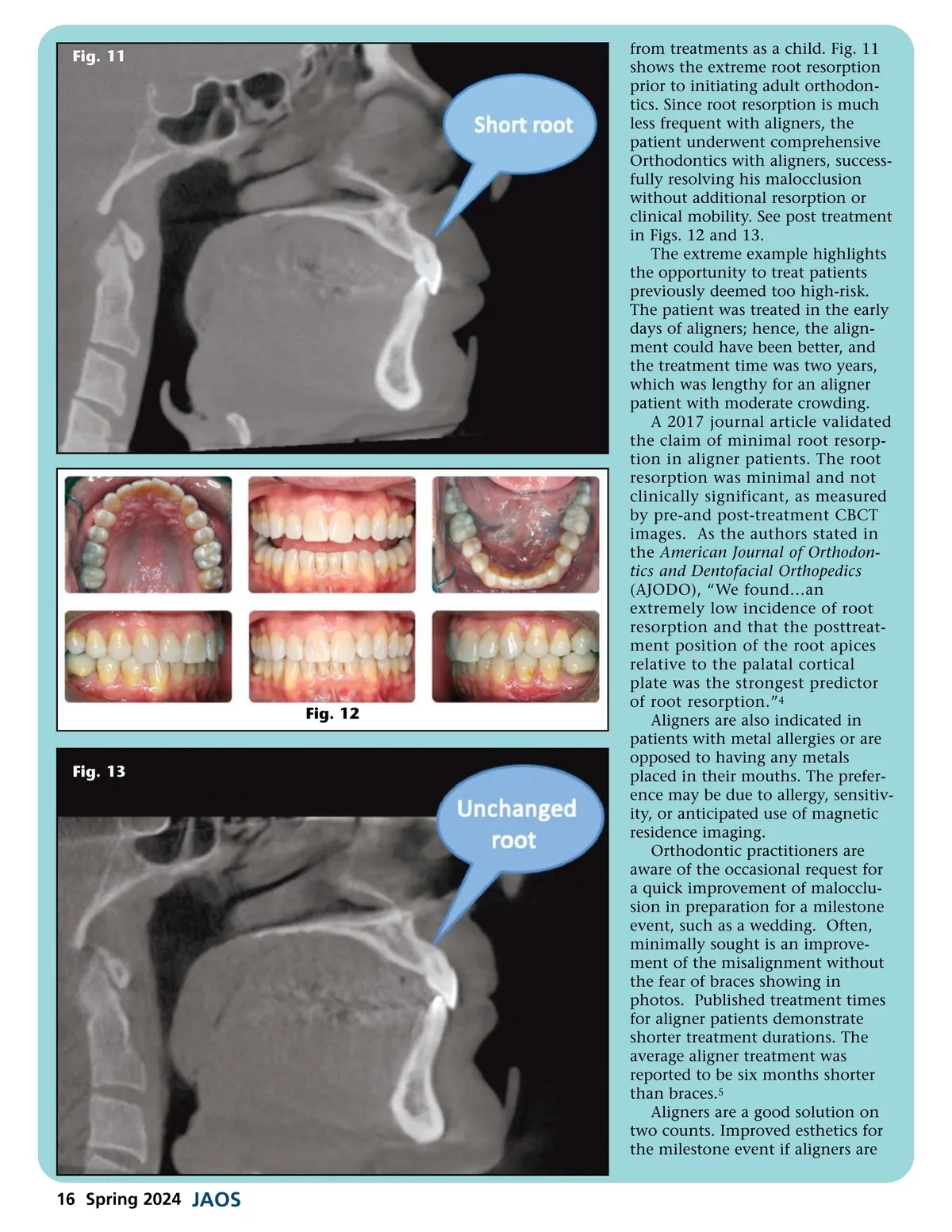
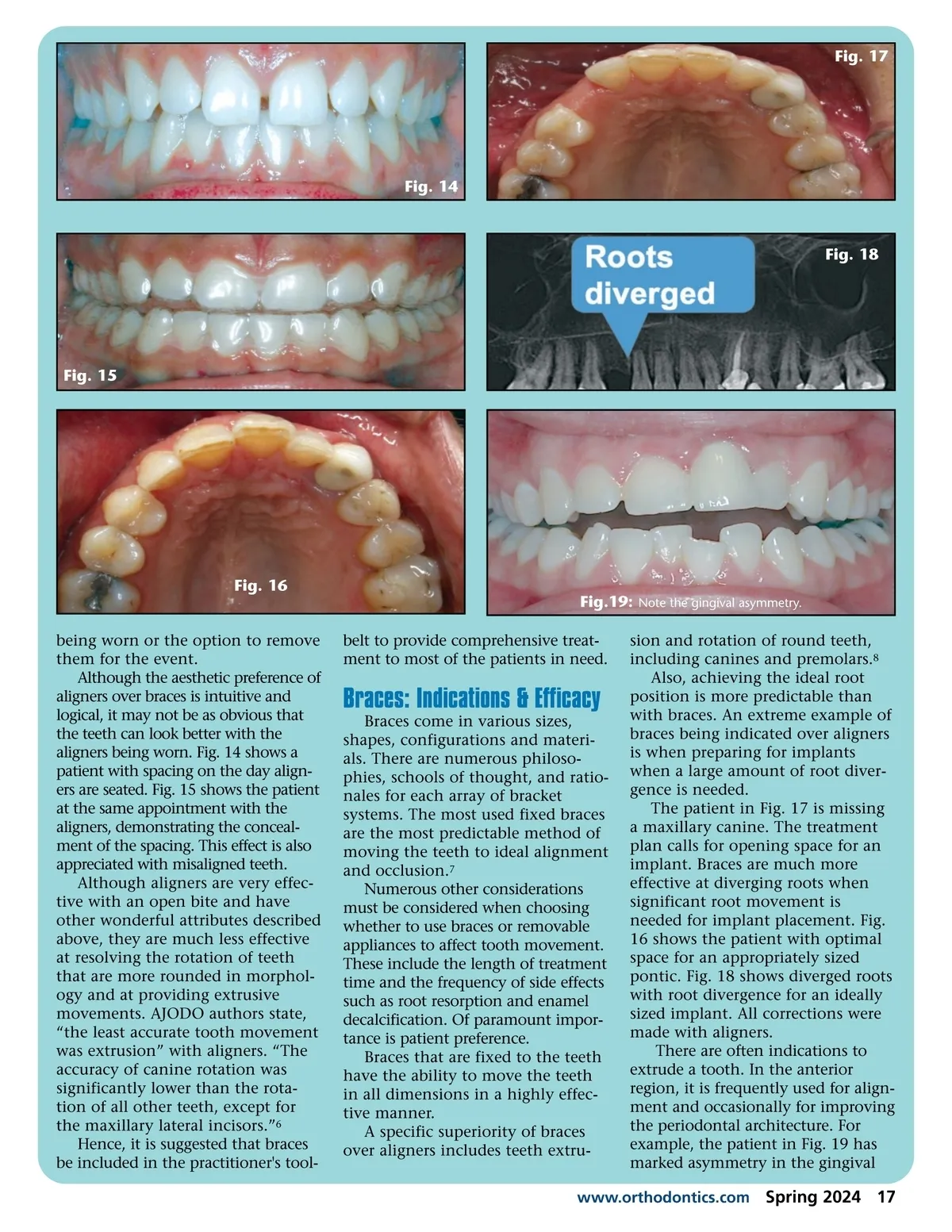
Fig. 11 Fig. 12 Fig. 13 from treatments as a child. Fig. 11 shows the extreme root resorption prior to initiating adult orthodon-tics. Since root resorption is much less frequent with aligners, the patient underwent comprehensive Orthodontics with aligners, success-fully resolving his malocclusion without additional resorption or clinical mobility. See post treatment in Figs. 12 and 13. The extreme example highlights the opportunity to treat patients previously deemed too high-risk. The patient was treated in the early days of aligners; hence, the align-ment could have been better, and the treatment time was two years, which was lengthy for an aligner patient with moderate crowding. A 2017 journal article validated the claim of minimal root resorp-tion in aligner patients. The root resorption was minimal and not clinically significant, as measured by pre-and post-treatment CBCT images. As the authors stated in the American Journal of Orthodon-tics and Dentofacial Orthopedics (AJODO), “We found…an extremely low incidence of root resorption and that the posttreat-ment position of the root apices relative to the palatal cortical plate was the strongest predictor of root resorption.” 4 Aligners are also indicated in patients with metal allergies or are opposed to having any metals placed in their mouths. The prefer-ence may be due to allergy, sensitiv-ity, or anticipated use of magnetic residence imaging. Orthodontic practitioners are aware of the occasional request for a quick improvement of malocclu-sion in preparation for a milestone event, such as a wedding. Often, minimally sought is an improve-ment of the misalignment without the fear of braces showing in photos. Published treatment times for aligner patients demonstrate shorter treatment durations. The average aligner treatment was reported to be six months shorter than braces. 5 Aligners are a good solution on two counts. Improved esthetics for the milestone event if aligners are 16 Spring 2024 JAOS
Journal of the American Orthodontic Society Spring 2024: Page 16