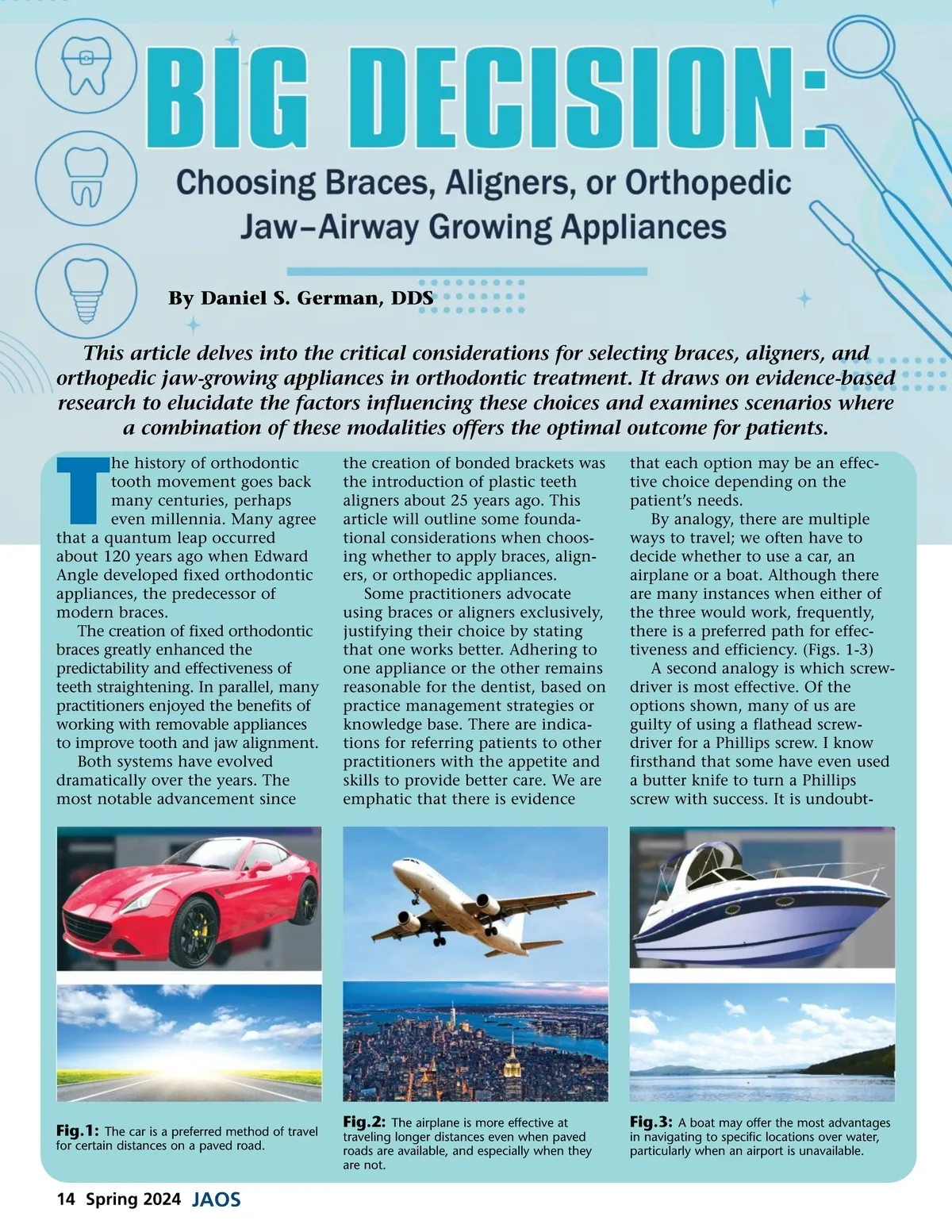
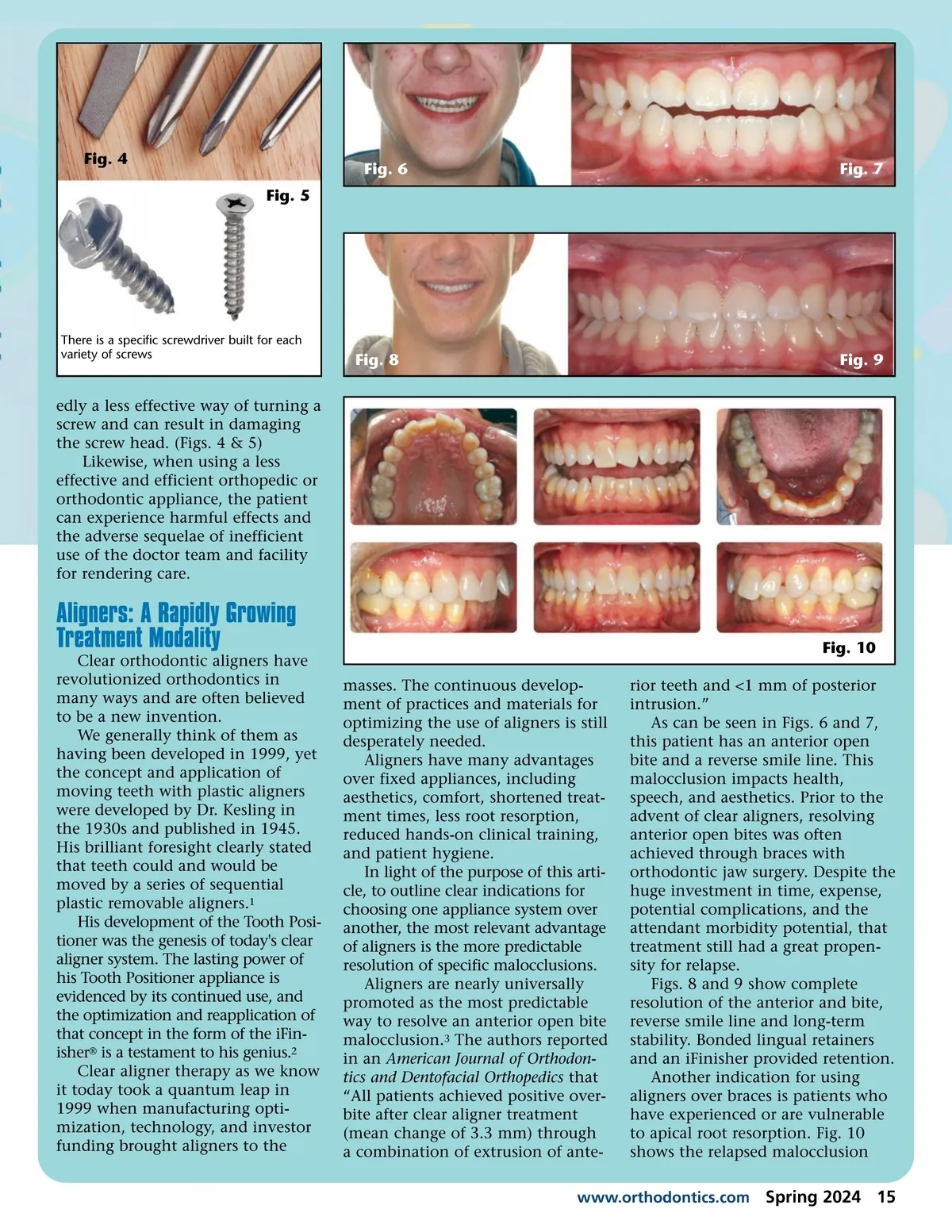
Fig. 4 Fig. 5 Fig. 6 Fig. 7 There is a specific screwdriver built for each variety of screws Fig. 8 Fig. 9 edly a less effective way of turning a screw and can result in damaging the screw head. (Figs. 4 & 5) Likewise, when using a less effective and efficient orthopedic or orthodontic appliance, the patient can experience harmful effects and the adverse sequelae of inefficient use of the doctor team and facility for rendering care. Aligners: A Rapidly Growing Treatment Modality Clear orthodontic aligners have revolutionized orthodontics in many ways and are often believed to be a new invention. We generally think of them as having been developed in 1999, yet the concept and application of moving teeth with plastic aligners were developed by Dr. Kesling in the 1930s and published in 1945. His brilliant foresight clearly stated that teeth could and would be moved by a series of sequential plastic removable aligners. 1 His development of the Tooth Posi-tioner was the genesis of today's clear aligner system. The lasting power of his Tooth Positioner appliance is evidenced by its continued use, and the optimization and reapplication of that concept in the form of the iFin-isher ® is a testament to his genius. 2 Clear aligner therapy as we know it today took a quantum leap in 1999 when manufacturing opti-mization, technology, and investor funding brought aligners to the masses. The continuous develop-ment of practices and materials for optimizing the use of aligners is still desperately needed. Aligners have many advantages over fixed appliances, including aesthetics, comfort, shortened treat-ment times, less root resorption, reduced hands-on clinical training, and patient hygiene. In light of the purpose of this arti-cle, to outline clear indications for choosing one appliance system over another, the most relevant advantage of aligners is the more predictable resolution of specific malocclusions. Aligners are nearly universally promoted as the most predictable way to resolve an anterior open bite malocclusion. 3 The authors reported in an American Journal of Orthodon-tics and Dentofacial Orthopedics that “All patients achieved positive over-bite after clear aligner treatment (mean change of 3.3 mm) through a combination of extrusion of ante-Fig. 10 rior teeth and <1 mm of posterior intrusion.” As can be seen in Figs. 6 and 7, this patient has an anterior open bite and a reverse smile line. This malocclusion impacts health, speech, and aesthetics. Prior to the advent of clear aligners, resolving anterior open bites was often achieved through braces with orthodontic jaw surgery. Despite the huge investment in time, expense, potential complications, and the attendant morbidity potential, that treatment still had a great propen-sity for relapse. Figs. 8 and 9 show complete resolution of the anterior and bite, reverse smile line and long-term stability. Bonded lingual retainers and an iFinisher provided retention. Another indication for using aligners over braces is patients who have experienced or are vulnerable to apical root resorption. Fig. 10 shows the relapsed malocclusion www.orthodontics.com Spring 2024 15
Journal of the American Orthodontic Society Spring 2024: Page 15